
🧠 Inductive vs Deductive Reasoning: Understanding Two Core Thinking Strategies
Inductive and deductive reasoning are two fundamental methods of logical thinking that play an essential role in scientific research, psychology, and MCAT critical analysis. These reasoning strategies help individuals interpret evidence, generate hypotheses, and draw conclusions based on observations or established principles. Understanding the difference between inductive and deductive reasoning is particularly valuable for MCAT students because many scientific passages and experimental questions rely on recognizing how researchers interpret data and develop conclusions.
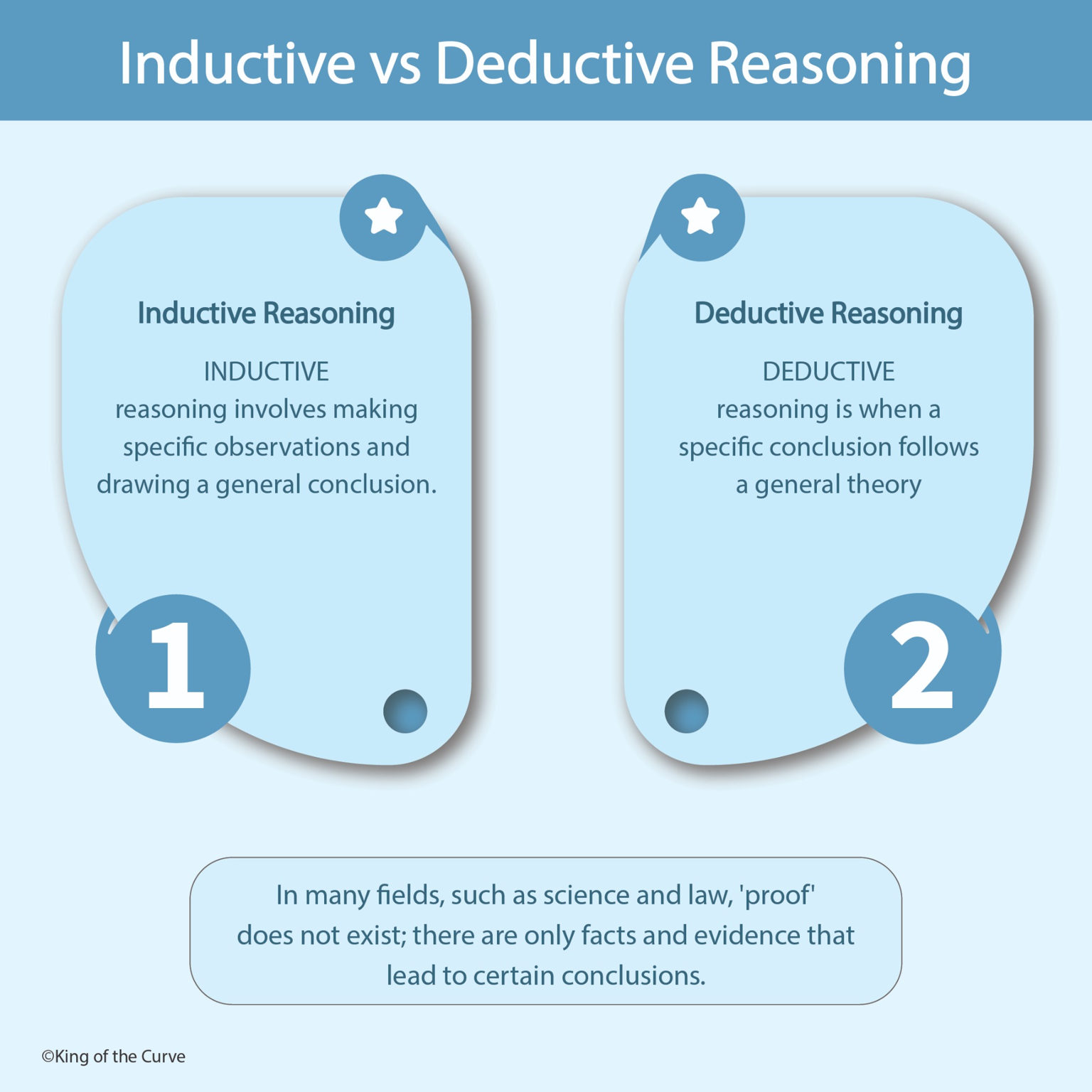
🧩 What Is Inductive Reasoning?
Inductive reasoning begins with specific observations and moves toward general conclusions or theories. Instead of starting with a rule, this type of reasoning identifies patterns from collected evidence and uses those patterns to form broader explanations. Scientists frequently use inductive reasoning when analyzing experimental results because repeated observations can help establish general principles about how natural systems behave.
🔎 What Is Deductive Reasoning?
Deductive reasoning works in the opposite direction by starting with a general theory or rule and applying it to reach a specific conclusion. If the premises are true and the reasoning process is logically valid, the conclusion must also be true. Deductive reasoning is often used in hypothesis testing, where scientists begin with an established theory and predict specific outcomes that should occur during an experiment.
⚖️ Key Differences Between the Two
The primary difference between inductive and deductive reasoning lies in the direction of logical thinking. Inductive reasoning builds theories based on observations, while deductive reasoning applies existing theories to predict outcomes. Both reasoning methods are essential in science because researchers frequently alternate between generating hypotheses from observations and testing those hypotheses through controlled experiments.
📊 Comparison of Inductive vs Deductive Reasoning
| Reasoning Type | Starting Point | Direction of Logic | Example |
|---|---|---|---|
| Inductive Reasoning | Specific observations | Specific → General | Observing multiple birds fly and concluding that birds generally fly |
| Deductive Reasoning | General principle | General → Specific | Knowing birds fly and predicting a newly discovered bird species can fly |
🧠 Why Scientists Use Both Methods
Scientific investigation rarely relies on just one type of reasoning. Researchers often begin with inductive reasoning when collecting observations and identifying patterns. After forming a potential explanation or theory, they then apply deductive reasoning to test predictions through experiments. This cycle allows scientists to refine theories and improve the accuracy of scientific knowledge over time.
📚 MCAT Strategy: Identifying Reasoning in Passages
On the MCAT, questions related to reasoning often appear in passages describing scientific experiments, research studies, or hypothesis testing. Students may be asked to determine whether researchers used inductive reasoning to develop a theory or deductive reasoning to test a hypothesis. Recognizing the direction of logic—whether the passage moves from observation to theory or from theory to prediction—can help students answer these questions more quickly.
🔬 Reasoning Beyond Science
Although these reasoning strategies are central to scientific thinking, they also appear in many other fields, including law, medicine, and everyday decision-making. Doctors often use inductive reasoning when identifying patterns of symptoms across patients, while deductive reasoning helps them apply medical knowledge to diagnose specific conditions.
📈 Mastering Reasoning with Visual Learning
Complex reasoning concepts become easier to understand when supported by visual explanations. King of the Curve provides hundreds of illustrated science and psychology concepts designed for MCAT preparation, helping students grasp high-yield topics quickly. Explore more visual study resources at mcat.kingofthecurve.org, a leading platform for MCAT concept visuals and exam preparation tools.

Frequently Asked Questions (FAQs)
-
Aim for 4-6 focused hours, ensuring you incorporate breaks to avoid burnout.
-
Practice mindfulness techniques, take practice exams under realistic conditions, and maintain a balanced lifestyle.
-
Set short-term goals, seek support from mentors, and reward yourself for small achievements.
-
Regular exercise improves focus, reduces stress, and enhances overall mental clarity.
-
KOTC offers personalized learning tools, gamification features, and adaptive question banks to help students stay on track without burnout.