
🛡️ IgA Secretion: A Key Defense at Mucosal Surfaces
Immunoglobulin A (IgA) is one of the most important antibodies involved in protecting the body’s mucosal surfaces. These surfaces include the intestinal tract, respiratory pathways, and other epithelial linings that are constantly exposed to microbes and foreign antigens.
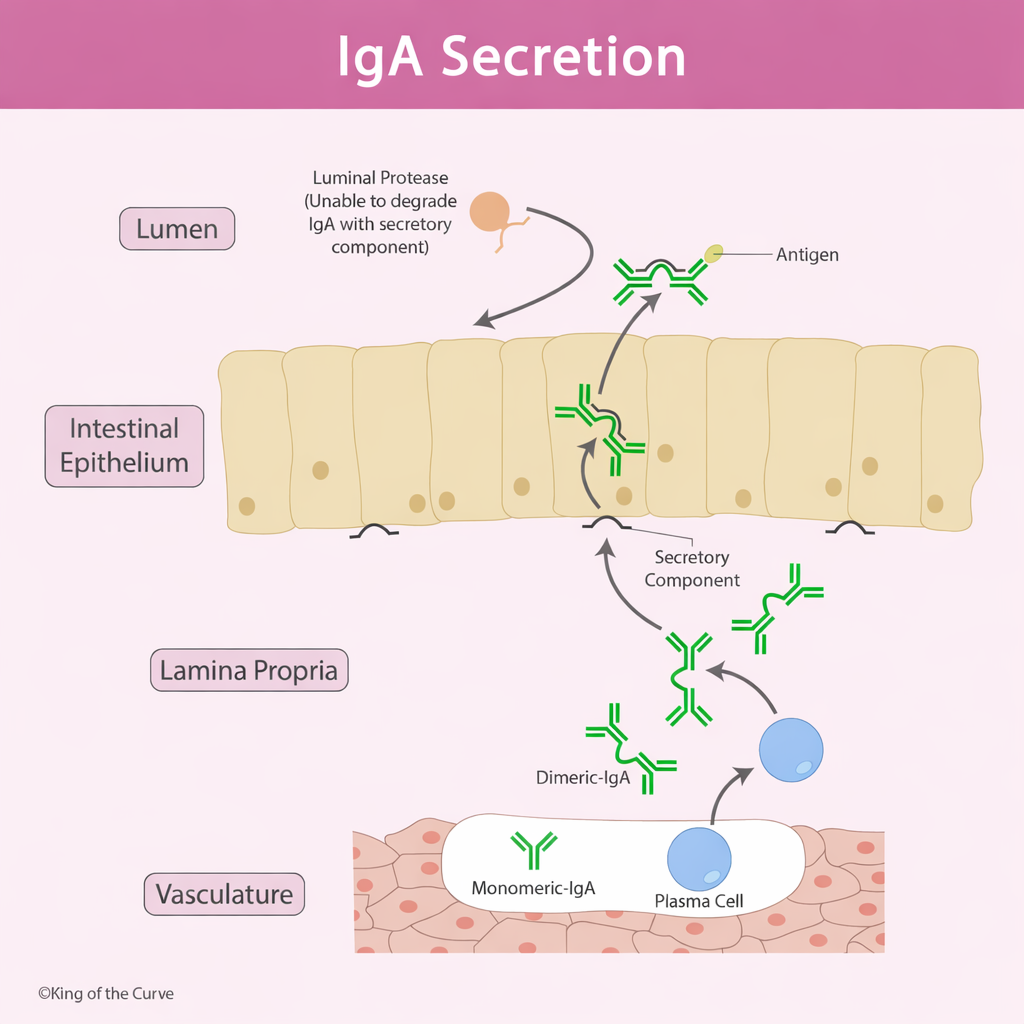
📍 Where IgA Secretion Takes Place
IgA secretion primarily occurs in the gut-associated mucosal immune system, especially across the intestinal lining.
The main anatomical regions involved are:
Lamina propria (beneath the epithelium)
Intestinal epithelial cells
Lumen (the interior space of the intestine)
This coordinated pathway ensures antibodies reach the lumen where pathogens are most likely to enter.
🧬 Step 1: IgA Production by Plasma Cells
The process begins in the lamina propria, where immune cells called plasma cells synthesize IgA antibodies.
IgA is initially produced as:
Monomeric IgA inside the body
Dimeric IgA (two IgA molecules linked together) for secretion
The dimeric form is especially important for mucosal protection.
🔗 Step 2: Binding to the Secretory Component
Dimeric IgA binds to a special receptor on intestinal epithelial cells known as the poly-Ig receptor (pIgR).
During this binding:
IgA attaches to pIgR
The receptor helps transport IgA across the epithelial barrier
A portion remains attached as the secretory component
This secretory component provides extra stability once IgA enters the lumen.
🚚 Step 3: Transport Across the Intestinal Epithelium
After binding, IgA is carried through the epithelial cell by a process called transcytosis.
This ensures:
Safe movement from tissue to lumen
Protection of IgA during transport
Delivery of antibodies directly to mucosal surfaces
This step is essential for immune defense at barrier sites.
🌊 Step 4: Release Into the Gut Lumen
At the luminal surface, IgA is released as secretory IgA (sIgA).
Secretory IgA is resistant to degradation because:
The secretory component shields IgA
Luminal proteases cannot easily break it down
This allows IgA to function effectively in harsh digestive environments.
🦠 Step 5: Neutralizing Pathogens Without Inflammation
Once in the lumen, secretory IgA helps protect the gut by:
Binding to antigens and microbes
Blocking pathogen attachment to epithelial cells
Neutralizing toxins
Preventing microbial invasion (immune exclusion)
A major advantage is that IgA works without triggering strong inflammation, preserving gut homeostasis.
⭐ Why IgA Secretion Is Clinically Important
IgA secretion is crucial because mucosal surfaces are the body’s largest entry point for pathogens.
Secretory IgA provides:
First-line immune defense
Protection against intestinal infections
Balanced immune response without tissue damage
This makes it one of the most important components of mucosal immunity.
✅ Key Takeaway
IgA secretion is a specialized immune process where plasma cells produce dimeric IgA, epithelial cells transport it via the secretory component, and secretory IgA is released into the gut lumen to neutralize pathogens safely.

Frequently Asked Questions (FAQs)
-
Aim for 4-6 focused hours, ensuring you incorporate breaks to avoid burnout.
-
Practice mindfulness techniques, take practice exams under realistic conditions, and maintain a balanced lifestyle.
-
Set short-term goals, seek support from mentors, and reward yourself for small achievements.
-
Regular exercise improves focus, reduces stress, and enhances overall mental clarity.
-
KOTC offers personalized learning tools, gamification features, and adaptive question banks to help students stay on track without burnout.