
🩸 Hemostasis Pathways and Associated Bleeding Disorders
Hemostasis is the body’s natural process of stopping bleeding after a blood vessel injury. It involves a complex cascade of clotting factors that work together to form a stable clot.
🔍 What Is Hemostasis?
Hemostasis occurs in three major steps:
🧱 Vasoconstriction – narrowing of blood vessels
🧩 Platelet plug formation
⚙️ Coagulation cascade – formation of a fibrin clot
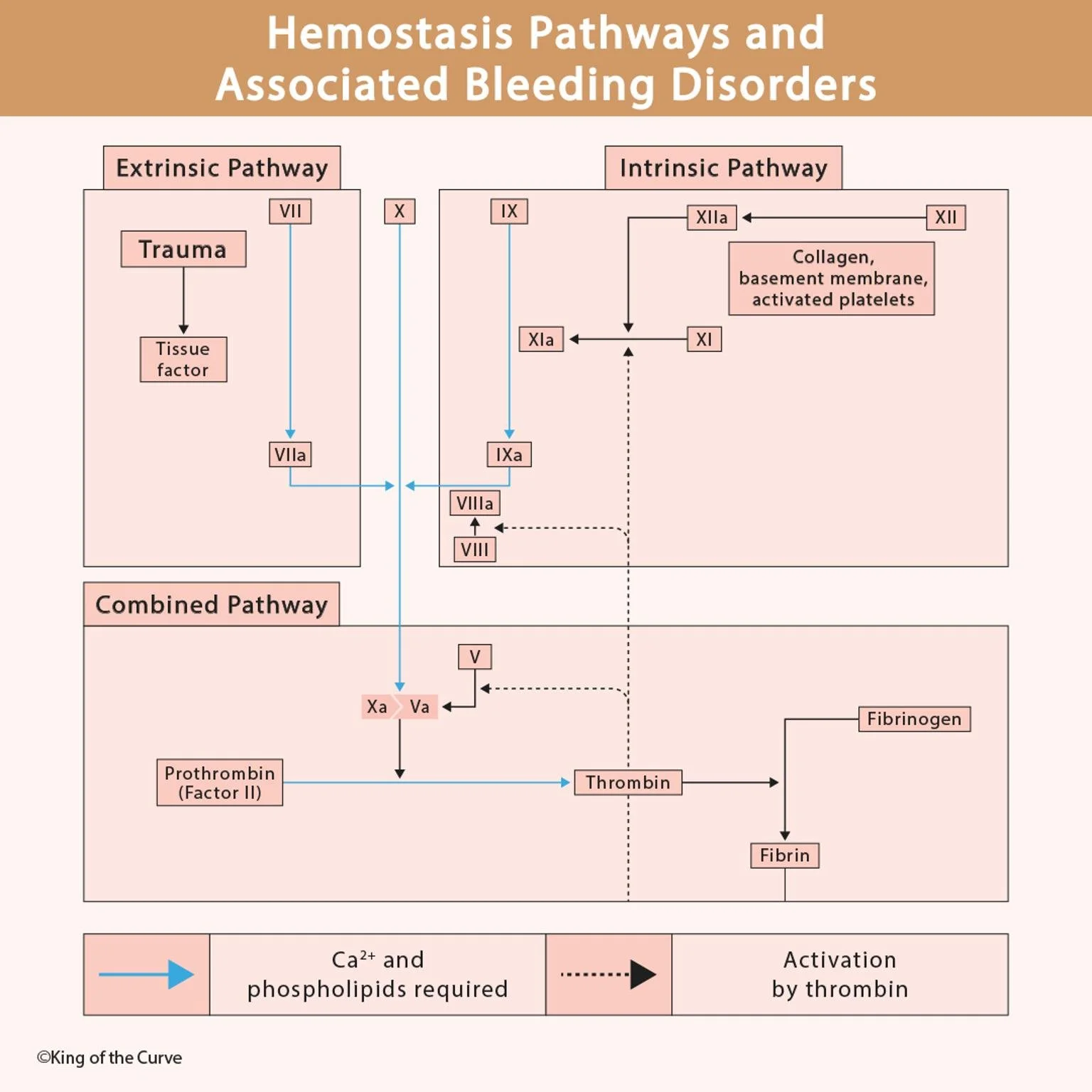
⚡ 1. Extrinsic Pathway (Fast Response)
The extrinsic pathway is triggered by external trauma.
🧬 Key Steps:
Injury exposes tissue factor (Factor III)
Activates Factor VII → VIIa
Leads to Factor X → Xa
🧪 Clinical Relevance:
Test: Prothrombin Time (PT)
Disorders:
Vitamin K deficiency
Liver disease
Warfarin therapy
🔄 2. Intrinsic Pathway (Amplification System)
Activated by internal vessel damage and collagen exposure.
🧬 Key Steps:
Factor XII → XIIa
Factor XI → XIa
Factor IX → IXa
Combines with Factor VIIIa → activates Factor X
🧪 Clinical Relevance:
Test: aPTT (Activated Partial Thromboplastin Time)
Disorders:
Hemophilia A (Factor VIII)
Hemophilia B (Factor IX)
Heparin therapy
🔗 3. Common Pathway (Final Clot Formation)
Both pathways converge here to form a clot.
🧬 Key Steps:
Factor Xa + Va → Prothrombin → Thrombin
Thrombin → Fibrinogen → Fibrin
Fibrin forms the stable clot
⚠️ Important:
Requires Ca²⁺ and phospholipids
Thrombin amplifies the cascade
🔥 Role of Thrombin
Thrombin is the central enzyme in clotting:
🔁 Converts fibrinogen → fibrin
⚡ Activates multiple clotting factors
🛡️ Stabilizes the clot
⚠️ Associated Bleeding Disorders
🟥 Extrinsic Pathway Disorders:
Vitamin K deficiency
Liver disease
Warfarin use
🟦 Intrinsic Pathway Disorders:
Hemophilia A (Factor VIII)
Hemophilia B (Factor IX)
🟨 Common Pathway Disorders:
Disseminated intravascular coagulation (DIC)
Severe liver disease
📊 Summary Table
| Pathway | Key Factors | Test Used | Common Disorders |
|---|---|---|---|
| Extrinsic | VII | PT | Warfarin, Vitamin K deficiency |
| Intrinsic | XII, XI, IX, VIII | aPTT | Hemophilia A & B |
| Common | X, V, II, I (Fibrinogen) | PT & aPTT | DIC, Liver disease |
🧠 Key Takeaways
Hemostasis involves three pathways
⚡ Extrinsic = fast response
🔄 Intrinsic = amplification
🔗 Common = final clot formation
🧪 PT & aPTT help diagnose disorders

Frequently Asked Questions (FAQs)
-
Aim for 4-6 focused hours, ensuring you incorporate breaks to avoid burnout.
-
Practice mindfulness techniques, take practice exams under realistic conditions, and maintain a balanced lifestyle.
-
Set short-term goals, seek support from mentors, and reward yourself for small achievements.
-
Regular exercise improves focus, reduces stress, and enhances overall mental clarity.
-
KOTC offers personalized learning tools, gamification features, and adaptive question banks to help students stay on track without burnout.