
⚗️ Understanding Half Reaction Balancing Steps
Balancing redox (oxidation-reduction) reactions can seem difficult at first, especially when electrons, charges, hydrogen, and oxygen atoms are involved. The half-reaction method is one of the most reliable and systematic techniques used in chemistry to balance these reactions accurately. This method separates oxidation and reduction into individual equations and balances them step by step.
🧪 What Is a Half Reaction?
A half reaction represents either the oxidation process or the reduction process occurring in a redox reaction. Oxidation involves the loss of electrons, while reduction involves the gain of electrons. Separating these two processes makes balancing easier because each half can be handled independently before combining them into one final balanced equation.
For example, in many electrochemical reactions, one species loses electrons while another gains them. The half-reaction method allows chemists to clearly track electron transfer and charge balance throughout the reaction.
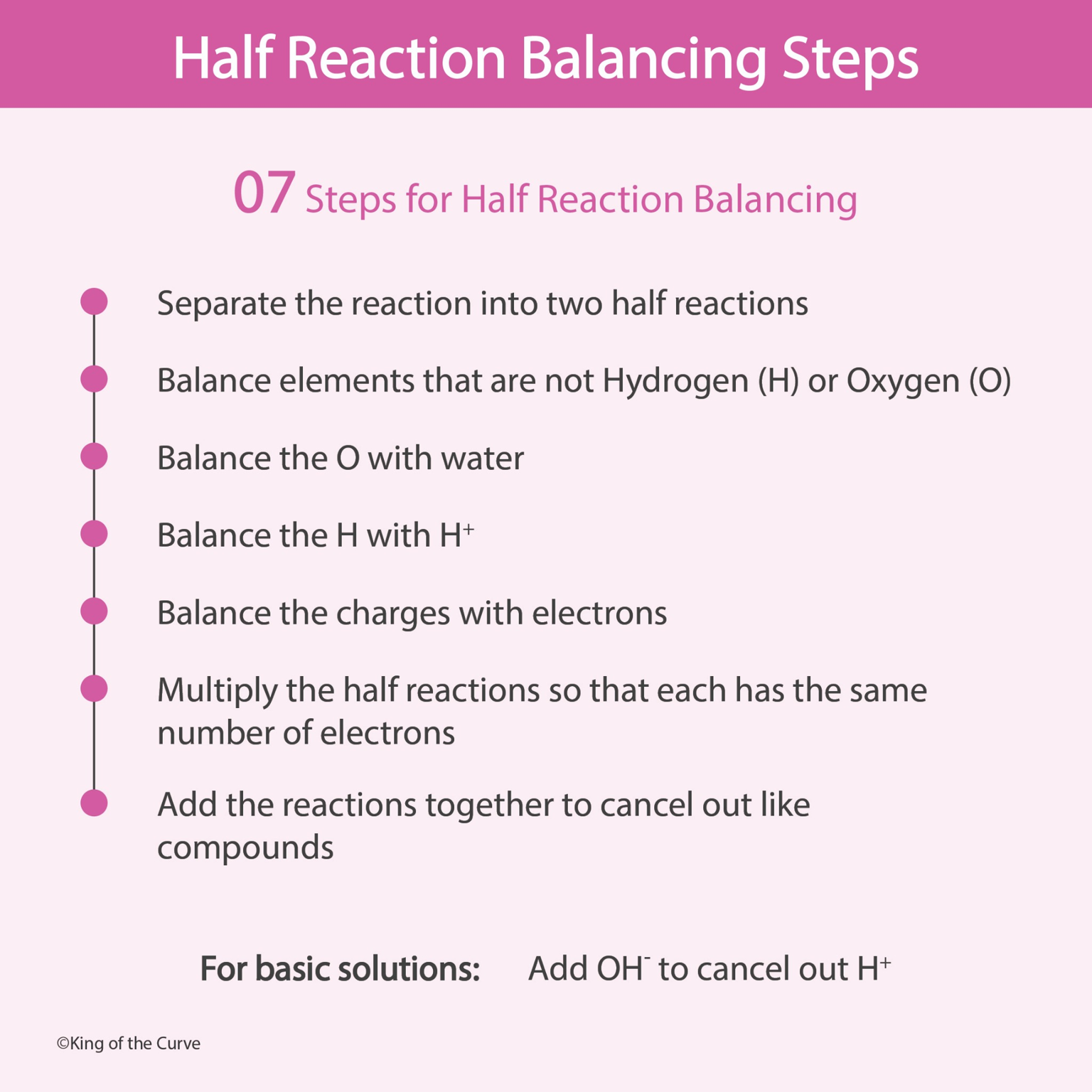
🧬 Step 1: Separate the Reaction into Two Half Reactions
The first step is to identify which substance is oxidized and which is reduced. Once identified, split the original reaction into two smaller half reactions. One equation will represent oxidation and the other reduction.
This separation simplifies the balancing process because each reaction can now be adjusted independently. It also helps identify electron movement clearly, which is essential in redox chemistry.
💧 Steps 2–4: Balance Atoms and Add Water or Hydrogen Ions
After separating the half reactions, balance all elements except hydrogen and oxygen first. Then balance oxygen atoms by adding water molecules (H₂O). Finally, balance hydrogen atoms by adding hydrogen ions (H⁺) when working in acidic solutions.
These steps ensure that the total number of atoms remains equal on both sides of the equation. Since oxygen and hydrogen commonly appear in aqueous reactions, water and hydrogen ions are convenient balancing agents.
⚡ Steps 5–7: Balance Charges and Combine the Equations
Once atoms are balanced, charges must also be balanced. This is done by adding electrons (e⁻) to the more positive side of the half reaction. After balancing charges, multiply the half reactions if necessary so that the number of electrons lost equals the number gained.
Finally, add the two half reactions together and cancel out identical species appearing on both sides. The result is a fully balanced redox equation that conserves both matter and electrical charge.
📊 Summary Table of Half-Reaction Balancing Steps
| Step | Purpose |
|---|---|
| Separate into half reactions | Identify oxidation and reduction |
| Balance non-H and non-O atoms | Equalize major elements |
| Add H2O to balance oxygen | Correct oxygen imbalance |
| Add H+ to balance hydrogen | Correct hydrogen imbalance |
| Add electrons to balance charge | Ensure electrical neutrality |
| Multiply equations if needed | Equalize electron transfer |
| Combine and simplify | Produce final balanced equation |
🧫 Balancing Reactions in Basic Solutions
When balancing reactions in basic solutions, an additional adjustment is required. After balancing the equation using H⁺ ions, add hydroxide ions (OH⁻) to both sides to neutralize the hydrogen ions. H⁺ and OH⁻ combine to form water, which may then be simplified if water appears on both sides.
This extra step converts the acidic form of the balanced equation into a basic form while still preserving atom and charge balance. It is especially important in reactions involving alkaline solutions or electrochemical cells operating under basic conditions.
🔬 Why the Half-Reaction Method Is Important
The half-reaction balancing method is widely used because it provides a logical and reliable framework for solving complex redox equations. It helps students understand electron transfer while ensuring accuracy in chemical calculations and laboratory work.
From batteries and fuel cells to biological oxidation and industrial chemistry, balanced redox equations are essential for understanding how chemical systems function. Mastering the half-reaction method builds a strong foundation for advanced chemistry topics and practical scientific applications.

Frequently Asked Questions (FAQs)
-
Aim for 4-6 focused hours, ensuring you incorporate breaks to avoid burnout.
-
Practice mindfulness techniques, take practice exams under realistic conditions, and maintain a balanced lifestyle.
-
Set short-term goals, seek support from mentors, and reward yourself for small achievements.
-
Regular exercise improves focus, reduces stress, and enhances overall mental clarity.
-
KOTC offers personalized learning tools, gamification features, and adaptive question banks to help students stay on track without burnout.