
🔬 Understanding GI Propulsion and Mixing for the MCAT
Propulsion and mixing within the gastrointestinal (GI) tract are fundamental processes that ensure food is effectively moved, churned, digested, and absorbed. These movements depend on highly coordinated interactions between smooth muscle layers, neural plexuses, and supporting tissue layers. For MCAT students, mastering this topic helps decode physiology passages involving peristalsis, segmentation, and enteric nervous system regulation.
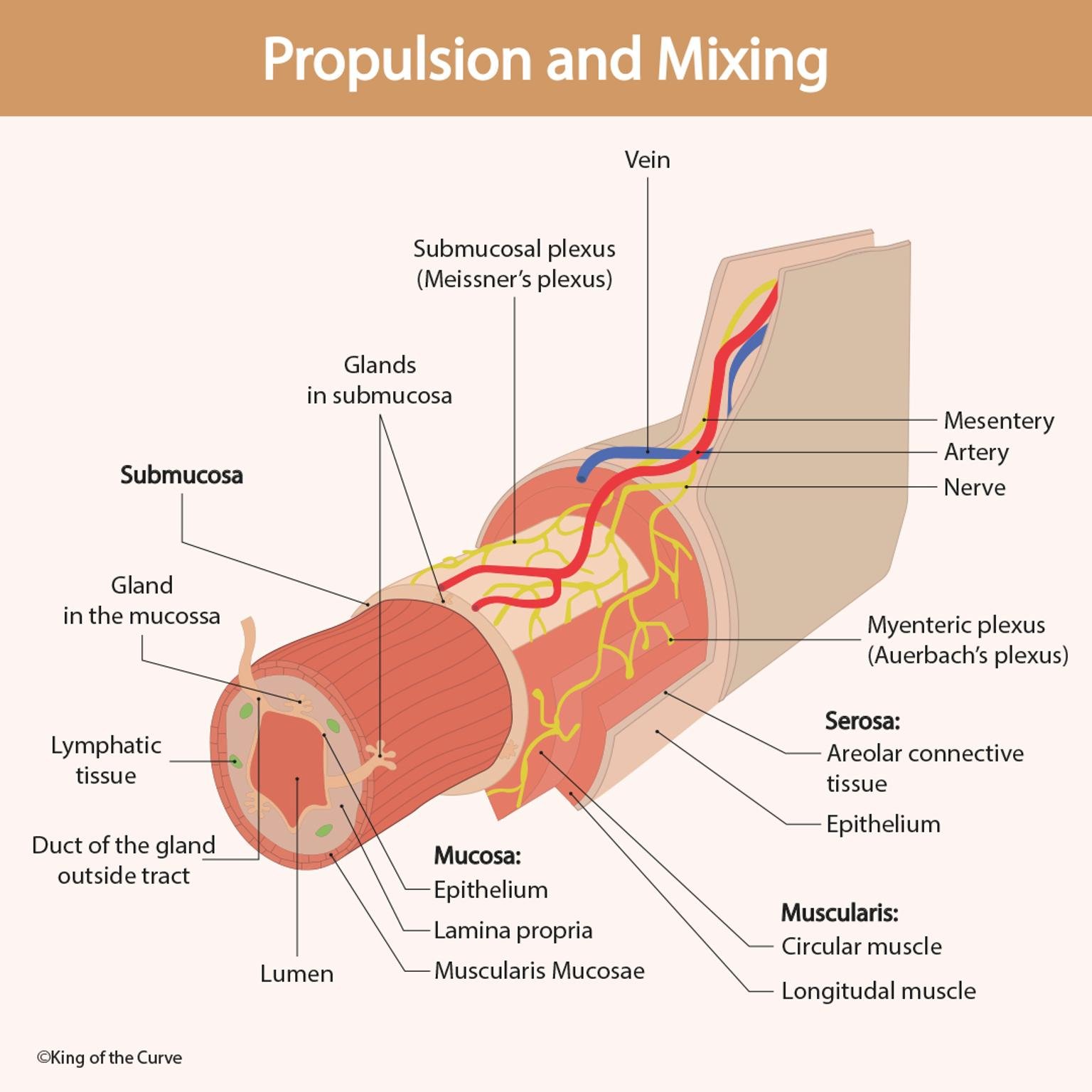
🧠 Breaking Down the KOTC GI Layer Visual
In the King of the Curve illustration, the GI tract is shown in cross-section, highlighting the major anatomical layers: mucosa, submucosa, muscularis, and serosa. Each layer contributes differently to propulsion and mixing. The mucosa contains epithelium and lymphatic tissue for nutrient absorption and immune function, while the submucosa houses glands and the submucosal (Meissner’s) plexus, crucial for secretion regulation.
⚙️ How the Muscularis Drives Movement
The muscularis layer — composed of circular and longitudinal smooth muscle — generates the mechanical forces responsible for movement. Circular muscle contractions narrow the lumen to mix contents, while longitudinal contractions shorten the tube to propel food forward. Working together, these actions create peristalsis and segmentation, two high-yield MCAT terms connected to motility patterns.
🔌 Enteric Nervous System: The GI “Brain”
Two major neural networks regulate propulsion: the submucosal plexus, which controls secretions and blood flow, and the myenteric plexus (Auerbach’s plexus), which coordinates smooth muscle contraction. These plexuses allow the gut to operate semi-autonomously while still responding to parasympathetic and sympathetic input — a favorite MCAT connection when comparing rest-and-digest vs. fight-or-flight physiology.
📊 Quick Reference Table: GI Layers and Their Functions
| GI Layer | Key Structures | Function |
|---|---|---|
| Mucosa | Epithelium, lamina propria, muscularis mucosae | Absorption, secretion, immune protection |
| Submucosa | Glands, blood vessels, Meissner’s plexus | Secretory control, vascular support |
| Muscularis | Circular & longitudinal muscles, Auerbach’s plexus | Motility: peristalsis & segmentation |
| Serosa | Areolar connective tissue, epithelium | Protection, structural support |
🚀 Why This Topic Matters for MCAT Passages
GI propulsion questions often appear in passages about motility disorders, neurotransmitter effects, or surgical interventions affecting the myenteric plexus. Students may also see experimental setups measuring muscle contraction or lumen pressure. Understanding how these layers work together — especially how the enteric nervous system modulates smooth muscle — simplifies even the most intimidating physiology passages.
📚 Strengthening Your Understanding With KOTC Tools
Using high-yield visuals like this one, combined with the Adaptive Q-Bank, timed modes, and guided science reviews at kingofthecurve.org/studyscience, helps reinforce long-term retention of GI physiology. When concepts like propulsion and mixing become intuitive, MCAT questions feel less like memorization and more like pattern recognition — a core KOTC learning philosophy.

Frequently Asked Questions (FAQs)
-
Aim for 4-6 focused hours, ensuring you incorporate breaks to avoid burnout.
-
Practice mindfulness techniques, take practice exams under realistic conditions, and maintain a balanced lifestyle.
-
Set short-term goals, seek support from mentors, and reward yourself for small achievements.
-
Regular exercise improves focus, reduces stress, and enhances overall mental clarity.
-
KOTC offers personalized learning tools, gamification features, and adaptive question banks to help students stay on track without burnout.