
🔬 Understanding Proton Pump Inhibitors (PPIs) for the MCAT
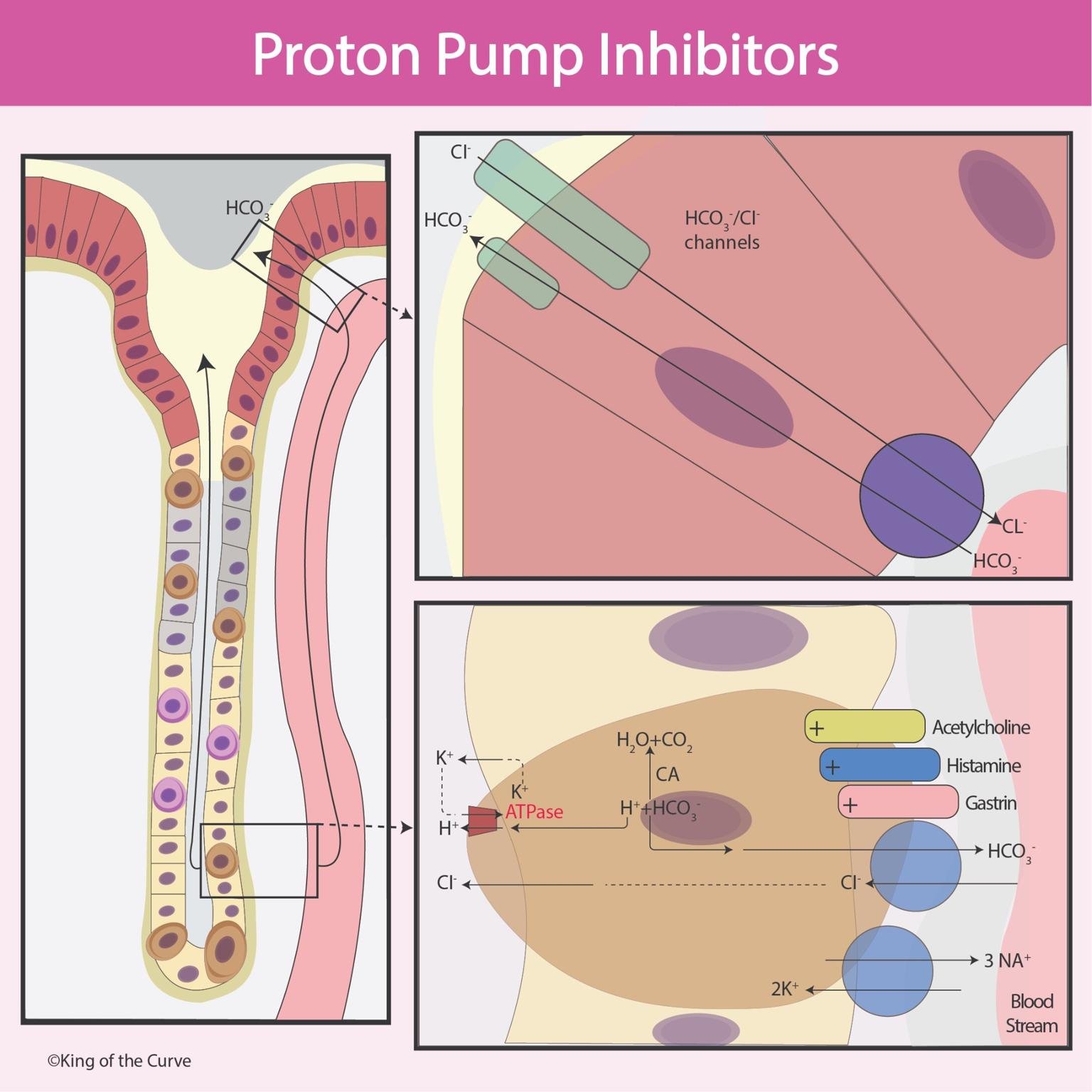
Proton Pump Inhibitors are among the most commonly prescribed medications for acid-related disorders, and they also appear frequently in MCAT physiology and biochemistry passages. PPIs work by targeting the H⁺/K⁺ ATPase pump in gastric parietal cells, reducing stomach acid production at the final step of secretion. The King of the Curve visual illustrates the underlying ionic movements and regulatory signals that control acid release in the stomach.
🧠 How Parietal Cells Normally Produce Acid
Parietal cells secrete hydrochloric acid (HCl) into the stomach lumen through a coordinated exchange of ions across their membranes. This process relies on carbonic anhydrase, which converts water and CO₂ into H⁺ and HCO₃⁻. The H⁺ is pumped into the stomach, while HCO₃⁻ exits into the bloodstream via chloride/bicarbonate exchangers—producing the well-known “alkaline tide” after meals.
⚡ The Central Role of the H⁺/K⁺ ATPase Pump
Located at the apical membrane of the parietal cell, the H⁺/K⁺ ATPase pump exchanges intracellular H⁺ for extracellular K⁺. This pump is the final step required for acid secretion, and because so many upstream pathways converge on it, inhibiting this pump dramatically decreases gastric acidity. For this reason, PPIs are far more potent than H₂ blockers, which act earlier in the signaling cascade.
💊 How Proton Pump Inhibitors Work
PPIs irreversibly bind to and inhibit the H⁺/K⁺ ATPase pump. Because new pumps must be synthesized before acid secretion can resume, their effect is long-lasting. This mechanism is especially relevant for MCAT questions that ask about irreversible inhibition, epithelial cell turnover, or medication timing relative to meals.
📊 High-Yield Table: Regulators of Parietal Cell Activity
| Regulator | Effect on Acid Secretion | Mechanism |
|---|---|---|
| Histamine | Increases | Activates H₂ receptors → ↑ cAMP |
| Acetylcholine | Increases | Stimulates M₃ receptors → ↑ Ca²⁺ |
| Gastrin | Increases | Activates CCKB receptors → ↑ Ca²⁺ |
| Somatostatin | Decreases | Inhibits gastrin and histamine release |
| PPIs | Strongly decrease | Irreversibly inhibit H⁺/K⁺ ATPase |
🧪 Why PPIs Matter for MCAT Physiology
PPIs tie together topics such as membrane transport, enzyme regulation, hormonal signaling, and acid–base physiology. MCAT passages may describe normal acid secretion, disorders like GERD, drug mechanisms, or compensatory changes such as elevated gastrin levels due to chronic acid suppression. Understanding the visual flow of ions—H⁺, K⁺, Cl⁻, and HCO₃⁻—makes these questions far more intuitive.
📚 Mastering Acid Secretion With KOTC Tools
King of the Curve’s visual-based learning system simplifies complex pathways like gastric acid secretion. Pairing detailed diagrams with active recall through the Adaptive Q-Bank, Daily Questions, and guided science explanations at kingofthecurve.org/studyscience reinforces long-term mastery. With the right tools, even intricate physiology topics like PPIs become clear, approachable, and score-boosting.

Frequently Asked Questions (FAQs)
-
Aim for 4-6 focused hours, ensuring you incorporate breaks to avoid burnout.
-
Practice mindfulness techniques, take practice exams under realistic conditions, and maintain a balanced lifestyle.
-
Set short-term goals, seek support from mentors, and reward yourself for small achievements.
-
Regular exercise improves focus, reduces stress, and enhances overall mental clarity.
-
KOTC offers personalized learning tools, gamification features, and adaptive question banks to help students stay on track without burnout.