
Attribution theory explains how people interpret the causes of their own behavior and the actions of others. In psychology and sociology, these explanations influence social judgments, relationships, and how we understand human behavior.
🧩 What Is Attribution Theory?
Attribution theory examines how individuals explain why events occur and why people behave in certain ways.
When observing someone's actions, people often try to determine whether the behavior results from personal characteristics or environmental influences.
For example, imagine a student arrives late to class. One observer might assume the student is irresponsible, while another might consider traffic delays or a family emergency.
Both observers see the same behavior but interpret its cause differently. This illustrates how attribution shapes social perception.
👤 What Is Dispositional Attribution?
Dispositional attribution, also called internal attribution, explains behavior through characteristics of the individual.
These characteristics may include personality, attitudes, motivation, abilities, or intentions.
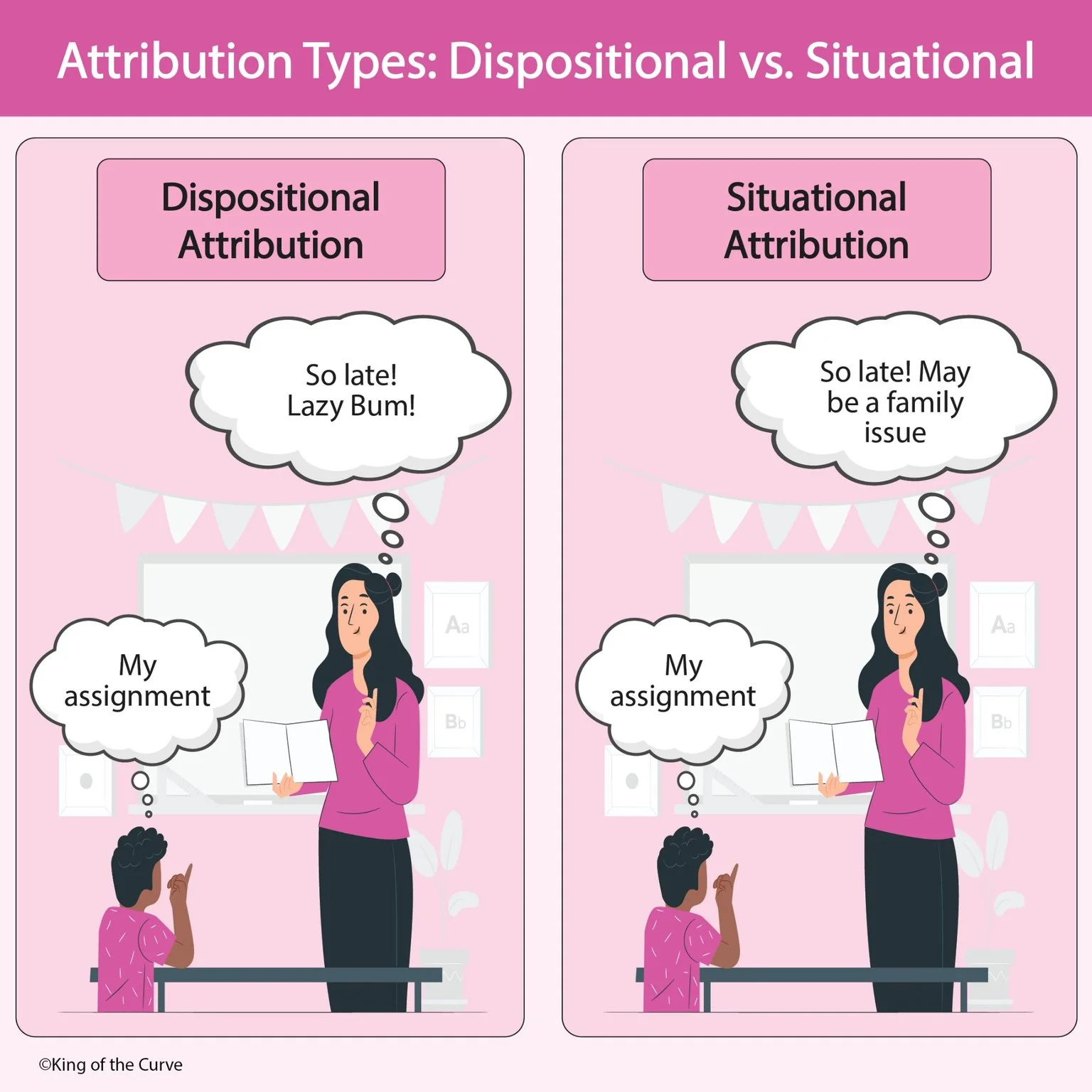
For example, a teacher might assume that a student who submits an assignment late is lazy or poorly organized.
This interpretation focuses on the student's personal qualities rather than considering external circumstances.
Dispositional explanations are not necessarily incorrect, but relying on them without considering the situation can lead to inaccurate judgments.
MCAT Tip: Dispositional attribution emphasizes internal factors such as personality, effort, and motivation.
🌍 What Is Situational Attribution?
Situational attribution, also called external attribution, explains behavior through environmental conditions or circumstances.
These influences may include social pressures, unexpected events, time constraints, or obstacles beyond an individual's control.
Consider the same student who submits an assignment late. Instead of assuming laziness, the teacher might consider whether the student experienced a family emergency.
This explanation emphasizes the circumstances surrounding the behavior rather than the student's personality.
Situational attribution highlights the importance of context when interpreting human actions.
MCAT Tip: Situational attribution emphasizes external influences, including environmental conditions and social pressures.
⚖️ Dispositional vs. Situational Attribution: Key Differences
Although both attribution types explain behavior, they differ in where they locate its cause.
| Feature | Dispositional Attribution | Situational Attribution |
|---|---|---|
| Alternative Name | Internal attribution | External attribution |
| Primary Focus | Personal characteristics | Environmental circumstances |
| Explanation | Behavior reflects traits, attitudes, or abilities. | Behavior reflects context or external pressures. |
| Example | A student is late because they are irresponsible. | A student is late because of traffic. |
| Common Factors | Personality, motivation, intentions | Social pressure, emergencies, obstacles |
| MCAT Connection | Fundamental attribution error | Contextual explanations of behavior |
The key distinction is whether an observer emphasizes characteristics within the person or influences outside the person.
🧠 Fundamental Attribution Error: A High-Yield MCAT Concept
The fundamental attribution error occurs when people overemphasize dispositional explanations and underestimate situational influences when interpreting other people's behavior.
For example, if someone cuts in front of you in traffic, you might immediately assume they are rude or reckless.
However, the driver may be responding to an emergency.
The fundamental attribution error does not mean that personality never influences behavior. Instead, it describes a tendency to give insufficient weight to the surrounding circumstances.
This bias is particularly important in MCAT psychology and sociology questions involving social judgment.
🔄 Actor–Observer Bias and Attribution
Actor–observer bias describes a tendency to explain one's own behavior more through situational factors while explaining other people's behavior more through dispositional factors.
Imagine two students receive poor exam grades.
One student explains their own performance by saying the exam was unusually difficult. However, the same student assumes that a classmate performed poorly because they did not study enough.
The individual uses an external explanation for their own behavior but an internal explanation for someone else's behavior.
Although this pattern is commonly taught in introductory psychology, research suggests that its strength varies across situations.
For MCAT preparation, focus on recognizing the contrast between explanations for one's own actions and those of others.
🎭 Self-Serving Bias: Protecting Self-Esteem
Self-serving bias occurs when individuals tend to attribute their successes to internal factors and their failures to external circumstances.
For example, a student who earns a high score might credit their intelligence and preparation.
If the same student performs poorly, they might blame the difficulty of the exam or an uncomfortable testing environment.
This pattern can help protect self-esteem and maintain a positive self-image.
However, self-serving bias differs from the fundamental attribution error because it specifically concerns how individuals explain their own successes and failures.
📚 Why Attribution Matters in Social Psychology
Attribution processes influence how people evaluate others, form relationships, and respond to social situations.
In educational settings, a teacher's explanation for a student's performance may influence the support or feedback they provide.
In healthcare, attribution can affect how professionals interpret patient behavior, including treatment adherence and lifestyle-related decisions.

Frequently Asked Questions (FAQs)
-
Aim for 4-6 focused hours, ensuring you incorporate breaks to avoid burnout.
-
Practice mindfulness techniques, take practice exams under realistic conditions, and maintain a balanced lifestyle.
-
Set short-term goals, seek support from mentors, and reward yourself for small achievements.
-
Regular exercise improves focus, reduces stress, and enhances overall mental clarity.
-
KOTC offers personalized learning tools, gamification features, and adaptive question banks to help students stay on track without burnout.