
⚡ Conservation of Energy: Understanding the Law That Powers Motion
Energy is one of the most important ideas in physics because it explains how and why objects move, slow down, speed up, or change direction. Whether you are watching a roller coaster drop from a steep hill or a ball bouncing on the ground, the same principle is always at work: energy is never lost it only changes form. This is known as the Law of Conservation of Energy, and it forms the foundation of classical mechanics.
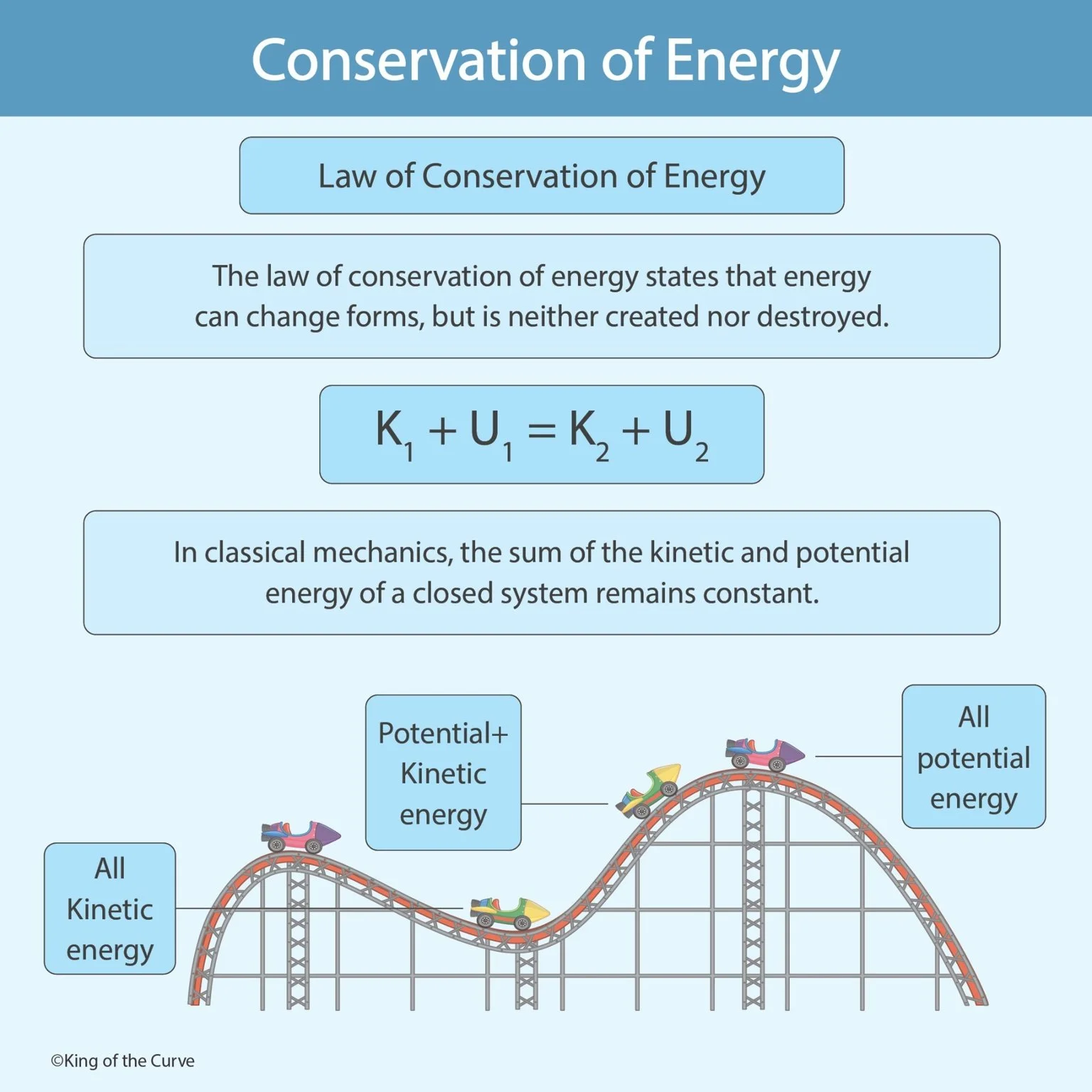
🔹 What Is the Law of Conservation of Energy?
The law of conservation of energy states that energy cannot be created or destroyed. Instead, energy can only be transferred or transformed from one type to another.
In other words, the total amount of energy in a closed system stays constant over time. Even when energy seems to disappear, it is simply changing form often into heat, sound, or another less visible type of energy.
This law helps scientists and engineers predict motion, design machines, and understand natural processes.
📘 The Conservation of Energy Equation
In physics, conservation of mechanical energy is often written as:
K1+U1=K2+U2
Where:
K = kinetic energy (energy of motion)
U = potential energy (stored energy due to position)
Subscripts 1 and 2 represent two different points in time or location
This equation shows that the sum of kinetic and potential energy remains the same, as long as no energy is lost to friction or external forces.
🏃 Kinetic Energy: Energy of Motion
Kinetic energy is the energy an object has because it is moving. The faster an object moves, the more kinetic energy it possesses.
Examples include:
A rolling ball
A moving car
A roller coaster speeding downhill
At the lowest point of a roller coaster track, the coaster moves fastest, meaning it has maximum kinetic energy.
🏔️ Potential Energy: Energy of Position
Potential energy is stored energy based on an object’s height or position in a gravitational field.
Examples include:
A book sitting on a shelf
A roller coaster at the top of a hill
Water stored behind a dam
At the highest point of the coaster’s path, it has maximum potential energy and very little kinetic energy.
🎢 Roller Coaster Example: Energy Transformation
A roller coaster is a perfect real-world demonstration of conservation of energy.
At the top of a hill:
Energy is mostly potential
As it descends:
Potential energy transforms into kinetic energy
At the bottom:
Energy is mostly kinetic
As it climbs again:
Kinetic energy converts back into potential energy
Even though the coaster slows down and speeds up, the total mechanical energy stays constant (ignoring friction).
📊 Table: Comparing Kinetic and Potential Energy
| Type of Energy | Symbol | Depends On | Example Situation |
|---|---|---|---|
| Kinetic Energy | K | Speed (motion) | Car driving fast on a highway |
| Potential Energy | U | Height or position | Roller coaster waiting at the top |
| Total Mechanical Energy | K + U | Both motion and position | Coaster moving along the track |
🌍 Why Conservation of Energy Matters
The law of conservation of energy is essential because it applies everywhere in physics and everyday life.
It helps explain:
Motion of planets and satellites
Pendulum swings
Mechanical systems like engines
Energy efficiency in technology
How renewable energy systems work
Understanding energy conservation allows us to predict behavior in systems and design safer, more efficient machines.
✅ Final Thoughts
The Law of Conservation of Energy is one of the most powerful principles in science. It teaches us that energy is always present—it simply changes form between potential and kinetic energy as objects move through the world.

Frequently Asked Questions (FAQs)
-
Aim for 4-6 focused hours, ensuring you incorporate breaks to avoid burnout.
-
Practice mindfulness techniques, take practice exams under realistic conditions, and maintain a balanced lifestyle.
-
Set short-term goals, seek support from mentors, and reward yourself for small achievements.
-
Regular exercise improves focus, reduces stress, and enhances overall mental clarity.
-
KOTC offers personalized learning tools, gamification features, and adaptive question banks to help students stay on track without burnout.