
The celiac trunk is a short artery arising from the front of the abdominal aorta, usually near the T12 vertebral level. It supplies much of the upper abdominal digestive system through three major branches. Its distribution includes the stomach, liver, gallbladder, spleen, and portions of the pancreas and duodenum.
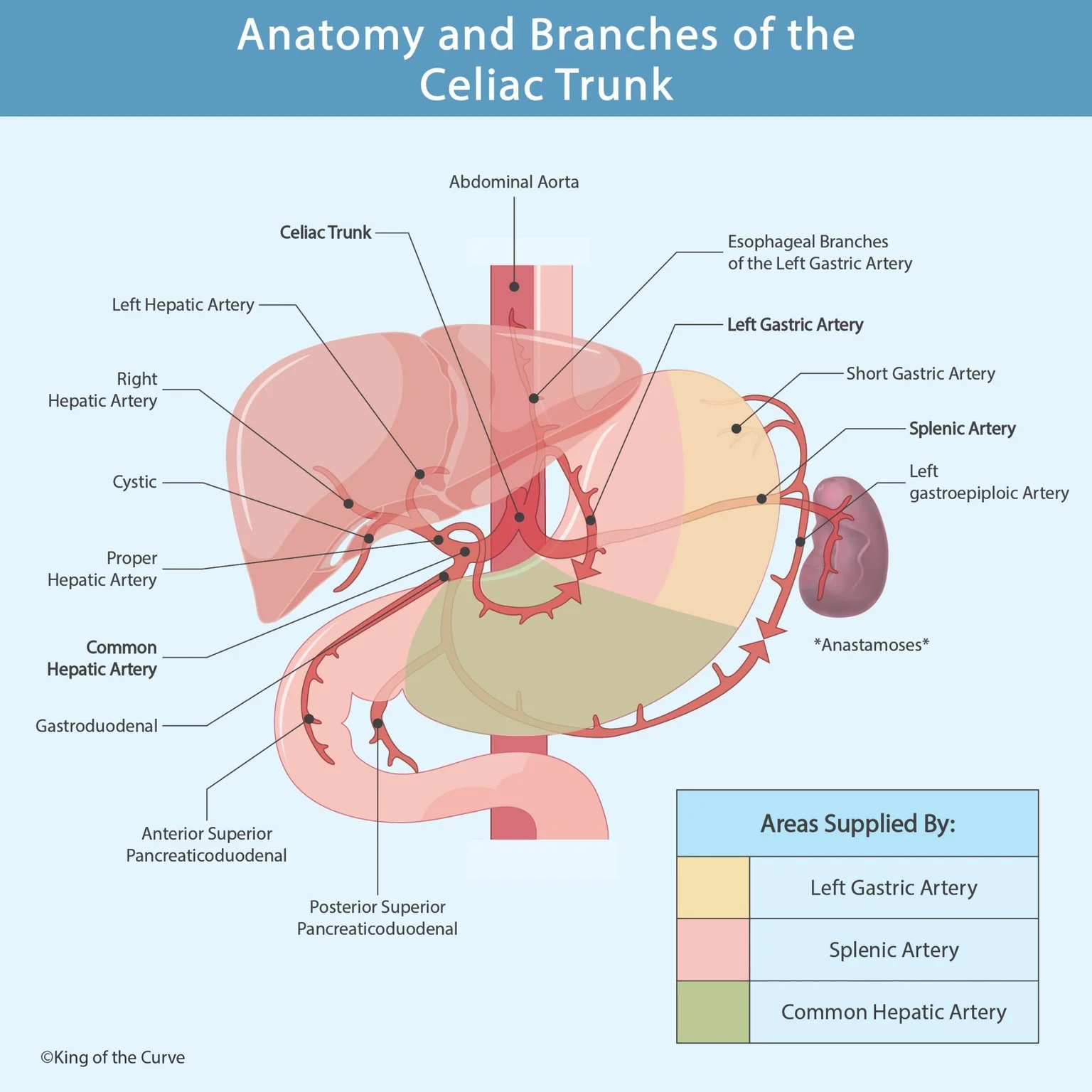
🌳 The Three Main Branches
The classic branches of the celiac trunk are the left gastric artery, splenic artery, and common hepatic artery. Each follows a different route toward its target organs and gives rise to smaller vessels. Although this three-branch arrangement is the standard learning pattern, anatomical variations can alter where individual arteries originate.
🍽️ Left Gastric Artery: Stomach and Esophagus
The left gastric artery travels toward the junction between the esophagus and stomach before following the stomach’s lesser curvature. It supplies nearby gastric tissue and gives off branches to the abdominal esophagus. Along the lesser curvature, it connects with the right gastric artery, forming an arterial anastomosis.
🟣 Splenic Artery: More Than the Spleen
The splenic artery follows a winding course along the upper border of the pancreas toward the spleen. Along the way, it gives off pancreatic branches, short gastric arteries, and the left gastroepiploic artery. These branches supply parts of the pancreas, the gastric fundus, and the left portion of the stomach’s greater curvature.
📊 Major Branches and Their Territories
Following each vessel from its origin to its smaller branches makes the celiac circulation easier to understand. The organ suggested by an artery’s name does not always represent its entire territory. For example, the splenic artery also contributes substantially to the blood supply of the stomach and pancreas.
| Main Branch | Important Branches or Connections | Main Areas Supplied |
|---|---|---|
| Left gastric artery | Esophageal branches; connection with right gastric artery | Abdominal esophagus and stomach along the lesser curvature |
| Splenic artery | Pancreatic branches, short gastric arteries, left gastroepiploic artery | Spleen, pancreatic body and tail, gastric fundus, and part of the greater curvature |
| Common hepatic artery | Gastroduodenal artery and continuation as proper hepatic artery | Through its branches: liver, gallbladder, parts of the stomach, proximal duodenum, and pancreatic head |
🟤 Common Hepatic and Proper Hepatic Arteries
The common hepatic artery travels toward the right and usually gives off the gastroduodenal artery before continuing as the proper hepatic artery. The proper hepatic artery then typically divides into right and left hepatic arteries supplying the liver. The cystic artery, which supplies the gallbladder, most commonly arises from the right hepatic artery.
🔄 Gastroduodenal Artery and Its Branches
The gastroduodenal artery passes behind the first part of the duodenum. Its branches include the right gastroepiploic artery and the superior pancreaticoduodenal arteries. These vessels contribute to the blood supply of the greater curvature of the stomach, the proximal duodenum, and the pancreatic head.
🔗 How Arterial Anastomoses Connect the Circulation
Anastomoses are connections between blood vessels that provide alternative routes for blood flow. The right and left gastric arteries connect along the lesser curvature, while the gastroepiploic arteries connect along the greater curvature. Around the pancreatic head, superior and inferior pancreaticoduodenal arteries link the celiac and superior mesenteric arterial systems.
🩺 Why Celiac Trunk Anatomy Matters
Understanding these branching patterns helps explain how neighboring digestive organs share their arterial supply. It also matters during procedures involving the liver, stomach, pancreas, gallbladder, or spleen, where preserving the correct vessels is essential. Because arterial origins and connections vary between individuals, the standard diagram provides a foundation rather than a universal map.

Frequently Asked Questions (FAQs)
-
Aim for 4-6 focused hours, ensuring you incorporate breaks to avoid burnout.
-
Practice mindfulness techniques, take practice exams under realistic conditions, and maintain a balanced lifestyle.
-
Set short-term goals, seek support from mentors, and reward yourself for small achievements.
-
Regular exercise improves focus, reduces stress, and enhances overall mental clarity.
-
KOTC offers personalized learning tools, gamification features, and adaptive question banks to help students stay on track without burnout.