
The stomach, liver, spleen, pancreas, and proximal duodenum receive arterial blood through branches arising mainly from the celiac trunk. These vessels deliver oxygen and nutrients needed for digestion, secretion, and tissue maintenance. The pancreatic head and duodenum also receive contributions from the superior mesenteric artery, creating connections between two major arterial territories.
🌳 The Celiac Trunk: Three Main Branches
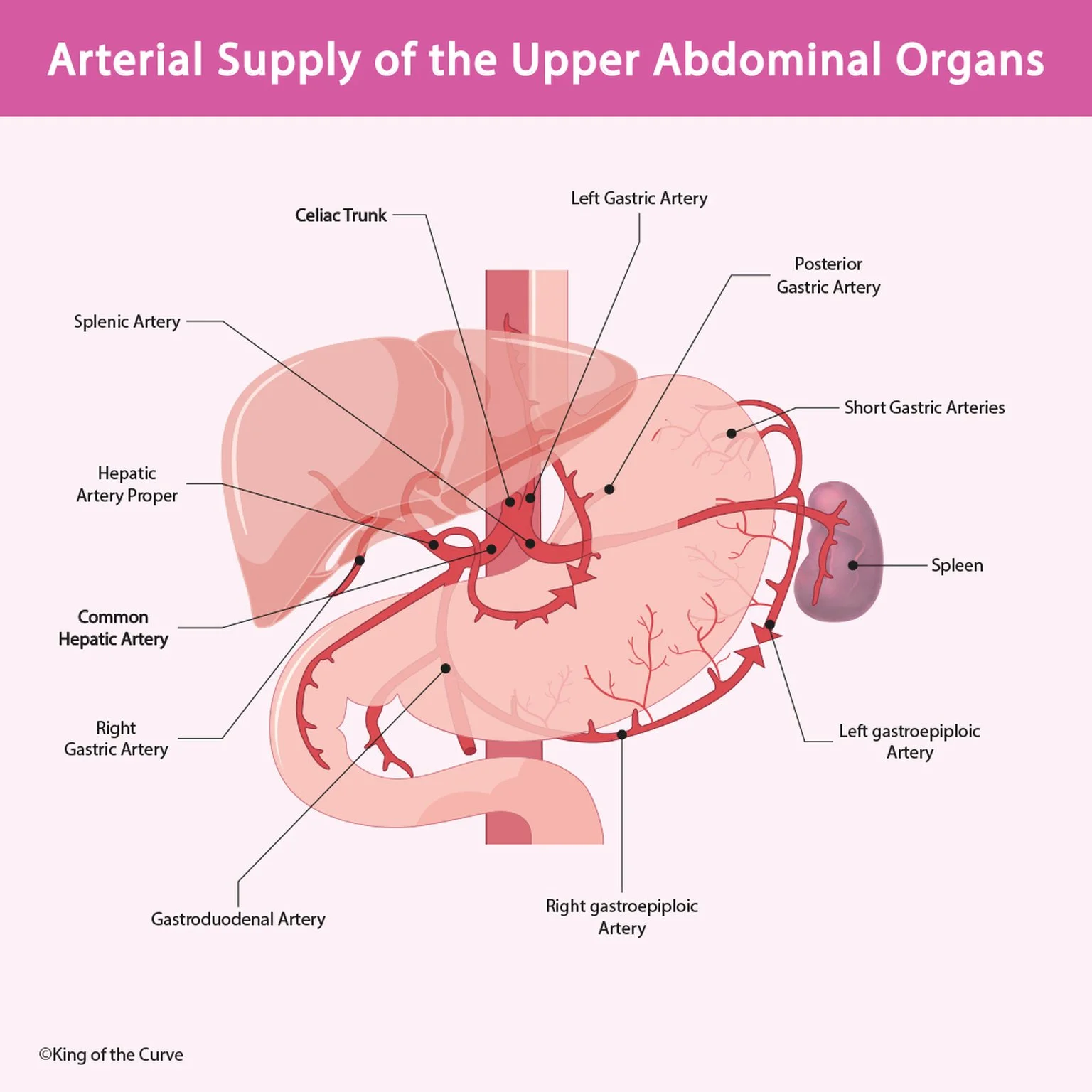
The celiac trunk is a short artery arising from the abdominal aorta just below the diaphragm, usually near the T12 vertebral level. Its three classic branches are the left gastric artery, splenic artery, and common hepatic artery. Together, these supply much of the abdominal foregut and the spleen. Branching patterns vary between individuals, so this arrangement represents the typical pattern.
🍽️ Left and Right Gastric Arteries: The Lesser Curvature
The left gastric artery travels toward the junction of the esophagus and stomach, gives off esophageal branches, and continues along the lesser curvature. It connects with the right gastric artery, which commonly arises from the proper hepatic artery, although its origin varies. Together, these vessels supply adjacent portions of the stomach along its shorter, concave border.
🟣 The Splenic Artery and Its Gastric Branches
The splenic artery follows a winding course along the superior border of the pancreas toward the spleen. Along the way, it supplies pancreatic branches and gives rise to the short gastric arteries and left gastroepiploic artery. The short gastric arteries supply the gastric fundus. A posterior gastric artery, when present, usually arises from the splenic artery and contributes to the posterior stomach’s blood supply.
📊 Major Arteries and Their Supply Territories
Following each vessel from its parent artery to its target organ makes the branching pattern easier to understand. Several organs receive blood from more than one branch, and connections between vessels provide overlapping supply.
| Artery | Typical Origin | Main Supply or Connection |
|---|---|---|
| Left gastric artery | Celiac trunk | Abdominal esophagus and stomach along the lesser curvature |
| Splenic artery | Celiac trunk | Spleen, pancreatic branches, and gastric branches |
| Common hepatic artery | Celiac trunk | Gives rise to the gastroduodenal artery and usually continues as the proper hepatic artery |
| Proper hepatic artery | Continuation of the common hepatic artery | Liver through right and left hepatic branches |
| Right gastric artery | Commonly the proper hepatic artery | Lesser curvature; connects with the left gastric artery |
| Gastroduodenal artery | Common hepatic artery | Proximal duodenum and pancreatic head through branches; gives rise to the right gastroepiploic artery |
| Left gastroepiploic artery | Splenic artery | Greater curvature; connects with the right gastroepiploic artery |
| Right gastroepiploic artery | Gastroduodenal artery | Greater curvature; connects with the left gastroepiploic artery |
| Short gastric arteries | Usually the splenic artery or its terminal branches | Gastric fundus |
🟤 Common and Proper Hepatic Arteries: Supplying the Liver
The common hepatic artery typically gives off the gastroduodenal artery before continuing as the proper hepatic artery. The proper hepatic artery then divides into right and left hepatic branches supplying the liver. The cystic artery, which supplies the gallbladder, usually arises from the right hepatic artery. The liver also receives substantial blood flow through the portal vein, giving it a dual blood supply.
🔄 Gastroepiploic Arteries: The Greater Curvature
The right and left gastroepiploic arteries, also called gastro-omental arteries, run along the greater curvature of the stomach. The right arises from the gastroduodenal artery, while the left arises from the splenic artery. They connect along the stomach’s longer, convex border and provide branches to the stomach and greater omentum. Their arrangement complements the gastric arteries along the lesser curvature.
🧩 Gastroduodenal Artery: Linking Arterial Territories
The gastroduodenal artery descends behind the proximal duodenum and supplies branches to the duodenum and pancreatic head. Its superior pancreaticoduodenal branches connect with inferior pancreaticoduodenal branches arising from the superior mesenteric circulation. These arterial arcades form an important link between the celiac and superior mesenteric territories and support blood flow around the pancreatic head.
🧠 Why Arterial Connections and Variations Matter
An anastomosis is a connection between blood vessels. The gastric arteries, gastroepiploic arteries, and pancreaticoduodenal arcades illustrate how neighboring arterial territories communicate. These connections may provide alternative routes for blood flow, although they do not guarantee protection from ischemia. Understanding both the typical anatomy and its variations is important when interpreting imaging, locating gastrointestinal bleeding, and planning abdominal procedures.

Frequently Asked Questions (FAQs)
-
Aim for 4-6 focused hours, ensuring you incorporate breaks to avoid burnout.
-
Practice mindfulness techniques, take practice exams under realistic conditions, and maintain a balanced lifestyle.
-
Set short-term goals, seek support from mentors, and reward yourself for small achievements.
-
Regular exercise improves focus, reduces stress, and enhances overall mental clarity.
-
KOTC offers personalized learning tools, gamification features, and adaptive question banks to help students stay on track without burnout.