
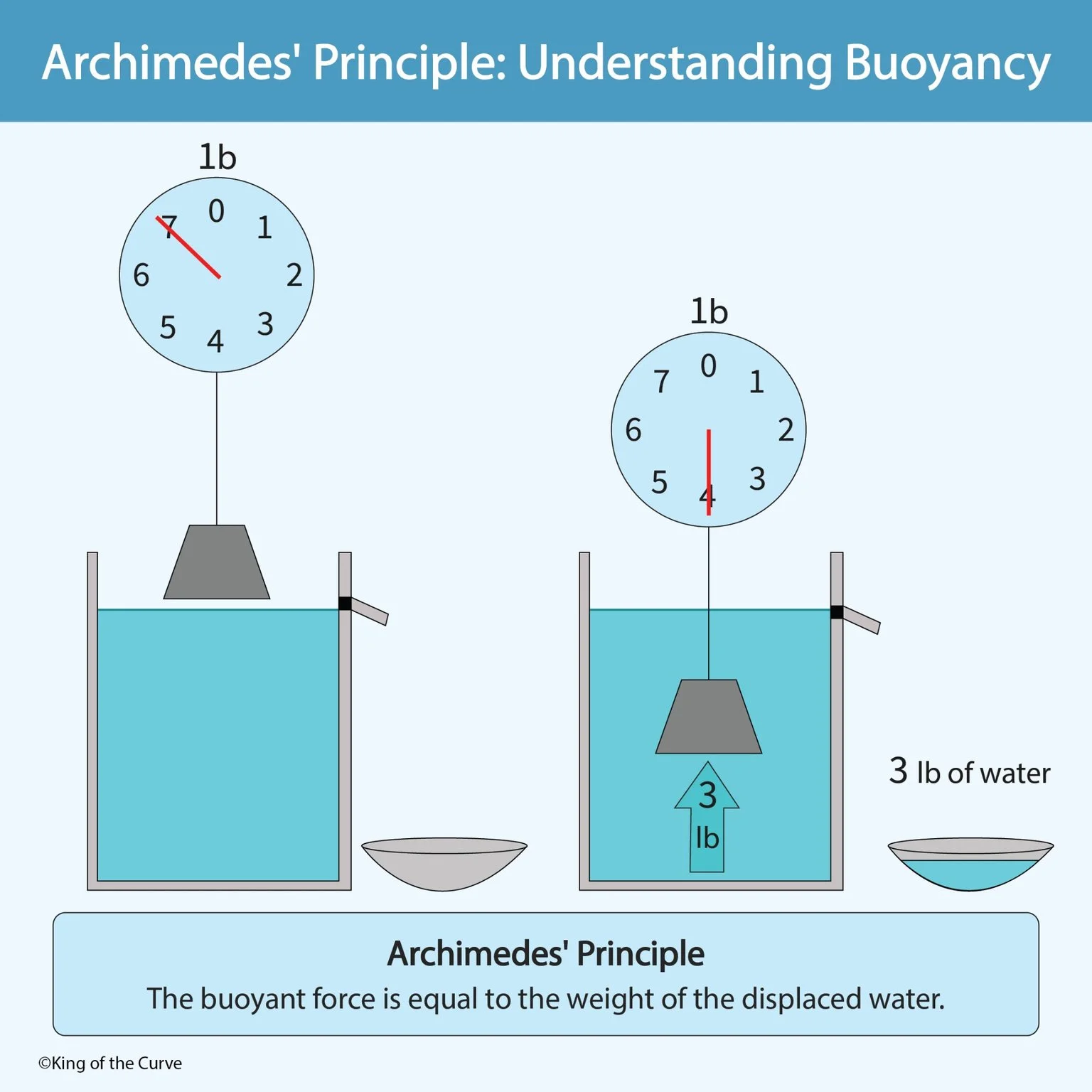
Archimedes’ principle states that an object partially or fully immersed in a fluid experiences an upward buoyant force equal to the weight of the fluid it displaces. This principle applies to liquids and gases, explaining why boats float, submerged objects feel lighter, and balloons rise through air. The displaced fluid’s weight determines the buoyant force not the object’s weight alone.
⬆️ Why Does Buoyant Force Act Upward?
Fluid pressure increases with depth. Consequently, the fluid pushes more strongly against the lower surfaces of an immersed object than against its upper surfaces. The combined pressure forces produce a net upward force called buoyant force. For an object surrounded by a stationary fluid, this pressure difference explains the upward support provided by the fluid.
🧮 The Buoyant Force Equation
The magnitude of buoyant force is calculated using FB=p f g V displaced, where p f is fluid density, g is gravitational acceleration, and V displaced is the volume of displaced fluid. Using kilograms per cubic meter, meters per second squared, and cubic meters gives force in newtons. For a fully submerged object, the displaced volume equals the object’s external volume; for a partially submerged object, only the submerged portion counts.
⚖️ Understanding the Diagram’s Scale Readings
The diagram shows an object with a scale reading of approximately 7 pounds-force in air and 4 pounds-force when submerged. The difference represents the buoyant force: 7-4=3 pounds-force. The displaced water therefore weighs 3 pounds-force. This interpretation assumes the object is stationary, does not touch the container, and experiences negligible buoyancy in air. Its mass remains unchanged—the water simply supports part of its weight.
📊 Key Quantities in Buoyancy
Distinguishing actual weight, buoyant force, and apparent weight makes buoyancy problems easier to solve. A spring scale measures the tension supporting the object, which decreases when an upward buoyant force helps support it.
| Quantity | Meaning | Equation or Relationship |
|---|---|---|
| Actual weight | Downward gravitational force on the object | W = mg |
| Buoyant force | Upward force exerted by the surrounding fluid | FB = ρf gVdisplaced |
| Displaced fluid volume | Volume of fluid excluded by the immersed object | Equals the submerged volume of the object |
| Apparent weight | Supporting tension measured for a stationary suspended object | Wapp = W − FB |
| Floating equilibrium | Balance between buoyancy and weight for a freely floating object | FB = W |
| Fraction submerged | Submerged fraction of a freely floating object’s total volume | Vsubmerged Vobject = ρobject,avg ρf |
🚢 Why Some Objects Float and Others Sink
An object’s average density relative to the fluid helps predict its behavior. If its average density is lower than the fluid’s, it can float with only part of its volume submerged. If it is denser, its weight exceeds the maximum buoyant force available when fully submerged, so it sinks unless another force supports it. A steel ship floats because its hollow structure gives the ship and enclosed air a sufficiently low average density.
💧 How Fluid Density Changes Buoyancy
For the same displaced volume, a denser fluid produces a greater buoyant force. This explains why a person generally floats more easily in seawater than in freshwater. A freely floating object still displaces fluid equal to its own weight in either liquid. In the denser liquid, however, it needs to displace less volume, so a smaller fraction of the object remains submerged.
📏 Does Greater Depth Mean Greater Buoyancy?
For a rigid object fully submerged in a fluid of approximately constant density, buoyant force does not increase simply because the object moves deeper. Pressure increases around the object, but the net upward force remains equal to the weight of the displaced fluid. Compressible objects, such as air-filled balloons, can behave differently because their volume may decrease with depth, reducing the displaced volume and buoyant force.

Frequently Asked Questions (FAQs)
-
Aim for 4-6 focused hours, ensuring you incorporate breaks to avoid burnout.
-
Practice mindfulness techniques, take practice exams under realistic conditions, and maintain a balanced lifestyle.
-
Set short-term goals, seek support from mentors, and reward yourself for small achievements.
-
Regular exercise improves focus, reduces stress, and enhances overall mental clarity.
-
KOTC offers personalized learning tools, gamification features, and adaptive question banks to help students stay on track without burnout.