
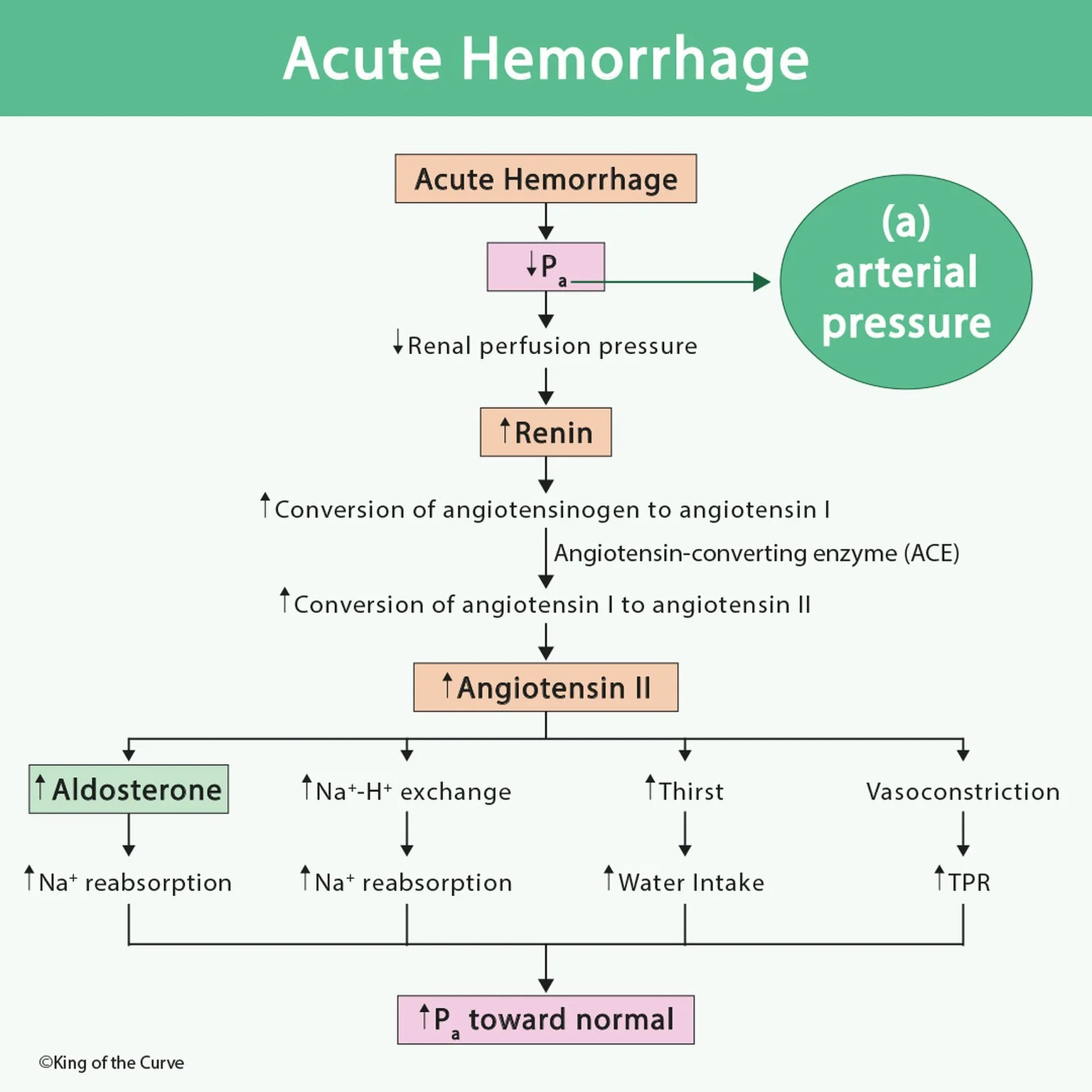
Acute hemorrhage is rapid blood loss that reduces circulating blood volume. This decreases venous return to the heart, which can lower stroke volume, cardiac output, and arterial pressure. Early compensatory responses may temporarily maintain blood pressure, so a normal reading does not rule out significant bleeding.
🫘 Why the Kidneys Release Renin
Reduced blood flow to the kidneys helps activate the renin–angiotensin–aldosterone system, or RAAS. Juxtaglomerular cells release renin in response to reduced renal perfusion pressure, sympathetic stimulation, and reduced sodium chloride delivery to the macula densa. These signals help the kidneys detect a threat to effective circulating volume.
🔄 From Renin to Angiotensin II
Renin is an enzyme that cleaves liver-produced angiotensinogen into angiotensin I. Angiotensin-converting enzyme, or ACE, then converts angiotensin I into angiotensin II. Angiotensin II coordinates several responses that support blood pressure, including vasoconstriction, sodium retention, thirst, and aldosterone release.
🫀 How Vasoconstriction Supports Arterial Pressure
Angiotensin II contracts vascular smooth muscle, narrowing arterioles and increasing total peripheral resistance, or TPR. This helps support arterial pressure when blood volume and cardiac output fall. However, increasing resistance does not replace lost blood or guarantee adequate oxygen delivery to tissues.
📊 Key Responses to Acute Hemorrhage
The response to blood loss combines rapid nervous system adjustments with hormonal mechanisms. The baroreceptor reflex acts quickly, while RAAS and other hormones help sustain vascular resistance and conserve fluid. These mechanisms work together, although severe or ongoing hemorrhage can overwhelm them.
| Response | Main Action | Effect on Circulation |
|---|---|---|
| Sympathetic activation | Increases heart rate, contractility, and vascular tone | Helps maintain cardiac output and pressure |
| Renin release | Initiates the angiotensin pathway | Promotes angiotensin II formation |
| Angiotensin II | Causes vasoconstriction and stimulates sodium conservation | Supports resistance and circulating volume |
| Aldosterone release | Increases renal sodium reabsorption | Helps conserve sodium and support fluid retention |
| ADH release | Increases collecting duct water reabsorption | Reduces water loss in urine |
| Thirst stimulation | Promotes drinking when water is available | Helps replenish body water |
🧂 How Aldosterone Conserves Sodium
Angiotensin II stimulates aldosterone release from the adrenal cortex. Aldosterone increases sodium reabsorption in the late distal nephron, particularly through epithelial sodium channels in principal cells. This supports extracellular fluid volume, while also promoting potassium secretion; its sodium-retaining action complements the water-conserving effects of ADH.
⚙️ Why Sodium–Hydrogen Exchange Increases
Angiotensin II also acts directly on the proximal tubule, increasing sodium–hydrogen exchanger activity. This brings more sodium into tubular cells while secreting hydrogen ions into the tubular fluid. Increased proximal sodium reabsorption helps conserve salt and water before the filtrate reaches later nephron segments.
💧 How Thirst and ADH Conserve Water
Angiotensin II stimulates thirst and promotes the release of antidiuretic hormone, also called ADH or vasopressin. ADH increases water reabsorption in the kidney’s collecting ducts, while thirst encourages water intake when drinking is possible. These are complementary responses: one limits water loss, and the other promotes water replacement.
🚨 Why Compensation Has Limits
RAAS helps defend blood pressure, but it cannot stop bleeding or replace lost red blood cells. Continued hemorrhage can cause inadequate tissue perfusion and progress to hemorrhagic shock despite compensatory responses. Severe acute bleeding therefore requires urgent assessment, bleeding control, and appropriate resuscitation rather than reliance on hormonal compensation alone.

Frequently Asked Questions (FAQs)
-
Aim for 4-6 focused hours, ensuring you incorporate breaks to avoid burnout.
-
Practice mindfulness techniques, take practice exams under realistic conditions, and maintain a balanced lifestyle.
-
Set short-term goals, seek support from mentors, and reward yourself for small achievements.
-
Regular exercise improves focus, reduces stress, and enhances overall mental clarity.
-
KOTC offers personalized learning tools, gamification features, and adaptive question banks to help students stay on track without burnout.