
🩸 Vasculitis: Understanding Vessel Size, Clinical Features, and Key Tests
Vasculitis refers to inflammation of blood vessel walls. This inflammation can damage vessels, reduce blood flow, and cause ischemic injury in affected tissues. Vasculitides are commonly organized according to the size of the vessels they predominantly affect: large, medium, or small vessels. Recognizing this classification can make complex clinical presentations easier to organize.
🔵 Large-Vessel Vasculitis
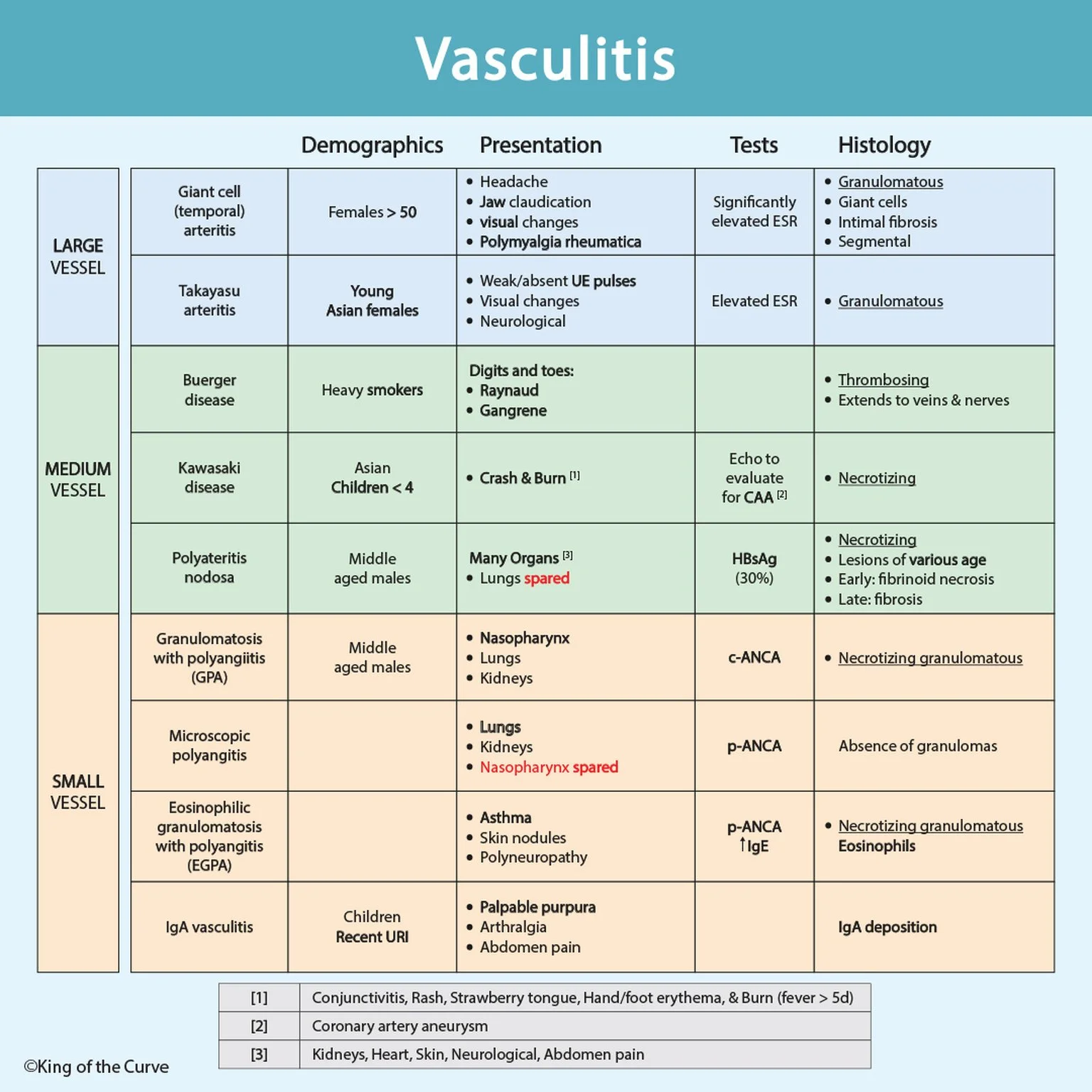
Large-vessel vasculitis primarily affects the aorta and its major branches. Two classic disorders are giant cell arteritis (GCA) and Takayasu arteritis. Although both can produce granulomatous inflammation, their typical patient populations and clinical presentations differ substantially.
👁️ Giant Cell Arteritis
Giant cell arteritis most commonly occurs in adults older than 50 years and is more common in women. Typical findings include headache, jaw claudication, visual symptoms, and an elevated erythrocyte sedimentation rate (ESR). It is also strongly associated with polymyalgia rheumatica. Histology may demonstrate granulomatous inflammation with giant cells and disruption of the internal elastic lamina.
💪 Takayasu Arteritis
Takayasu arteritis typically affects younger women and involves large arteries such as the aorta and its branches. Narrowing of these vessels may produce weak or absent upper-extremity pulses, differences in blood pressure between arms, vascular bruits, or neurologic symptoms. Like GCA, the disease can show granulomatous inflammation.
🟢 Medium-Vessel Vasculitis
Important medium-vessel disorders include polyarteritis nodosa (PAN) and Kawasaki disease. PAN is a necrotizing vasculitis of medium and small muscular arteries that can affect multiple organs but classically spares the pulmonary circulation. It has an association with hepatitis B in a subset of cases. Kawasaki disease primarily affects children and is particularly important because of the risk of coronary artery aneurysms.
🚬 Where Does Buerger Disease Fit?
Buerger disease (thromboangiitis obliterans) is strongly associated with tobacco use and affects small- and medium-sized vessels, particularly in the extremities. Patients can develop distal ischemia, pain, Raynaud phenomenon, ulceration, and gangrene. Because it can involve vessels of more than one caliber, treating it as strictly a medium-vessel vasculitis is an oversimplification.
🟠 Small-Vessel Vasculitis and ANCA
Several high-yield small-vessel vasculitides are associated with antineutrophil cytoplasmic antibodies (ANCA). Granulomatosis with polyangiitis (GPA) is commonly associated with PR3-ANCA (often producing a c-ANCA pattern) and frequently affects the upper respiratory tract, lungs, and kidneys. Microscopic polyangiitis often involves the lungs and kidneys but lacks the granulomatous upper-airway disease characteristic of GPA and is commonly associated with MPO-ANCA (often p-ANCA).
🫁 EGPA and IgA Vasculitis
Eosinophilic granulomatosis with polyangiitis (EGPA) is associated with asthma, eosinophilia, and eosinophil-rich granulomatous inflammation; MPO-ANCA/p-ANCA may be present in some patients. IgA vasculitis is an immune-complex small-vessel vasculitis that commonly presents in children with palpable purpura, arthralgia or arthritis, abdominal symptoms, and sometimes renal involvement. IgA deposition is a characteristic finding.
📊 High-Yield Vasculitis Comparison
| 🩸 Vasculitis | 🔍 Typical Clues | 🧠 Important Association / Finding |
|---|---|---|
| Giant cell arteritis | Age > 50, headache, jaw claudication | Granulomatous inflammation |
| Takayasu arteritis | Young women, weak pulses | Large-vessel granulomatous disease |
| Kawasaki disease | Children, mucocutaneous inflammation | Coronary artery aneurysm risk |
| Polyarteritis nodosa | Multisystem disease, pulmonary sparing | HBV association in some cases |
| GPA | Upper airway + lungs + kidneys | PR3-ANCA / c-ANCA pattern |
| Microscopic polyangiitis | Lungs + kidneys | MPO-ANCA / p-ANCA pattern |
| EGPA | Asthma + eosinophilia | Eosinophil-rich inflammation |
| IgA vasculitis | Purpura + joint / abdominal symptoms | IgA deposition |
🎯 High-Yield MCAT Takeaway
For exam questions, first identify the vessel size, then connect the patient's demographics, organs involved, laboratory findings, and histology. Remember the major patterns: GCA → older adults and headache/jaw claudication; Takayasu → young women and reduced pulses; Kawasaki → children and coronary involvement; PAN → systemic disease with pulmonary sparing; GPA → upper airway, lungs, kidneys; MPA → lungs and kidneys without granulomas; EGPA → asthma and eosinophilia; IgA vasculitis → palpable purpura, abdominal/joint symptoms, and IgA deposition. This framework is more useful than memorizing each disorder in isolation.

Frequently Asked Questions (FAQs)
-
Aim for 4-6 focused hours, ensuring you incorporate breaks to avoid burnout.
-
Practice mindfulness techniques, take practice exams under realistic conditions, and maintain a balanced lifestyle.
-
Set short-term goals, seek support from mentors, and reward yourself for small achievements.
-
Regular exercise improves focus, reduces stress, and enhances overall mental clarity.
-
KOTC offers personalized learning tools, gamification features, and adaptive question banks to help students stay on track without burnout.