
🧠 Two-Point Discrimination Explained: Why Your Tongue Beats Your Back
Two-point discrimination is one of the most testable sensory concepts because it combines neuroanatomy, receptor physiology, and real-world clinical testing. The MCAT loves using it to assess how receptor density affects perception, while the NCLEX and USMLE connect it to neurological exams and sensory pathway damage. In this blog, I’m going to break down the two-point threshold using the KOTC visual so you can understand exactly why some body regions detect detail better than others.
📏 What Is the Two-Point Threshold? (Simple Definition)
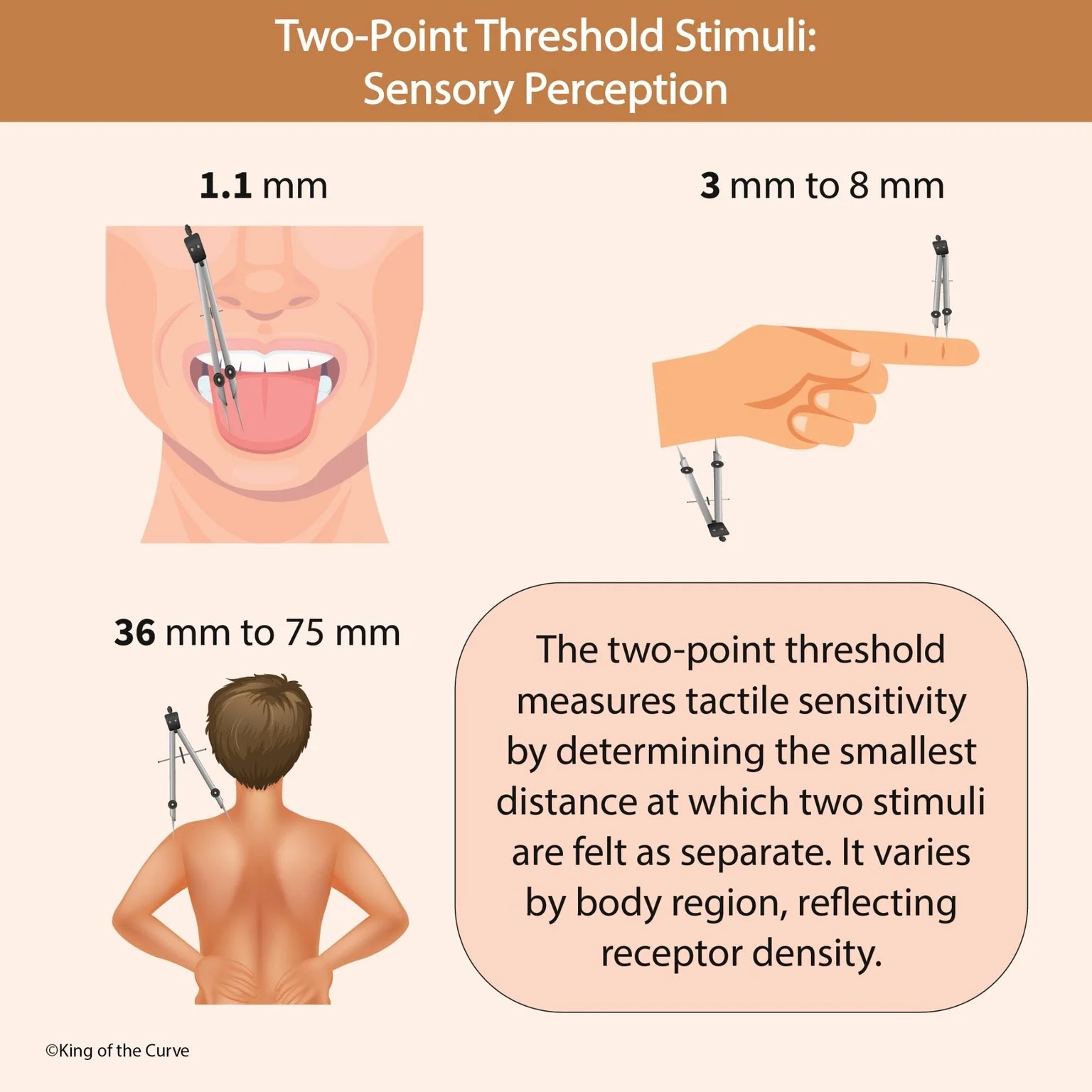
The two-point threshold measures tactile sensitivity by finding the smallest distance at which a person can feel two separate touches rather than one. If two stimuli are too close together, the brain interprets them as a single touch. The key reason thresholds vary across the body is receptor density—areas with more touch receptors provide more precise sensory information.
👅 Why the Tongue Has the Smallest Threshold (High Receptor Density)
Your tongue has an incredibly low two-point threshold (about 1.1 mm on the visual), meaning it can detect extremely fine differences in touch. That’s because the tongue has high mechanoreceptor density and small receptive fields. This is why you can detect tiny food particles stuck in your mouth, or why the tongue helps with speech articulation and precise oral movements. On exams, the tongue is a classic example of high sensory resolution.
✋ Fingers Are Also Highly Sensitive (But Not Like the Tongue)
Fingertips have a two-point threshold around 3–8 mm, which is still very sensitive. This is because fingertips contain densely packed mechanoreceptors (like Meissner corpuscles and Merkel discs) and have small receptive fields. That’s why you can feel the edge of a coin or read Braille by touch. In clinical practice, fingertip discrimination is a useful marker of peripheral nerve function, especially in neuropathy screening.
🧍 Why the Back Has the Largest Threshold (Low Receptor Density + Large Receptive Fields)
The back has a much larger two-point threshold (36–75 mm in the visual) because mechanoreceptors are more sparsely distributed and receptive fields are larger. When two points touch the back, they often activate the same sensory neuron, and the brain interprets the sensation as one. This concept is frequently tested in MCAT-style passages as a data interpretation question—where students must connect threshold measurements to receptor density and neural mapping.
🧠 How the Brain Interprets Touch (Receptive Fields + Lateral Inhibition)
Two-point discrimination isn’t just about receptor number—it’s also about how the nervous system sharpens sensory contrast. Lateral inhibition helps neurons suppress neighboring signals, making touch localization sharper in areas like the fingers and tongue. This is also why these areas take up more space in the sensory homunculus—your brain dedicates more cortex to processing high-resolution touch input. If you understand receptive fields + lateral inhibition, you can answer most exam questions related to this topic.
📊 Two-Point Threshold Quick Table (High-Yield Memorization)
| Body Region | Typical Two-Point Threshold | What It Means |
|---|---|---|
| Tongue | ~1.1 mm | Highest tactile sensitivity |
| Fingertips | ~3–8 mm | High receptor density + small receptive fields |
| Back | ~36–75 mm | Lower receptor density + large receptive fields |
| General Rule | Smaller distance = better discrimination | Receptor density + cortical mapping |
🧪 MCAT + NCLEX + USMLE Tip: How This Shows Up on Exams
On the MCAT, two-point discrimination questions often appear as graphs or tables asking you to infer which region has higher receptor density or smaller receptive fields. The test may describe a patient with decreased discrimination due to neuropathy and ask which pathway is involved (usually dorsal column–medial lemniscus). On NCLEX and USMLE, this topic is tied to neuro exams, diabetic neuropathy screening, spinal cord lesions, or sensory loss affecting fine touch. A simple exam rule: worse two-point discrimination = reduced tactile receptor signaling or pathway disruption.

Frequently Asked Questions (FAQs)
-
Aim for 4-6 focused hours, ensuring you incorporate breaks to avoid burnout.
-
Practice mindfulness techniques, take practice exams under realistic conditions, and maintain a balanced lifestyle.
-
Set short-term goals, seek support from mentors, and reward yourself for small achievements.
-
Regular exercise improves focus, reduces stress, and enhances overall mental clarity.
-
KOTC offers personalized learning tools, gamification features, and adaptive question banks to help students stay on track without burnout.