
💧 Surface Tension: Molecular Forces in Liquids
Surface tension is the tendency of a liquid’s surface to resist deformation and minimize its surface area. It results from cohesive intermolecular forces between molecules. For the MCAT, water is a key example because strong hydrogen bonding produces relatively high surface tension.
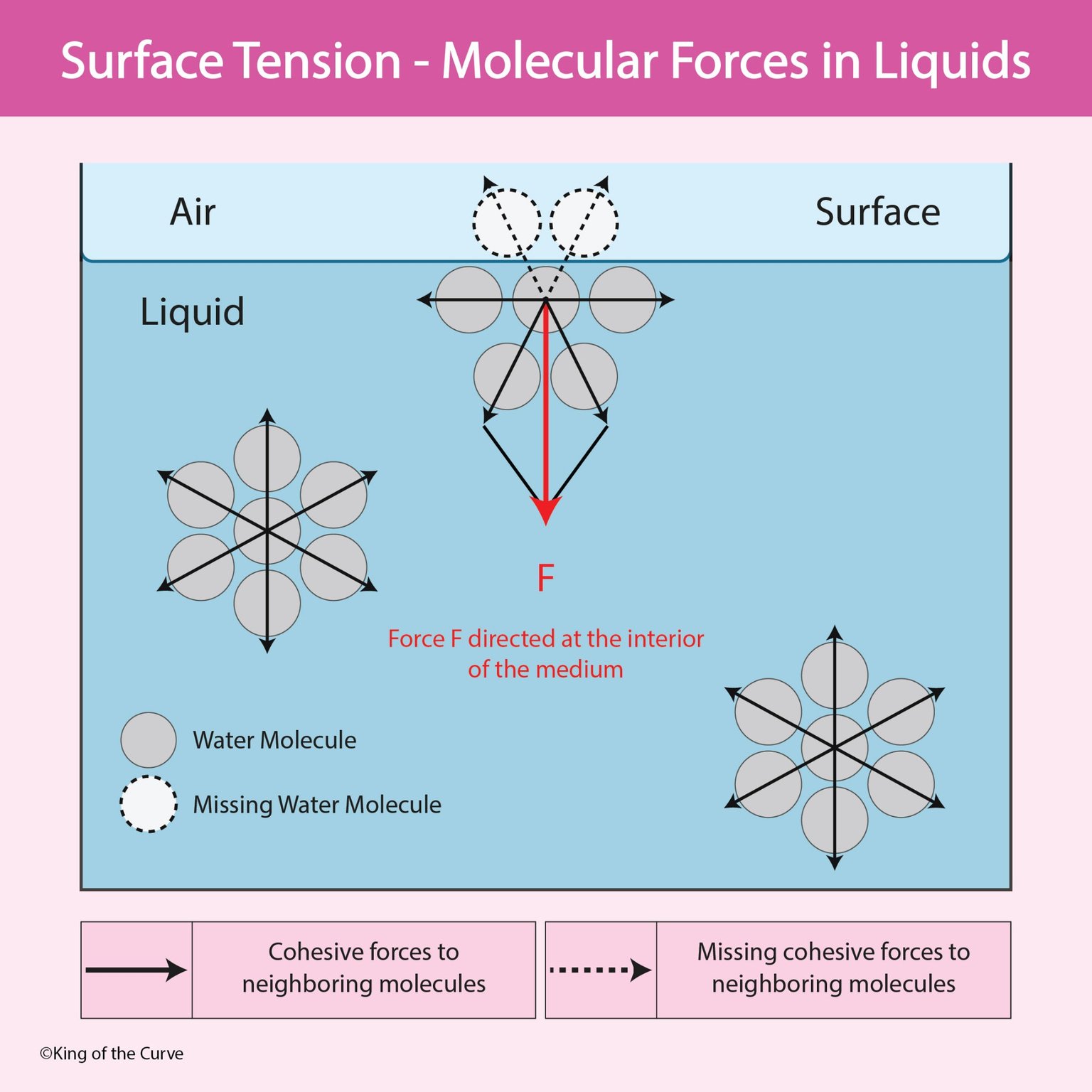
🔗 Cohesive Forces Between Molecules
Cohesion describes attraction between molecules of the same substance. Inside a liquid, a molecule is surrounded by neighboring molecules, so attractive forces act in many directions. These forces tend to balance, producing little or no net intermolecular force on a molecule in the bulk liquid.
⬇️ What Happens at the Surface?
Molecules at the surface have fewer neighboring liquid molecules above them. Consequently, their cohesive interactions are asymmetric, producing a net inward tendency toward the bulk liquid. This difference between surface and interior molecules is fundamental to understanding surface tension.
⚛️ Why Water Has High Surface Tension
Water molecules are polar and form hydrogen bonds with one another. These relatively strong intermolecular attractions increase cohesion. As a result, creating additional water surface requires energy because intermolecular interactions must be disrupted.
📏 Surface Tension and Surface Area
Liquids naturally tend to minimize their surface area when other forces permit. This is why small liquid droplets tend toward a spherical shape: for a given volume, a sphere has the smallest surface area. Surface tension therefore helps explain the rounded appearance of water droplets.
📊 Key Surface-Tension Concepts
| 💧 Concept | 📘 Meaning | 🎯 MCAT Connection |
|---|---|---|
| Cohesion | Attraction between like molecules | Water-water attraction |
| Adhesion | Attraction between unlike substances | Water interacting with another surface |
| Surface Tension | Resistance to increasing surface area | Stronger cohesion generally increases it |
| Hydrogen Bonding | Strong intermolecular attraction involving hydrogen bonded to N, O, or F | Major contributor to water’s surface tension |
| Surfactant | Substance that reduces surface tension | Important in pulmonary physiology |
🫁 Surfactants and Surface Tension
Surfactants reduce surface tension by disrupting or weakening cohesive interactions at an interface. A major biological example is pulmonary surfactant, which lowers surface tension in the alveoli and helps reduce the tendency of alveoli to collapse during breathing.
🌡️ Temperature and Surface Tension
Increasing temperature generally decreases surface tension. Molecules with greater kinetic energy can more readily overcome intermolecular attractions, reducing the cohesive effect at the liquid surface. This relationship connects thermodynamics and intermolecular forces.
🧠 MCAT High-Yield Takeaway
Remember the central idea: molecules inside a liquid experience attractions in many directions, while molecules at the surface have fewer neighboring liquid molecules and therefore experience an inward cohesive tendency. Stronger intermolecular forces generally produce greater surface tension, while surfactants reduce it. This concept connects MCAT physics and chemistry with biological topics such as alveolar function.

Frequently Asked Questions (FAQs)
-
Aim for 4-6 focused hours, ensuring you incorporate breaks to avoid burnout.
-
Practice mindfulness techniques, take practice exams under realistic conditions, and maintain a balanced lifestyle.
-
Set short-term goals, seek support from mentors, and reward yourself for small achievements.
-
Regular exercise improves focus, reduces stress, and enhances overall mental clarity.
-
KOTC offers personalized learning tools, gamification features, and adaptive question banks to help students stay on track without burnout.