
⚡ Superposition Principle in Electrostatics: Forces Between Charges
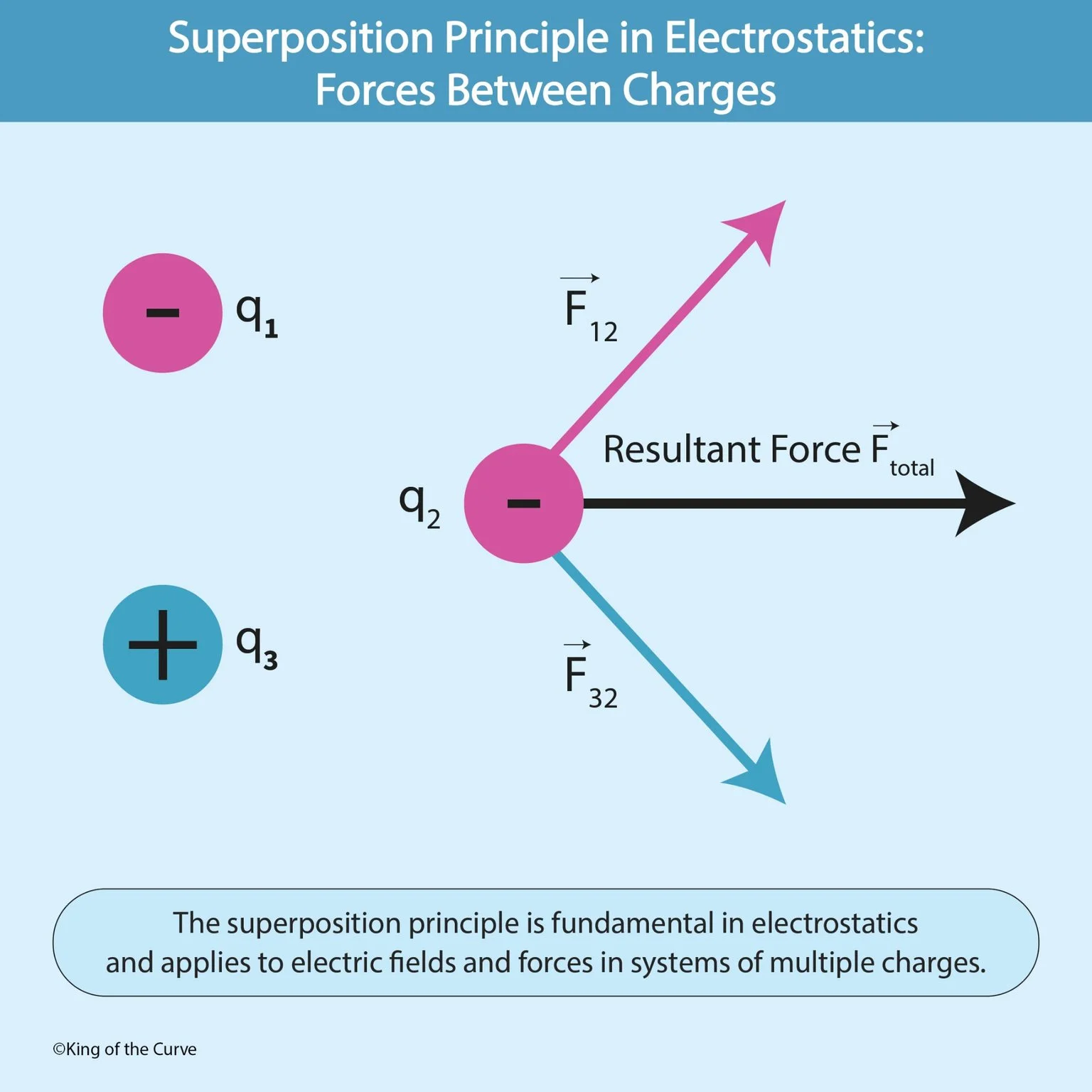
The superposition principle states that when multiple charges exert forces on a single charge, the total electrostatic force is the vector sum of all the individual forces acting on that charge. Each pairwise interaction can be calculated independently using Coulomb’s law before the forces are combined.
⚛️ Coulomb’s Law and Electric Force
The magnitude of the electrostatic force between two point charges is described by Coulomb’s law:
F = k|q₁q₂|/r², where k is Coulomb’s constant, q₁ and q₂ are the charges, and r is the distance between them. The direction of the force depends on whether the charges attract or repel.
➕ Attraction vs. Repulsion
Charges with the same sign repel, while charges with opposite signs attract. Therefore, determining the sign and location of every charge is essential before assigning the direction of each force vector. On MCAT problems, drawing arrows before performing calculations can help prevent sign and direction errors.
🧭 Electrostatic Force Is a Vector
Force has both magnitude and direction, so individual electrostatic forces cannot generally be added as ordinary numbers. Instead, resolve each force into its x- and y-components, add corresponding components, and then determine the magnitude and direction of the resultant force.
📐 Calculating the Net Force
For a charge experiencing several electrostatic forces, the relationship can be written as F⃗net = F⃗₁ + F⃗₂ + F⃗₃ + …. If forces act along the same line, they can be added or subtracted according to direction. When they act at angles, vector-component methods are required.
🔢 Superposition Example
Suppose a negative charge is influenced by another negative charge and a positive charge. The negative charge will be repelled by the negative source charge and attracted toward the positive source charge. Calculate each force separately, assign its direction, and then add the vectors to determine the net force.
| ⚡ Concept | 📘 Key Idea | 🎯 MCAT Reminder |
|---|---|---|
| Coulomb’s law | F = k|q₁q₂|/r² | Force decreases with r² |
| Like charges | Repel | Force points away |
| Opposite charges | Attract | Force points toward |
| Superposition | Add individual force vectors | Add components when needed |
| Net force | Vector sum of all forces | Direction matters |
⚡ Superposition and Electric Fields
The same principle applies to electric fields. If several charges produce electric fields at one point, the total field is E⃗net = E⃗₁ + E⃗₂ + …. Once the net electric field is known, the force on a test charge can be found using F⃗ = qE⃗.
🎯 Common MCAT Mistakes
A common mistake is adding only the magnitudes of forces while ignoring their directions. Also remember that doubling the distance between two charges reduces the electrostatic force to one-fourth of its original magnitude because of the inverse-square relationship.
🧠 MCAT High-Yield Takeaway
For MCAT electrostatics questions, remember the sequence: calculate each interaction independently → determine each force direction → resolve vectors if necessary → add the vectors. Superposition connects Coulomb’s law, electric fields, vector addition, and net force, making it an important concept for MCAT physics.

Frequently Asked Questions (FAQs)
-
Aim for 4-6 focused hours, ensuring you incorporate breaks to avoid burnout.
-
Practice mindfulness techniques, take practice exams under realistic conditions, and maintain a balanced lifestyle.
-
Set short-term goals, seek support from mentors, and reward yourself for small achievements.
-
Regular exercise improves focus, reduces stress, and enhances overall mental clarity.
-
KOTC offers personalized learning tools, gamification features, and adaptive question banks to help students stay on track without burnout.