
🌊 Structure of a Wave: Wavelength, Amplitude, Crests, and Troughs
A wave is a disturbance that transfers energy from one location to another without necessarily producing a net transfer of matter. Waves appear throughout MCAT physics in topics such as sound, electromagnetic radiation, oscillations, and interference. Understanding basic wave anatomy makes the major wave equations much easier to apply.
🔝 What Is a Crest?
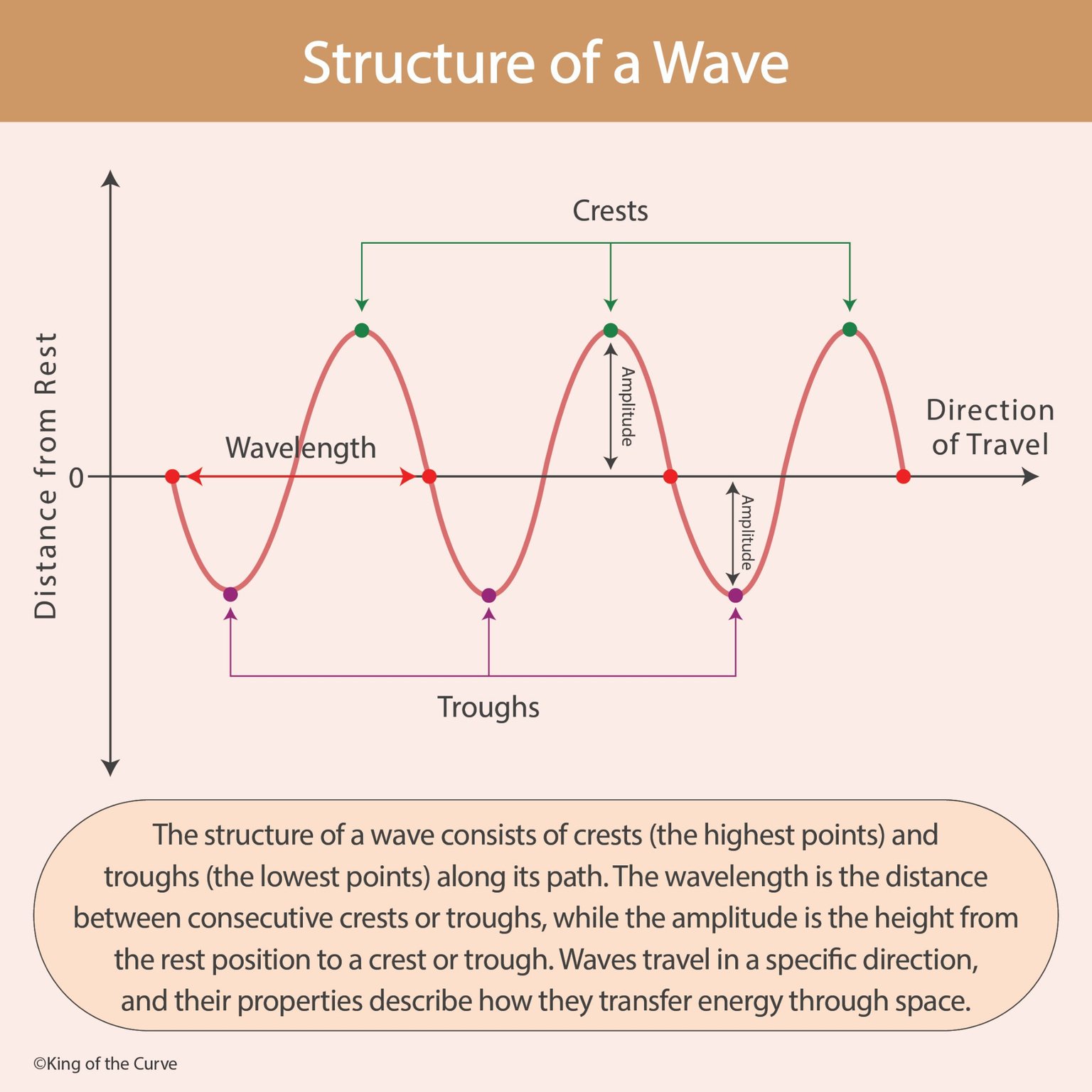
The crest is the highest point of a transverse wave relative to its equilibrium or rest position. Crests repeat at regular intervals in a periodic wave. The distance from one crest to the next consecutive crest represents one complete wavelength.
🔻 What Is a Trough?
The trough is the lowest point of a transverse wave relative to the equilibrium position. Like crests, consecutive troughs are separated by one wavelength. A crest and its neighboring trough represent opposite maximum displacements from equilibrium.
📏 Understanding Wavelength
Wavelength (λ) is the distance between two consecutive points that are in the same phase, such as crest-to-crest or trough-to-trough. Wavelength is usually measured in meters and is related to wave speed and frequency through the high-yield equation v = fλ.
↕️ Understanding Amplitude
Amplitude is the maximum displacement of a point on the wave from its equilibrium position. It can be measured from the rest position to either a crest or a trough. The vertical distance from a crest all the way to a trough is therefore twice the amplitude, not one amplitude.
⚡ Frequency, Wavelength, and Wave Speed
The relationship between wave speed, frequency, and wavelength is expressed as v = fλ, where v is wave speed, f is frequency, and λ is wavelength. If wave speed remains constant, increasing frequency decreases wavelength, while decreasing frequency increases wavelength.
📊 High-Yield Wave Properties
| 🌊 Property | 📘 Meaning | 🎯 MCAT Key Point |
|---|---|---|
| Crest | Highest point of a transverse wave | Maximum positive displacement |
| Trough | Lowest point of a transverse wave | Maximum negative displacement |
| Amplitude (A) | Maximum displacement from equilibrium | Measured from rest position to a crest or trough |
| Wavelength (λ) | Distance between equivalent points in phase | Crest-to-crest or trough-to-trough |
| Frequency (f) | Number of cycles per second | Measured in hertz (Hz) |
| Period (T) | Time required for one complete cycle | T = 1/f |
| Wave speed (v) | Speed at which the wave pattern propagates | v = fλ |
🔊 Why Amplitude and Frequency Matter
Amplitude and frequency describe different characteristics of a wave. For sound waves, greater amplitude is generally associated with greater intensity, while frequency determines pitch. For electromagnetic radiation, frequency is related to photon energy through E = hf, making frequency especially important in MCAT questions involving light.
🎯 MCAT High-Yield Takeaway
Remember the core relationships: crest = highest displacement, trough = lowest displacement, amplitude = maximum displacement from equilibrium, and wavelength = distance between equivalent points in phase. Also memorize v = fλ and T = 1/f. These principles provide the foundation for understanding standing waves, sound, interference, resonance, and electromagnetic radiation on the MCAT.

Frequently Asked Questions (FAQs)
-
Aim for 4-6 focused hours, ensuring you incorporate breaks to avoid burnout.
-
Practice mindfulness techniques, take practice exams under realistic conditions, and maintain a balanced lifestyle.
-
Set short-term goals, seek support from mentors, and reward yourself for small achievements.
-
Regular exercise improves focus, reduces stress, and enhances overall mental clarity.
-
KOTC offers personalized learning tools, gamification features, and adaptive question banks to help students stay on track without burnout.