
🦷 Understanding the Salivary Glands: Anatomy, Function, and Clinical Relevance
The salivary glands play an essential role in digestion, oral health, and immune protection, yet they’re often overlooked until a condition arises. For MCAT students, mastering the anatomy of these glands is high-yield because they commonly show up in questions about digestive physiology, enzyme activity, and head and neck anatomy. Using the KOTC science visual above, let’s break down what you need to know.
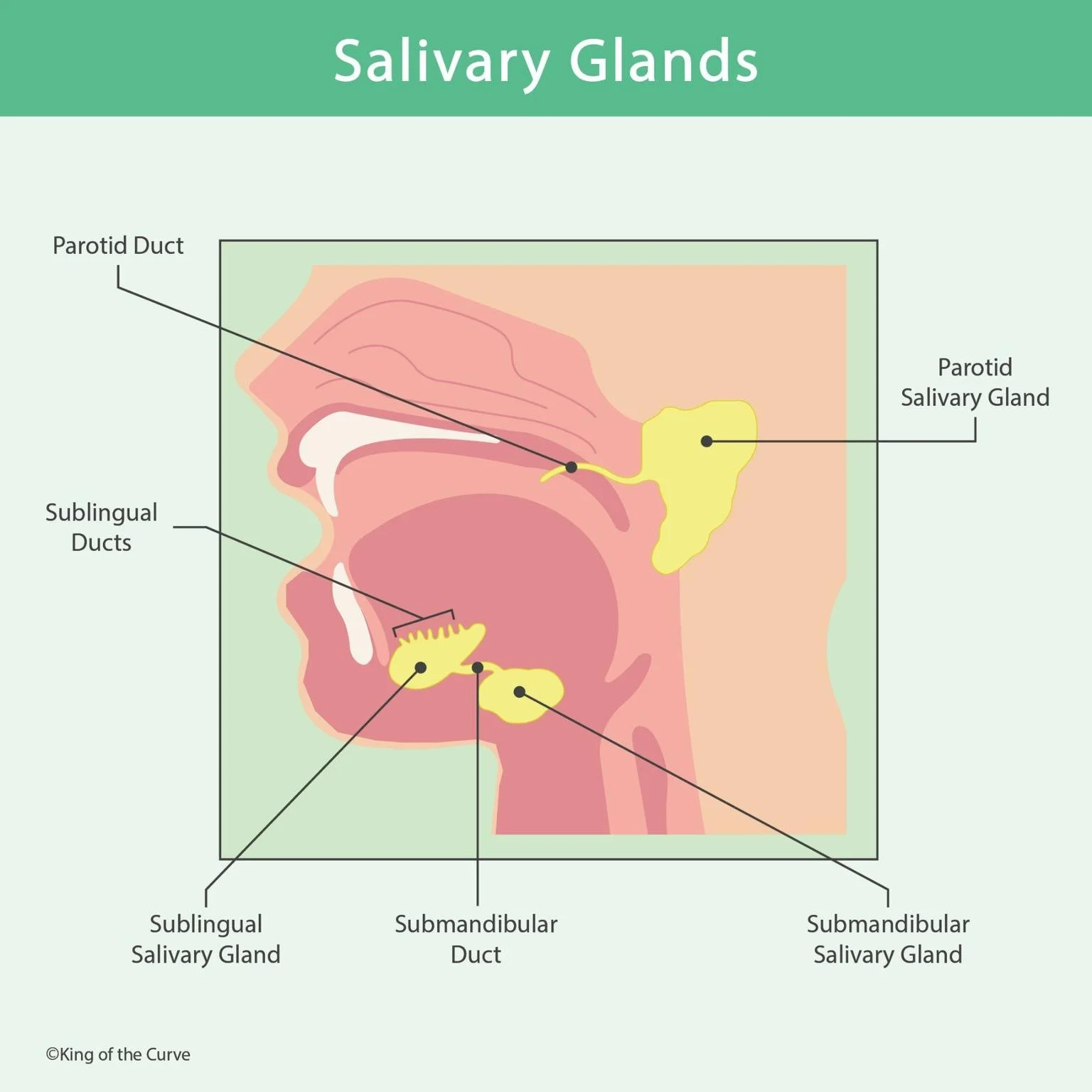
🟡 Overview of the Major Salivary Glands
Humans have three major pairs of salivary glands: parotid, submandibular, and sublingual. Each pair has a unique location and secretion type. The parotid glands, the largest, lie near the ear and drain into the oral cavity through the parotid duct, releasing primarily serous (watery) secretions rich in amylase.
💧 Sublingual and Submandibular Glands: Small but Mighty
The sublingual glands, located beneath the tongue, have multiple small ducts and produce mostly mucous secretions.
The submandibular glands sit beneath the jaw and drain via the submandibular duct. They produce the majority of resting saliva, making them the most clinically relevant when it comes to salivary stones.
📊 Summary Table: Major Salivary Glands
| Salivary Gland | Location | Type of Secretion | Primary Duct | High-Yield Notes |
|---|---|---|---|---|
| Parotid | Lateral to mandible, over masseter | Serous | Parotid duct (Stensen’s duct) | Largest gland; affected in mumps |
| Submandibular | Beneath mandible | Mixed (mostly serous) | Submandibular duct (Wharton’s duct) | Most common site of sialolithiasis |
| Sublingual | Beneath tongue | Mostly mucous | Multiple sublingual ducts | Smallest major gland |
🧪 What’s in Saliva and Why It Matters
Saliva contains amylase, lingual lipase, IgA, bicarbonate, and lysozyme. These components help digest carbohydrates, neutralize acids, and protect the mouth from bacteria. MCAT passages often reference salivary enzymes when covering metabolism or oral health.
🩺 Clinical Correlations Students Must Know
Two conditions frequently tested include:
Sialolithiasis (salivary stones): Most common in the submandibular duct due to its long, upward path and thicker secretions.
Mumps: Viral infection that characteristically inflames the parotid gland, leading to painful swelling.
Understanding duct pathways on diagrams like the KOTC visual above helps you quickly recognize these pathologies during exams.
🚀 Strengthen Your Anatomy Knowledge with KOTC
Consistent visual learning boosts long-term retention. King of the Curve provides 1,000+ science illustrations, adaptive question banks, daily quizzes, and gamification tools to help you master difficult concepts effortlessly.
Explore more at mcat.kingofthecurve.org or check out our Pre-Med Essentials at kingofthecurve.org/pre-med-essentials.

Frequently Asked Questions (FAQs)
-
Aim for 4-6 focused hours, ensuring you incorporate breaks to avoid burnout.
-
Practice mindfulness techniques, take practice exams under realistic conditions, and maintain a balanced lifestyle.
-
Set short-term goals, seek support from mentors, and reward yourself for small achievements.
-
Regular exercise improves focus, reduces stress, and enhances overall mental clarity.
-
KOTC offers personalized learning tools, gamification features, and adaptive question banks to help students stay on track without burnout.