
👁️ Understanding the Retina: A High-Yield Look at Cellular Layers
The retina is one of the most beautifully complex and highly tested structures in neurobiology. For the MCAT, it represents a perfect blend of anatomy, sensory physiology, and signaling pathways. King of the Curve’s visual breaks down the multilayered organization of the retina into something intuitive, helping students grasp how rods, cones, bipolar cells, and ganglion cells work together to convert light into neural signals your brain can interpret.
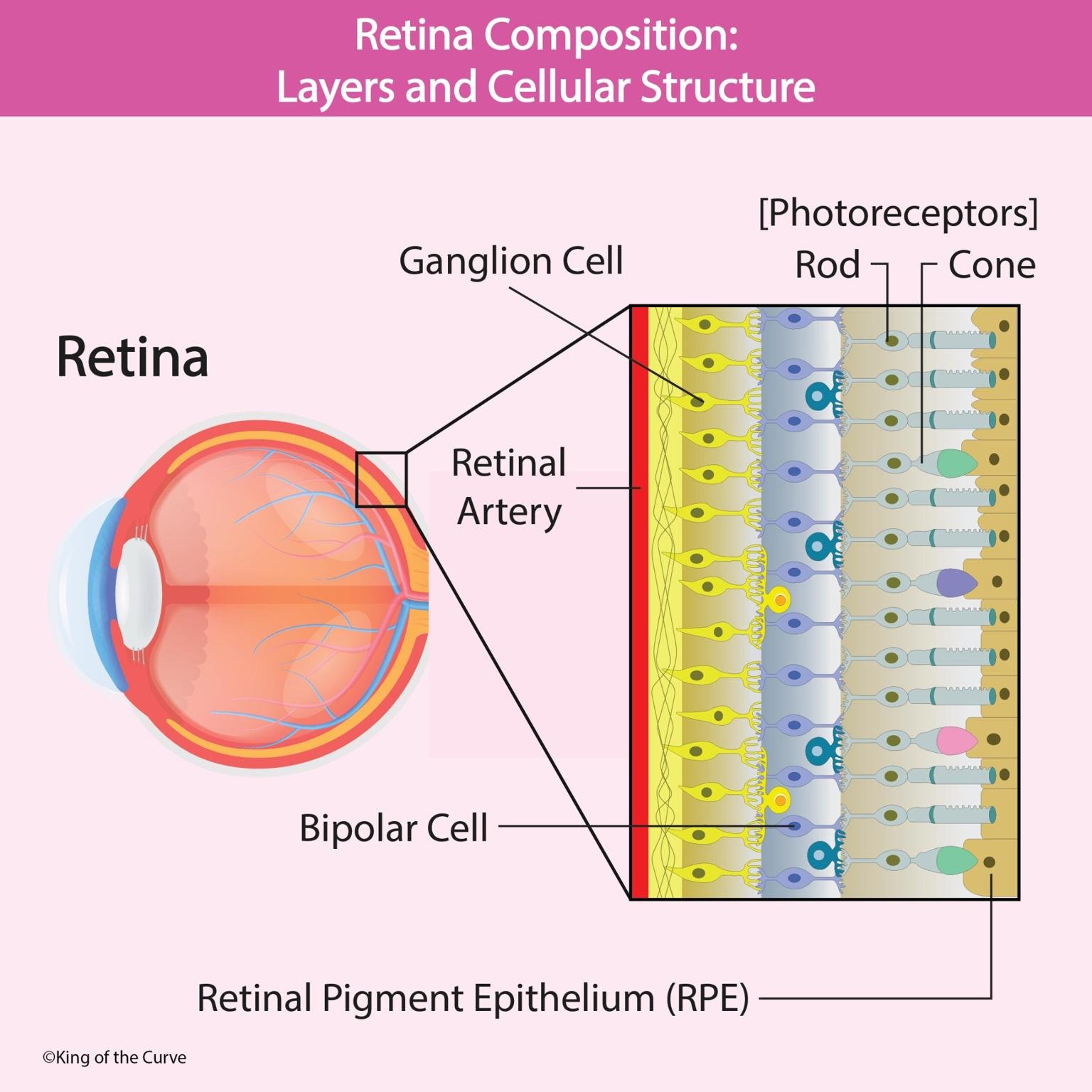
🔬 From Light to Vision: How the Retina Is Organized
The retina isn’t just a sheet of light-sensing tissue. It is composed of highly specialized layers that process visual information in a precise order. Light passes through the ganglion and bipolar cell layers before reaching the photoreceptors at the back of the retina. Only after the rods and cones detect light does the signal travel back toward the brain through bipolar and ganglion cells. This reversed layout often surprises students, but KOTC’s diagram highlights how the layers are arranged and interconnected.
🎨 Photoreceptors: Rods and Cones
Photoreceptors form the foundation of vision. Rods are incredibly sensitive to light and dominate in low-light and peripheral vision. Cones, on the other hand, provide sharp central vision and color discrimination. Understanding these differences is crucial for MCAT passages dealing with night blindness, color vision defects, or retinal diseases. The diagram clearly distinguishes the structure of rods and cones, making it easier to visualize their distinct functions.
🔄 Bipolar and Ganglion Cells: The Signal Relay Team
Once photoreceptors convert light into electrical signals, those signals must be processed and sent along the visual pathway. That’s where bipolar cells and ganglion cells come in. Bipolar cells act as intermediaries, integrating information from rods and cones. Ganglion cells then carry this processed signal out of the retina via the optic nerve. Disruptions at these levels—such as in glaucoma—affect signal transmission rather than light detection itself.
🧱 Retinal Pigment Epithelium (RPE): The Unsung Hero
The RPE is a thin but indispensable layer that supports photoreceptor health. It absorbs excess light, recycles visual pigments, and transports nutrients to photoreceptors. Dysfunction of the RPE can lead to serious retinal diseases, including age-related macular degeneration—something the MCAT loves to test because it connects anatomy to pathology.
📊 High-Yield Table: Retinal Layers and Their Functions
| Retinal Structure | Function | MCAT Relevance |
|---|---|---|
| Photoreceptors (Rods & Cones) | Detect light; convert photons into neural signals | Night vision, color vision, visual defects |
| Bipolar Cells | Relay signals from photoreceptors to ganglion cells | Visual processing disorders |
| Ganglion Cells | Transmit signals to the brain via the optic nerve | Glaucoma, visual field defects |
| RPE (Retinal Pigment Epithelium) | Nourishes photoreceptors and absorbs stray light | Macular degeneration, photoreceptor health |
🎯 Why This Matters for the MCAT
Vision is one of the most highly tested sensory systems on the MCAT. Questions frequently ask about phototransduction, retinal cell organization, or the consequences of damage at different levels. Having a strong visual model like the KOTC retina diagram helps you answer these questions quickly and confidently. Explore more retina-related diagrams and MCAT-focused explanations at kingofthecurve.org/studyscience to strengthen your understanding.

Frequently Asked Questions (FAQs)
-
Aim for 4-6 focused hours, ensuring you incorporate breaks to avoid burnout.
-
Practice mindfulness techniques, take practice exams under realistic conditions, and maintain a balanced lifestyle.
-
Set short-term goals, seek support from mentors, and reward yourself for small achievements.
-
Regular exercise improves focus, reduces stress, and enhances overall mental clarity.
-
KOTC offers personalized learning tools, gamification features, and adaptive question banks to help students stay on track without burnout.