
🧪 Resonance Structures Explained: A High-Yield MCAT Chemistry Guide
Resonance is one of the most important concepts in MCAT general and organic chemistry. It explains why a single Lewis structure sometimes cannot accurately represent the distribution of electrons in a molecule or ion.
⚛️ What Are Resonance Structures?
Resonance structures are alternative Lewis structures that represent different valid arrangements of electrons within the same molecule or ion.
The key rule is:
Atoms stay in the same positions; only electrons move.
Resonance commonly involves movement of π electrons, lone pairs, and formal charges.
The individual drawings are called resonance contributors. They do not represent separate molecules.
🔄 Resonance Does NOT Mean the Molecule Flips Back and Forth
A common MCAT misconception is that a molecule rapidly switches between its resonance structures.
It does not.
The real molecule exists as a resonance hybrid, meaning its electron distribution reflects contributions from the valid resonance structures simultaneously.
For example, if several equivalent resonance contributors place a double bond in different locations, the actual bonds may have partial double-bond character rather than alternating between distinct single and double bonds.
➡️ How Are Resonance Structures Written?
Resonance contributors are connected using a double-headed resonance arrow:
Structure A ↔ Structure B
Do not confuse this with an equilibrium arrow. Resonance contributors are not separate chemical species existing in equilibrium.
When drawing a new contributor:
Keep the atomic framework unchanged.
Move electrons, not atoms.
Maintain valid total electron count and overall charge.
Follow octet rules where applicable.
Recalculate formal charges after moving electrons.
🧮 Nitrate Ion: A Classic Resonance Example
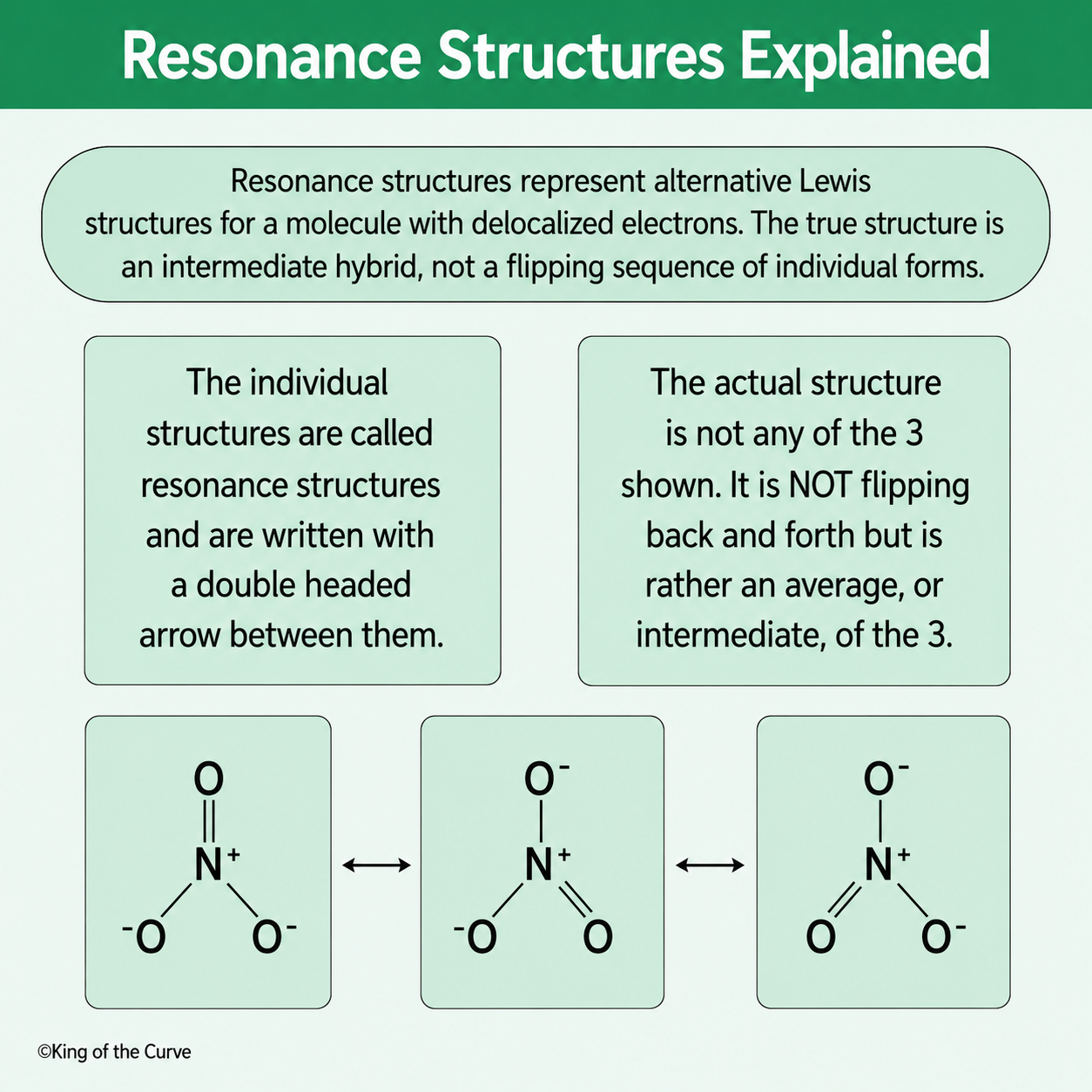
The diagram shows the nitrate ion, NO₃⁻, a classic example of resonance.
Nitrate can be represented by three equivalent resonance structures. In each contributor, one N–O bond is drawn as a double bond while the other two are drawn as single bonds.
Because all three contributors are equivalent, the real nitrate ion does not contain one permanently localized N=O double bond.
Instead, the π electrons are delocalized across all three N–O bonds.
As a result:
All three N–O bonds are equivalent.
Their actual bond order is:
Bond order = 4 total bond units ÷ 3 N–O bonds = 4/3 ≈ 1.33
Therefore, each N–O bond has a character intermediate between a conventional single and double bond.
🧠 How to Identify the Most Important Resonance Contributor
Not every resonance contributor necessarily contributes equally to the resonance hybrid. When comparing non-equivalent structures, generally favor contributors that:
Give atoms complete octets when possible.
Minimize the number and magnitude of formal charges.
Minimize unnecessary charge separation.
Place negative formal charge on more electronegative atoms.
Place positive formal charge on less electronegative atoms.
Equivalent contributors, such as the three principal nitrate structures, contribute equally.
📐 Resonance and Molecular Stability
Electron delocalization generally stabilizes a molecule or ion.
Instead of concentrating electron density or charge on a single atom, resonance can distribute it over several atoms.
This concept appears frequently in MCAT questions involving:
Carboxylates, amides, phenoxide ions, conjugated systems, aromatic compounds, and charged intermediates.
For example, the conjugate base of a carboxylic acid is resonance-stabilized because its negative charge can be delocalized over two oxygen atoms. This stabilization helps explain the acidity of carboxylic acids.
🧬 Resonance vs. Isomers
Resonance structures are not isomers.
With resonance:
Same atoms + same connectivity + different electron placement
With constitutional isomers:
Same molecular formula + different atom connectivity
If atoms themselves must move to transform one drawing into another, you are generally not looking at resonance contributors.
⚠️ Common MCAT Resonance Mistakes
Be especially careful not to:
Move atoms when drawing resonance contributors.
Break σ bonds unnecessarily.
Treat resonance arrows as equilibrium arrows.
Assume resonance structures are physically switching back and forth.
Forget formal charges.
Violate second-row octets for atoms such as carbon, nitrogen, oxygen, and fluorine.
Assume every possible contributor contributes equally.
🎯 MCAT High-Yield Takeaway
The central idea is simple:
Resonance structures are drawings; the resonance hybrid is the actual molecule.
When the MCAT asks about resonance, think electron delocalization → increased stability. Also remember that equivalent resonance contributors can produce equivalent bonds with bond orders intermediate between ordinary single and double bonds.
⭐ Quick Memory Trick
Resonance = electrons roam, atoms stay home.
That rule will help you avoid one of the most common resonance mistakes on test day.

Frequently Asked Questions (FAQs)
-
Aim for 4-6 focused hours, ensuring you incorporate breaks to avoid burnout.
-
Practice mindfulness techniques, take practice exams under realistic conditions, and maintain a balanced lifestyle.
-
Set short-term goals, seek support from mentors, and reward yourself for small achievements.
-
Regular exercise improves focus, reduces stress, and enhances overall mental clarity.
-
KOTC offers personalized learning tools, gamification features, and adaptive question banks to help students stay on track without burnout.