
⚗️ Rate Laws Made Easy: Zero, First, and Second-Order Reactions for the MCAT
Rate laws are one of the most testable concepts in MCAT chemical kinetics. They connect reactant concentration to reaction rate and help predict what happens when concentration changes. Today, we’ll break down zero-order, first-order, and second-order reactions using patterns that are much easier to recognize than memorize.
🧪 What Is a Rate Law?
A rate law describes how reaction rate depends on reactant concentration. For a simple reaction involving reactant A, it can be written as Rate = k[A]ⁿ, where k is the rate constant and n is the reaction order with respect to A. Importantly, reaction order is generally determined experimentally, not simply from the coefficients of a balanced equation.
0️⃣ Zero-Order Reactions
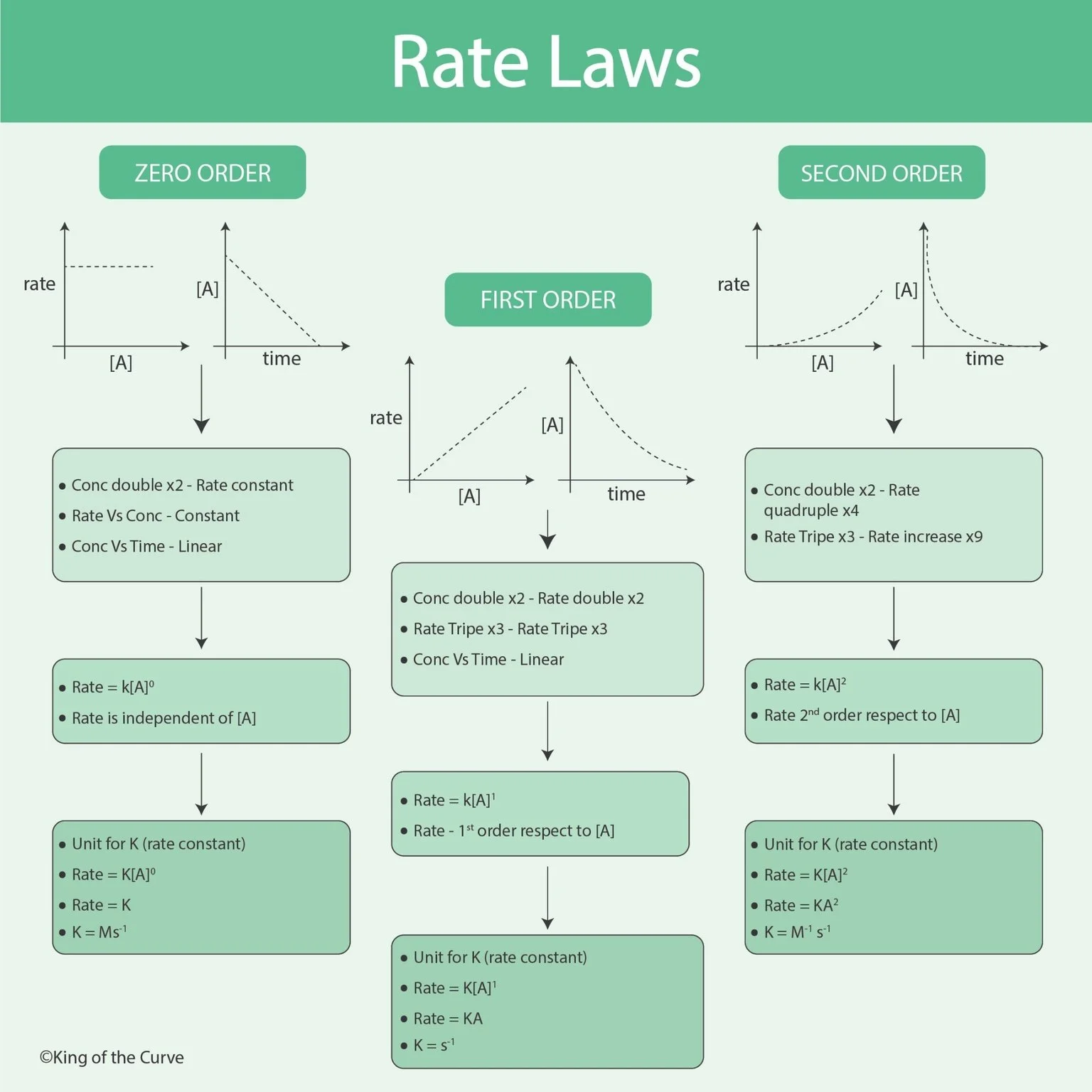
A zero-order reaction follows Rate = k[A]⁰ = k, so changing [A] does not change the reaction rate. Doubling or tripling the reactant concentration therefore leaves the rate unchanged. A plot of rate versus [A] is horizontal, while [A] versus time decreases linearly.
1️⃣ First-Order Reactions
For a first-order reaction, Rate = k[A]. If [A] doubles, the rate doubles; if [A] triples, the rate triples. Concentration decreases exponentially with time, while ln[A] versus time gives a straight line. First-order reactions also have the useful half-life relationship t½ = ln(2)/k.
2️⃣ Second-Order Reactions
For the common single-reactant second-order case, Rate = k[A]². Doubling [A] makes the rate four times greater, while tripling [A] makes it nine times greater. The concentration itself decreases nonlinearly over time, but a plot of 1/[A] versus time is linear.
📊 Compare the Three Reaction Orders
The easiest way to solve many kinetics questions is to compare how a concentration change affects rate.
| ⚗️ Order | 🧪 Rate Law | 📈 If [A] Doubles | 📉 Linearized Plot | 🔬 Units of k |
|---|---|---|---|---|
| Zero | Rate = k | No change | [A] vs. time | M·s−1 |
| First | Rate = k[A] | Rate ×2 | ln[A] vs. time | s−1 |
| Second | Rate = k[A]2 | Rate ×4 | 1/[A] vs. time | M−1·s−1 |
📈 How Concentration Reveals Reaction Order
Suppose an experiment doubles [A]. If the measured rate remains constant, the reaction is zero order in A. If the rate doubles, it is first order. If the rate quadruples, it is second order. This concentration-rate comparison is a fast way to determine an unknown exponent in an MCAT kinetics problem.
🧠 MCAT Strategy for Rate-Law Questions
When the MCAT provides a table of experimental trials, compare two trials where only one reactant concentration changes. Determine the factor by which concentration changed, then compare it with the factor by which rate changed. From there, identify the exponent in the rate law before moving on to calculate k or predict a new reaction rate.
🎯 Learn the Pattern, Not Just the Formula
Think of the three orders as a simple sequence: double → ×1, ×2, ×4 for zero, first, and second order. Pair that pattern with the linearized plots—[A], ln[A], and 1/[A] versus time and kinetics becomes much easier to recognize. Explore more high-yield science visuals and practice at mcat.kingofthecurve.org, including King of the Curve’s Adaptive Q-Bank, daily questions, timed modes, and other MCAT study tools.

Frequently Asked Questions (FAQs)
-
Aim for 4-6 focused hours, ensuring you incorporate breaks to avoid burnout.
-
Practice mindfulness techniques, take practice exams under realistic conditions, and maintain a balanced lifestyle.
-
Set short-term goals, seek support from mentors, and reward yourself for small achievements.
-
Regular exercise improves focus, reduces stress, and enhances overall mental clarity.
-
KOTC offers personalized learning tools, gamification features, and adaptive question banks to help students stay on track without burnout.