
🍗 Protein Absorption in the Small Intestine
Proteins consumed in the diet must be broken down into amino acids and small peptides before they can be absorbed into the bloodstream. The small intestine, particularly the jejunum, is the primary site of protein absorption. Specialized transport proteins located on the apical and basolateral membranes of enterocytes ensure that amino acids and dipeptides efficiently move from the intestinal lumen into the circulation. Understanding these transport mechanisms is essential for the MCAT, USMLE, and other medical examinations.
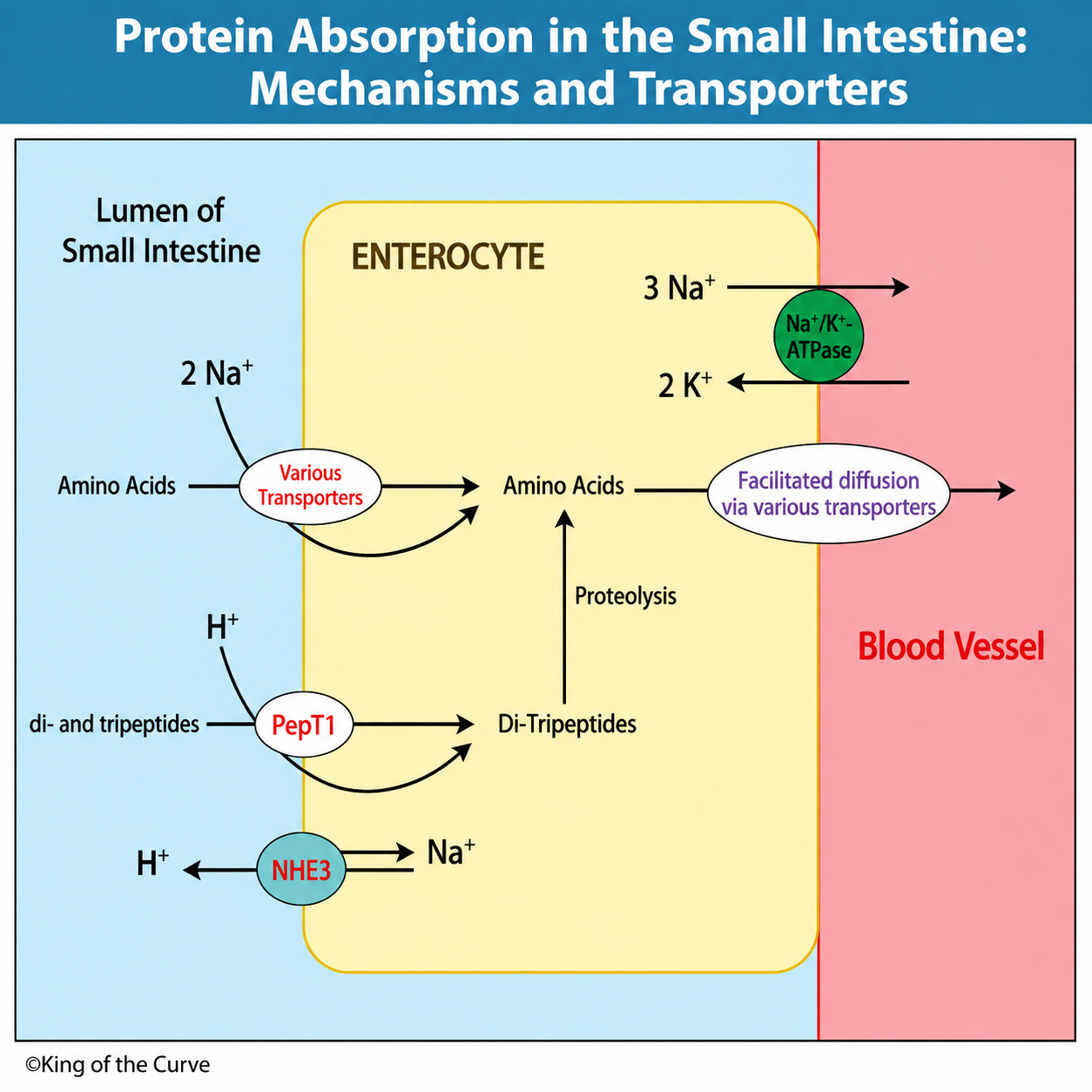
🧬 Protein Digestion Before Absorption
Protein digestion begins in the stomach with pepsin and continues in the small intestine through pancreatic enzymes such as trypsin, chymotrypsin, elastase, and carboxypeptidases. These enzymes break proteins into free amino acids, dipeptides, and tripeptides. Brush border peptidases further digest peptides, producing molecules small enough to be transported across the intestinal epithelium.
🚪 Sodium-Dependent Amino Acid Transport
Most free amino acids enter enterocytes through Na⁺-dependent cotransporters located on the apical membrane. These transporters use the sodium concentration gradient established by the Na⁺/K⁺-ATPase pump on the basolateral membrane. As sodium moves into the cell, amino acids are carried along against their concentration gradient through secondary active transport.
⚡ PepT1 and Peptide Uptake
Dipeptides and tripeptides are absorbed through the PepT1 transporter, which uses a proton (H⁺) gradient rather than sodium. This H⁺-dependent cotransporter allows efficient uptake of small peptides into the enterocyte. Once inside the cell, intracellular peptidases rapidly hydrolyze these peptides into individual amino acids.
🔄 The Role of NHE3 and the Proton Gradient
The proton gradient necessary for PepT1 function is maintained by the Na⁺/H⁺ exchanger (NHE3) located on the apical membrane. NHE3 exchanges intracellular hydrogen ions for luminal sodium ions, continuously recycling protons and supporting ongoing peptide absorption. This coordinated activity between NHE3 and PepT1 maximizes nutrient uptake.
🔋 Na⁺/K⁺-ATPase Maintains the Driving Force
The Na⁺/K⁺-ATPase pump on the basolateral membrane is the key energy source behind amino acid absorption. It actively pumps 3 Na⁺ out of the enterocyte and 2 K⁺ into the cell, maintaining a low intracellular sodium concentration. This sodium gradient powers secondary active transport systems responsible for amino acid uptake from the intestinal lumen.
🩸 Transport into the Bloodstream
After intracellular peptides are converted into free amino acids, amino acids exit the enterocyte through facilitated diffusion and specialized amino acid transporters on the basolateral membrane. These transporters move amino acids into the surrounding capillaries, allowing them to enter the portal circulation and travel directly to the liver for metabolism and distribution.
📋 Summary Table: Protein Absorption Mechanisms
| Component | Function | Transport Type | High-Yield Point |
|---|---|---|---|
| Na+-dependent amino acid transporters | Absorb free amino acids | Secondary active transport | Uses the Na+ gradient |
| PepT1 | Absorbs dipeptides and tripeptides | H+-dependent cotransport | Peptides are hydrolyzed inside enterocytes |
| NHE3 | Exchanges Na+ for H+ | Secondary active transport | Maintains the proton gradient for PepT1 |
| Na+/K+-ATPase | Pumps 3 Na+ out and 2 K+ in | Primary active transport | Creates the Na+ gradient for absorption |
| Intracellular peptidases | Break peptides into amino acids | Enzymatic digestion | Occurs inside enterocytes |
| Basolateral amino acid transporters | Move amino acids into the blood | Facilitated diffusion | Delivers nutrients to the portal circulation |
🎯 High-Yield MCAT Pearls
For exams, remember that free amino acids use Na⁺-dependent secondary active transport, while dipeptides and tripeptides use the H⁺-dependent PepT1 transporter. The Na⁺/H⁺ exchanger (NHE3) maintains the proton gradient for PepT1, and the Na⁺/K⁺-ATPase generates the sodium gradient that drives amino acid absorption. Together, these transporters ensure efficient dietary protein absorption and represent one of the most commonly tested gastrointestinal physiology topics on the MCAT and medical licensing exams.

Frequently Asked Questions (FAQs)
-
Aim for 4-6 focused hours, ensuring you incorporate breaks to avoid burnout.
-
Practice mindfulness techniques, take practice exams under realistic conditions, and maintain a balanced lifestyle.
-
Set short-term goals, seek support from mentors, and reward yourself for small achievements.
-
Regular exercise improves focus, reduces stress, and enhances overall mental clarity.
-
KOTC offers personalized learning tools, gamification features, and adaptive question banks to help students stay on track without burnout.