
🟢 Pancreatic Ductal Cells: How the Pancreas Creates Bicarbonate-Rich Fluid
Pancreatic ductal cells play a critical role in digestion by secreting bicarbonate-rich fluid into the pancreatic ducts. This alkaline secretion neutralizes acidic chyme entering the duodenum from the stomach, creating the optimal pH for digestive enzymes to function.
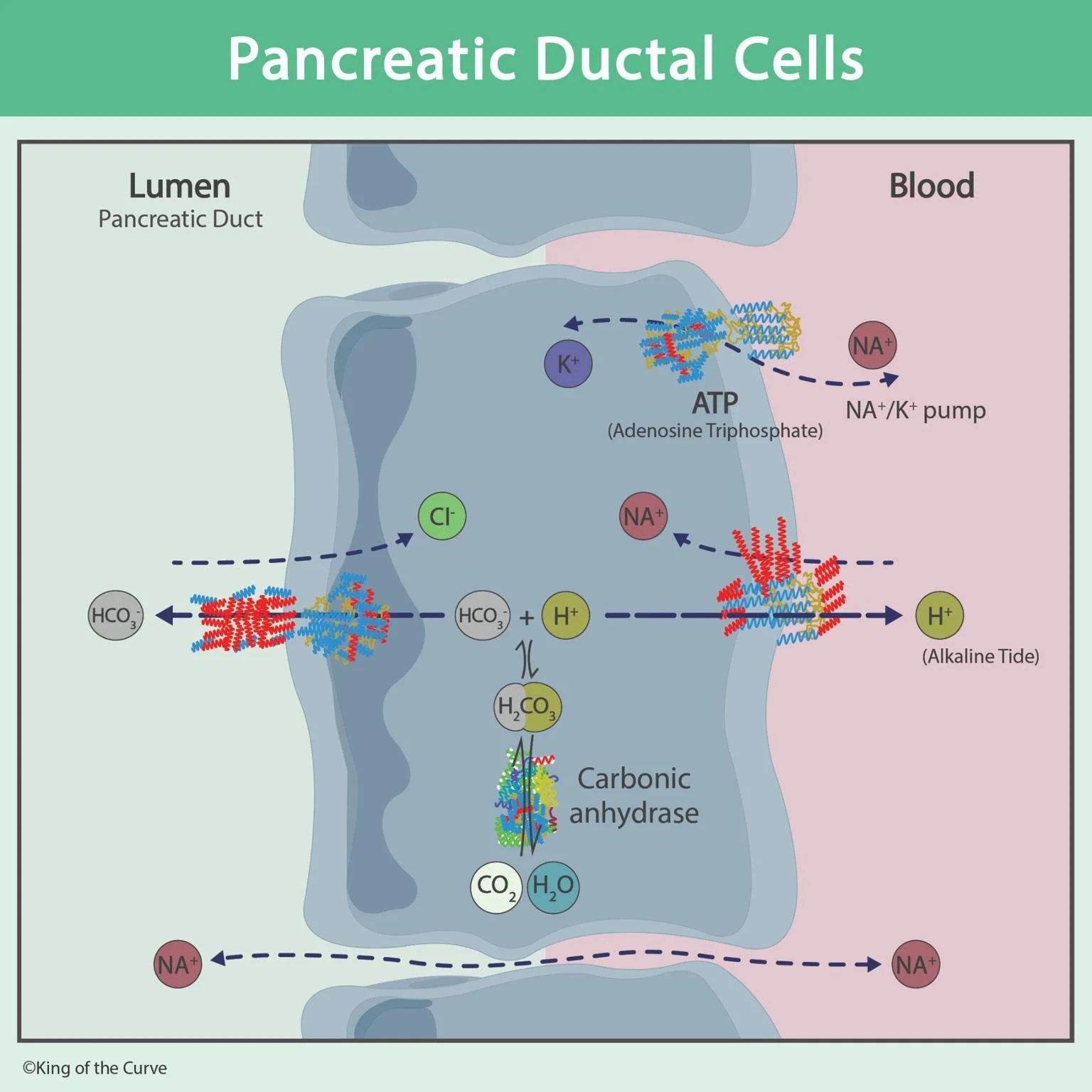
🧪 The Main Function of Pancreatic Ductal Cells
The primary job of pancreatic ductal cells is to:
Secrete bicarbonate (HCO₃⁻) into the pancreatic duct lumen
Neutralize gastric acid in the duodenum
Maintain proper pH for pancreatic enzymes
Facilitate digestion of fats, proteins, and carbohydrates
Without adequate bicarbonate secretion, digestive enzymes become less effective and intestinal mucosa can be damaged.
🔄 Step 1: Formation of Bicarbonate Inside the Cell
Inside the ductal cell, bicarbonate is produced through the action of carbonic anhydrase.
Reaction:
CO₂ + H₂O ⇌ H₂CO₃ ⇌ H⁺ + HCO₃⁻
Carbon dioxide (CO₂) combines with water (H₂O)
Carbonic acid (H₂CO₃) forms
It dissociates into:
Hydrogen ion (H⁺)
Bicarbonate (HCO₃⁻)
This reaction is rapid due to carbonic anhydrase.
➡️ Step 2: Secretion of Bicarbonate into the Lumen
Bicarbonate exits the apical side (toward the pancreatic duct lumen) primarily via:
🔹 Cl⁻/HCO₃⁻ exchanger
Chloride (Cl⁻) enters the cell
Bicarbonate (HCO₃⁻) exits into the duct lumen
This results in a bicarbonate-rich pancreatic fluid.
🔁 Step 3: Recycling of Chloride (CFTR Channel)
Chloride is recycled through channels (notably CFTR) to maintain exchanger function.
This chloride recycling ensures:
Continuous bicarbonate secretion
Proper fluid movement into the duct
This mechanism is especially important in conditions like cystic fibrosis, where CFTR dysfunction reduces bicarbonate secretion.
⚡ Step 4: Basolateral Na⁺/K⁺ Pump Maintains Ion Gradients
On the blood-facing (basolateral) side:
🔹 Na⁺/K⁺ ATPase pump
Pumps Na⁺ out into blood
Pumps K⁺ into the cell
Uses ATP for energy
This maintains the sodium gradient that drives secondary transport processes.
🔄 Step 5: Hydrogen Ion (H⁺) Secretion into Blood — “Alkaline Tide”
The hydrogen ions (H⁺) generated during bicarbonate formation are transported into the blood.
This results in a temporary increase in blood alkalinity known as:
🩸 Alkaline Tide
This phenomenon is similar to what occurs in gastric parietal cells—but in the opposite direction.
💧 Why Is This Important for Digestion?
When acidic chyme leaves the stomach, it must be neutralized before entering the small intestine.
Pancreatic bicarbonate:
Raises duodenal pH
Protects intestinal mucosa
Activates pancreatic enzymes
Supports fat digestion
Without this buffering system, digestive efficiency drops significantly.
🧬 Clinical Correlation
🧪 Cystic Fibrosis
Defective CFTR channel
Impaired chloride recycling
Reduced bicarbonate secretion
Thick, viscous pancreatic secretions
This leads to pancreatic insufficiency and malabsorption.
🧠 Quick Summary Table
| Component | Function |
|---|---|
| Carbonic anhydrase | Generates HCO₃⁻ and H⁺ |
| Cl⁻/HCO₃⁻ exchanger | Secretes bicarbonate into the duct lumen |
| CFTR channel | Recycles chloride to sustain bicarbonate secretion |
| Na⁺/K⁺ pump | Maintains ion gradients (uses ATP) |
| H⁺ secretion to blood | Causes “alkaline tide” |
📌 Key Takeaway
Pancreatic ductal cells are specialized epithelial cells designed to secrete alkaline, bicarbonate-rich fluid. This secretion neutralizes gastric acid and ensures optimal digestive enzyme activity in the small intestine.
Understanding this mechanism is crucial for mastering GI physiology and for recognizing diseases like cystic fibrosis and chronic pancreatitis.

Frequently Asked Questions (FAQs)
-
Aim for 4-6 focused hours, ensuring you incorporate breaks to avoid burnout.
-
Practice mindfulness techniques, take practice exams under realistic conditions, and maintain a balanced lifestyle.
-
Set short-term goals, seek support from mentors, and reward yourself for small achievements.
-
Regular exercise improves focus, reduces stress, and enhances overall mental clarity.
-
KOTC offers personalized learning tools, gamification features, and adaptive question banks to help students stay on track without burnout.