
Overview of Hematopoiesis and Key Cytokines Involved
Blood cells are essential for transporting oxygen, fighting infections, and maintaining normal blood clotting. The process responsible for producing all blood cells is called hematopoiesis. This highly regulated process begins in the bone marrow, where hematopoietic stem cells differentiate into specialized blood cells under the influence of various cytokines and growth factors.
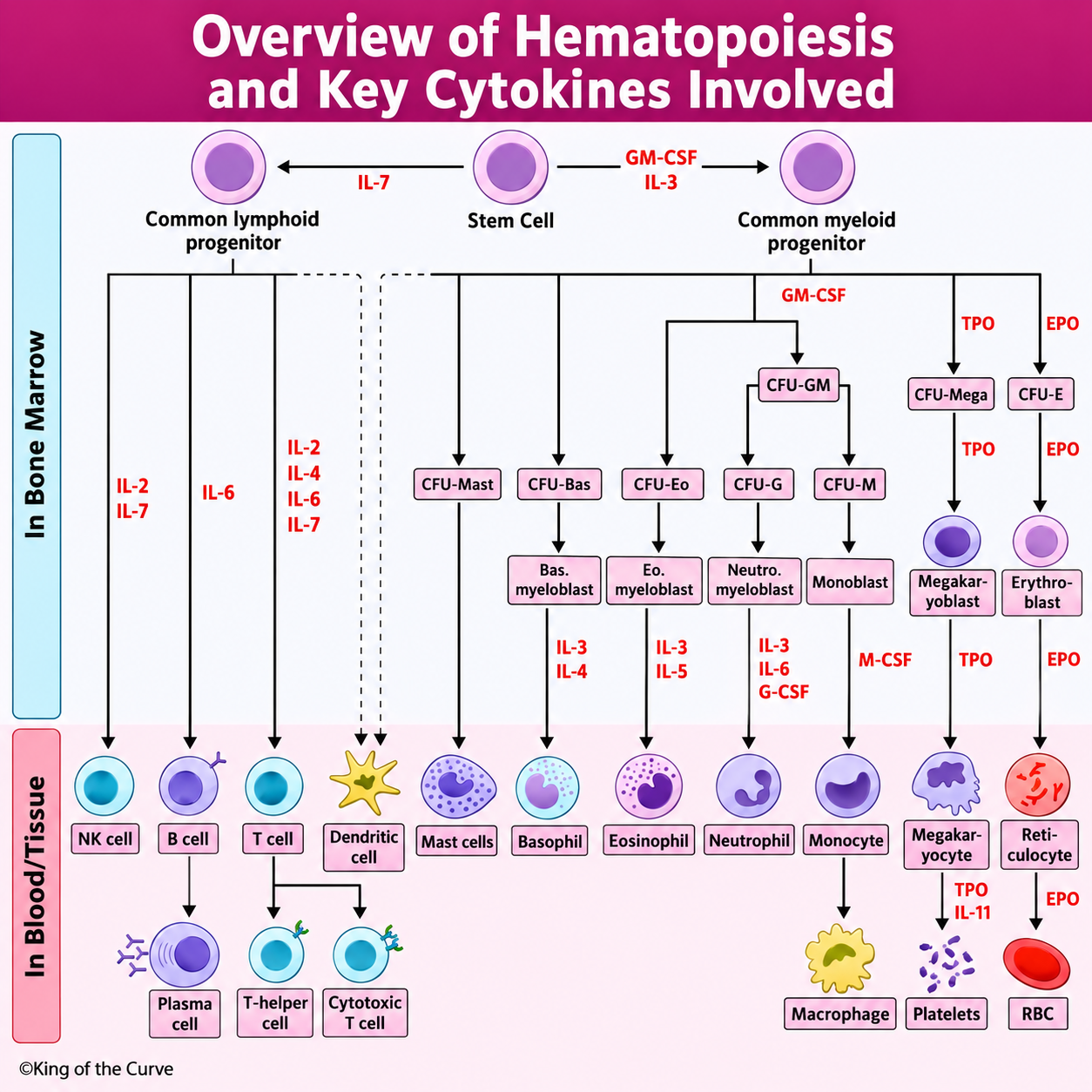
🩸 What Is Hematopoiesis?
Hematopoiesis is the continuous production and maturation of blood cells from hematopoietic stem cells (HSCs) found primarily in the bone marrow.
These stem cells possess two important characteristics:
Self-renewal, allowing them to maintain the stem cell population.
Multipotency, enabling them to differentiate into every type of blood cell.
In healthy adults, billions of blood cells are produced daily to replace aging or damaged cells.
🌱 Hematopoietic Stem Cells: The Starting Point
At the center of hematopoiesis lies the hematopoietic stem cell, which gives rise to two major progenitor cells:
Common lymphoid progenitor (CLP)
Common myeloid progenitor (CMP)
Each lineage produces distinct groups of blood cells with specialized physiological functions.
🧬 Lymphoid Lineage
The common lymphoid progenitor primarily develops into immune cells responsible for adaptive immunity.
These include:
Natural killer (NK) cells
B lymphocytes
T lymphocytes
Dendritic cells (partially)
Several cytokines regulate lymphoid differentiation.
Key Cytokines
IL-7 – Essential for lymphocyte development
IL-2 – Promotes T-cell proliferation
IL-4 – Supports helper T-cell differentiation
IL-6 – Participates in immune regulation
🛡️ Major Lymphoid Cells
🔹 Natural Killer (NK) Cells
NK cells are components of innate immunity that destroy virus-infected and tumor cells without prior sensitization.
🧫 B Cells
B lymphocytes mature into plasma cells, which produce antibodies responsible for humoral immunity.
🧪 T Cells
T lymphocytes differentiate into:
Helper T cells (CD4+)
Cytotoxic T cells (CD8+)
These cells coordinate immune responses and directly eliminate infected cells.
🔬 Dendritic Cells
Dendritic cells function as professional antigen-presenting cells, linking innate and adaptive immunity.
🏭 Myeloid Lineage
The common myeloid progenitor generates most circulating blood cells outside the lymphoid lineage.
These include:
Neutrophils
Eosinophils
Basophils
Monocytes
Mast cells
Megakaryocytes
Erythrocytes
Their differentiation is controlled by several colony-stimulating factors and hormones.
⚙️ Colony-Forming Units (CFUs)
As myeloid progenitors mature, they pass through intermediate stages called colony-forming units (CFUs).
Examples include:
CFU-GM
CFU-G
CFU-M
CFU-Eo
CFU-Bas
CFU-Mast
CFU-Mega
CFU-E
Each CFU is committed to producing a specific blood cell lineage.
🧪 Important Cytokines and Growth Factors
The infographic highlights several critical regulators.
| 🧬 Cytokine | ⚙️ Primary Function |
|---|---|
| IL-3 | Stimulates multiple hematopoietic progenitor cells. |
| GM-CSF | Promotes the development of granulocytes and macrophages. |
| G-CSF | Promotes neutrophil production and maturation. |
| M-CSF | Stimulates monocyte and macrophage differentiation. |
| IL-5 | Drives eosinophil development and activation. |
| IL-4 | Supports basophil development and T-cell differentiation. |
| IL-6 | Enhances immune-cell maturation and inflammatory signaling. |
| IL-7 | Supports the development of the lymphoid lineage. |
| TPO | Stimulates megakaryocyte maturation and platelet production. |
| EPO | Stimulates erythrocyte, or red blood cell, production. |
🦠 Granulocyte Development
Granulocytes are white blood cells characterized by cytoplasmic granules.
🟢 Neutrophils
Neutrophils are the body's primary defense against bacterial infections.
Important regulators include:
G-CSF
IL-3
IL-6
🟠 Eosinophils
Eosinophils combat parasitic infections and participate in allergic reactions.
Major cytokines:
IL-5
IL-3
🟣 Basophils
Basophils release histamine and contribute to allergic inflammation.
Their differentiation is supported by:
IL-3
IL-4
🧫 Monocyte–Macrophage Lineage
Monocytes circulate in the bloodstream before entering tissues, where they differentiate into macrophages.
Macrophages:
Remove pathogens
Clear dead cells
Present antigens
Coordinate inflammatory responses
The principal regulator is:
M-CSF (Macrophage Colony-Stimulating Factor)
🧬 Mast Cells
Mast cells originate from bone marrow progenitors and mature within tissues.
They play vital roles in:
Allergic reactions
Anaphylaxis
Parasite defense
Inflammatory signaling
🩸 Platelet Formation
Platelets originate from megakaryocytes, which develop from CFU-Mega.
The primary hormone responsible is:
Thrombopoietin (TPO)
TPO stimulates:
Megakaryoblast development
Megakaryocyte maturation
Platelet production
IL-11 also contributes to platelet formation.
❤️ Red Blood Cell Development
Red blood cells develop through the erythroid lineage:
CFU-E → Erythroblast → Reticulocyte → Mature RBC
The principal regulator is:
Erythropoietin (EPO)
Produced mainly by the kidneys in response to hypoxia, EPO increases red blood cell production to improve oxygen delivery.
📍 Bone Marrow vs Blood and Tissue
The infographic separates hematopoiesis into two major locations.
Bone Marrow
Within the bone marrow:
Stem cells divide
Progenitor cells differentiate
Immature precursor cells develop
Blood and Tissue
After maturation:
Mature blood cells enter circulation
Some migrate into tissues
Monocytes become macrophages
B cells become plasma cells
T cells specialize into helper and cytotoxic cells
📊 Clinical Significance
Understanding hematopoiesis is fundamental in medicine because abnormalities in this pathway contribute to numerous diseases, including:
Leukemia
Lymphoma
Multiple myeloma
Aplastic anemia
Neutropenia
Polycythemia
Thrombocytopenia
Bone marrow failure syndromes
Many therapeutic agents—including EPO, G-CSF, and TPO receptor agonists—are based directly on hematopoietic cytokines.
🎯 Key Takeaways
Hematopoiesis is the lifelong process of blood cell formation.
Hematopoietic stem cells differentiate into lymphoid and myeloid progenitors.
Cytokines and growth factors precisely regulate each stage of blood cell development.
IL-7 supports lymphocyte development, while IL-3 acts on early progenitors.
G-CSF, GM-CSF, and M-CSF regulate granulocyte and monocyte production.
TPO stimulates platelet formation, whereas EPO promotes red blood cell production.
Proper regulation of hematopoiesis is essential for immune function, oxygen transport, and blood clotting, making it a cornerstone of both normal physiology and clinical medicine.

Frequently Asked Questions (FAQs)
-
Aim for 4-6 focused hours, ensuring you incorporate breaks to avoid burnout.
-
Practice mindfulness techniques, take practice exams under realistic conditions, and maintain a balanced lifestyle.
-
Set short-term goals, seek support from mentors, and reward yourself for small achievements.
-
Regular exercise improves focus, reduces stress, and enhances overall mental clarity.
-
KOTC offers personalized learning tools, gamification features, and adaptive question banks to help students stay on track without burnout.