
🧠 Neural Summation: Temporal, Spatial, and EPSP–IPSP Integration
Neurons constantly receive signals from many synapses. Summation is the process by which these postsynaptic potentials combine to determine whether the membrane potential reaches threshold and triggers an action potential. For the MCAT, the key is understanding how excitatory and inhibitory inputs interact at the postsynaptic neuron.
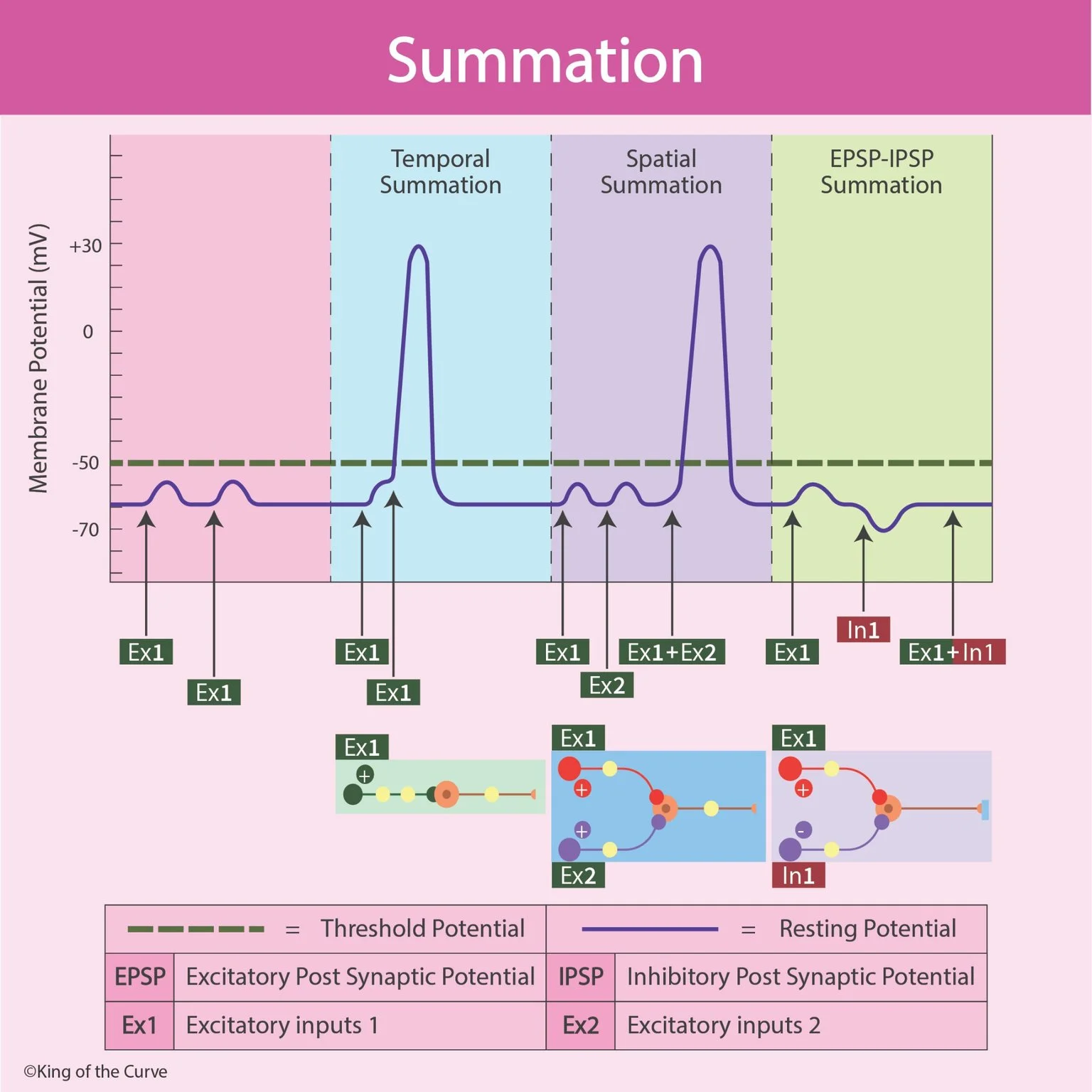
🟢 EPSPs vs. IPSPs
An excitatory postsynaptic potential (EPSP) depolarizes the postsynaptic membrane, moving its potential closer to threshold. An inhibitory postsynaptic potential (IPSP) generally moves the membrane potential away from threshold or stabilizes it against depolarization. Neither an individual EPSP nor an IPSP is itself an action potential; they are graded potentials whose effects can be combined.
⏱️ Temporal Summation
Temporal summation occurs when one presynaptic neuron produces multiple postsynaptic potentials in rapid succession. If the signals arrive before the previous potential has completely faded, their effects overlap. Several subthreshold EPSPs can therefore add together until the postsynaptic membrane reaches threshold.
📍 Spatial Summation
Spatial summation occurs when signals from multiple presynaptic neurons arrive at approximately the same time at different locations on a postsynaptic neuron. Their graded potentials combine as they spread toward the axon hillock. Multiple excitatory inputs can produce enough depolarization to reach threshold even when each input alone is insufficient.
➕ How Excitatory Inputs Combine
EPSPs from different sources can reinforce one another. For example, if excitatory input 1 and excitatory input 2 each produce a small depolarization, simultaneous activation may generate a larger combined depolarization. If this brings the membrane to threshold, voltage-gated channels can initiate an action potential.
➖ How Inhibitory Inputs Affect Summation
Excitatory and inhibitory inputs can also occur together. An IPSP can oppose the effect of an EPSP, reducing the net depolarization at the trigger zone. The neuron therefore integrates the combined effect of its excitatory and inhibitory synaptic inputs, rather than responding independently to every incoming signal.
📊 Temporal vs. Spatial Summation
| 🧠 Feature | ⏱️ Temporal Summation | 📍 Spatial Summation |
|---|---|---|
| Main idea | Signals add over time | Signals add across locations |
| Inputs | Repeated input from the same synapse/source | Inputs from multiple synapses/sources |
| Timing | Rapid succession | Approximately simultaneous |
| Effect | Graded potentials overlap | Graded potentials combine |
| Possible result | Threshold may be reached | Threshold may be reached |
🎯 Threshold and the Action Potential
The axon hillock/initial segment is the major site where integrated synaptic signals influence action-potential initiation. When net depolarization reaches threshold, an action potential is generated according to the all-or-none principle. Increasing the strength of a graded potential does not create a “bigger” action potential; instead, stronger stimulation can affect whether action potentials occur and their firing frequency.
🧪 MCAT High-Yield Takeaway
Remember the distinction: temporal = time; spatial = space. EPSPs generally promote action-potential generation, while IPSPs generally reduce its likelihood. The final neuronal response depends on the integration of these graded signals and whether the membrane at the trigger zone reaches threshold—a classic MCAT connection between membrane potentials, synaptic transmission, and nervous-system physiology.

Frequently Asked Questions (FAQs)
-
Aim for 4-6 focused hours, ensuring you incorporate breaks to avoid burnout.
-
Practice mindfulness techniques, take practice exams under realistic conditions, and maintain a balanced lifestyle.
-
Set short-term goals, seek support from mentors, and reward yourself for small achievements.
-
Regular exercise improves focus, reduces stress, and enhances overall mental clarity.
-
KOTC offers personalized learning tools, gamification features, and adaptive question banks to help students stay on track without burnout.