
👶 Key Fertility Rates and Formulas
Fertility statistics are essential tools in demography, public health, epidemiology, and population studies. They help researchers and policymakers understand reproductive trends, population growth, and reproductive health patterns.
📊 What Is the Birth Rate?
The Birth Rate, also known as the Crude Birth Rate (CBR), measures the number of live births occurring in a population during a specific year relative to the total population.
🧮 Formula
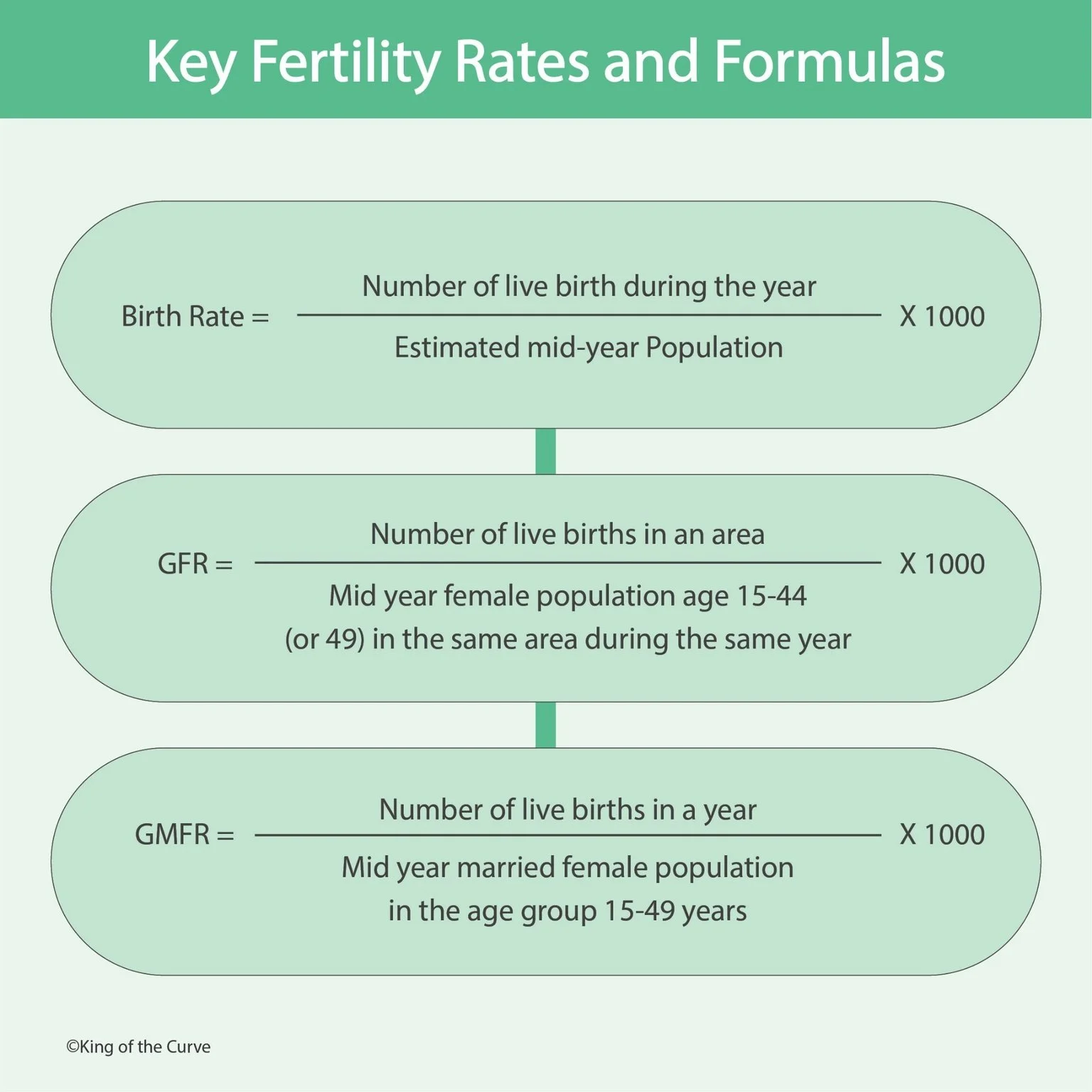
Birth Rate = (Number of live births during the year ÷ Estimated mid-year population) × 1000
🎯 Why It Matters
The birth rate provides a general overview of population growth and reproductive activity.
📝 Example
If a city has:
5,000 live births in one year
A mid-year population of 250,000
Birth Rate = (5,000 ÷ 250,000) × 1000 = 20 births per 1,000 population
👩⚕️ What Is the General Fertility Rate (GFR)?
The General Fertility Rate (GFR) provides a more accurate measure of fertility by focusing only on women of reproductive age rather than the entire population.
🧮 Formula
GFR = (Number of live births in an area ÷ Mid-year female population aged 15–44 or 15–49 years) × 1000
🎯 Why It Matters
GFR focuses specifically on women who are biologically capable of bearing children, making it more precise than the crude birth rate.
📌 Applications
Measuring reproductive patterns
Comparing fertility between regions
Monitoring childbearing trends
Evaluating family planning programs
📝 Example
If:
5,000 live births occur in a year
There are 100,000 women aged 15–49
GFR = (5,000 ÷ 100,000) × 1000 = 50 births per 1,000 women of reproductive age
💍 What Is the General Marital Fertility Rate (GMFR)?
The General Marital Fertility Rate (GMFR) narrows the analysis further by focusing on married women within reproductive age groups.
🧮 Formula
GMFR = (Number of live births in a year ÷ Mid-year married female population aged 15–49 years) × 1000
🎯 Why It Matters
GMFR evaluates fertility specifically among married women, providing valuable demographic insights.
📌 Uses
Demographic research
Marriage and fertility studies
Population policy planning
Sociological analysis
📝 Example
If:
5,000 live births occur during the year
There are 50,000 married women aged 15–49
GMFR = (5,000 ÷ 50,000) × 1000 = 100 births per 1,000 married women
⚖️ Comparing Birth Rate, GFR, and GMFR
| Measure | Population Used | Purpose |
|---|---|---|
| Birth Rate (CBR) | Total population | General population growth indicator |
| General Fertility Rate (GFR) | Women aged 15–44/49 | Measures fertility among women of reproductive age |
| General Marital Fertility Rate (GMFR) | Married women aged 15–49 | Measures fertility among married women |
🌍 Importance of Fertility Indicators
🏛️ Population Planning
Governments use fertility data to forecast population growth and future resource needs.
🏥 Public Health Programs
Health agencies assess maternal and child health services based on fertility patterns.
📈 Economic Forecasting
Population growth influences labor markets, education systems, and healthcare demand.
👨👩👧 Family Planning Evaluation
Fertility indicators help determine the effectiveness of reproductive health initiatives.
⚠️ Limitations of Fertility Rates
📉 Birth Rate
Includes individuals not capable of reproduction in the denominator.
Less precise for fertility analysis.
👩⚕️ General Fertility Rate
Does not account for marital status.
May not fully reflect cultural differences in childbearing patterns.
💍 General Marital Fertility Rate
Less useful in societies where many births occur outside marriage.
Depends on accurate marital status data.
🔑 Key Takeaways
👶 Birth Rate measures live births relative to the total population.
👩⚕️ General Fertility Rate (GFR) measures births among women of reproductive age.
💍 General Marital Fertility Rate (GMFR) measures births among married women aged 15–49.
📊 GFR and GMFR provide more specific fertility insights than the crude birth rate.
🌍 These indicators are widely used in demography, epidemiology, public health, and population studies.
📚 Conclusion
Understanding Birth Rate, General Fertility Rate (GFR), and General Marital Fertility Rate (GMFR) is fundamental for population analysis and public health planning. These fertility indicators help researchers and policymakers evaluate reproductive trends, forecast population growth, and develop effective healthcare strategies.

Frequently Asked Questions (FAQs)
-
Aim for 4-6 focused hours, ensuring you incorporate breaks to avoid burnout.
-
Practice mindfulness techniques, take practice exams under realistic conditions, and maintain a balanced lifestyle.
-
Set short-term goals, seek support from mentors, and reward yourself for small achievements.
-
Regular exercise improves focus, reduces stress, and enhances overall mental clarity.
-
KOTC offers personalized learning tools, gamification features, and adaptive question banks to help students stay on track without burnout.