
💕 Interpersonal Attraction
Interpersonal attraction is a fundamental concept in social psychology that explores why people are drawn to one another and how relationships develop. Attraction influences friendships, romantic partnerships, workplace interactions, and social networks. Researchers have long studied the factors that determine whom we like, trust, and choose to spend time with.
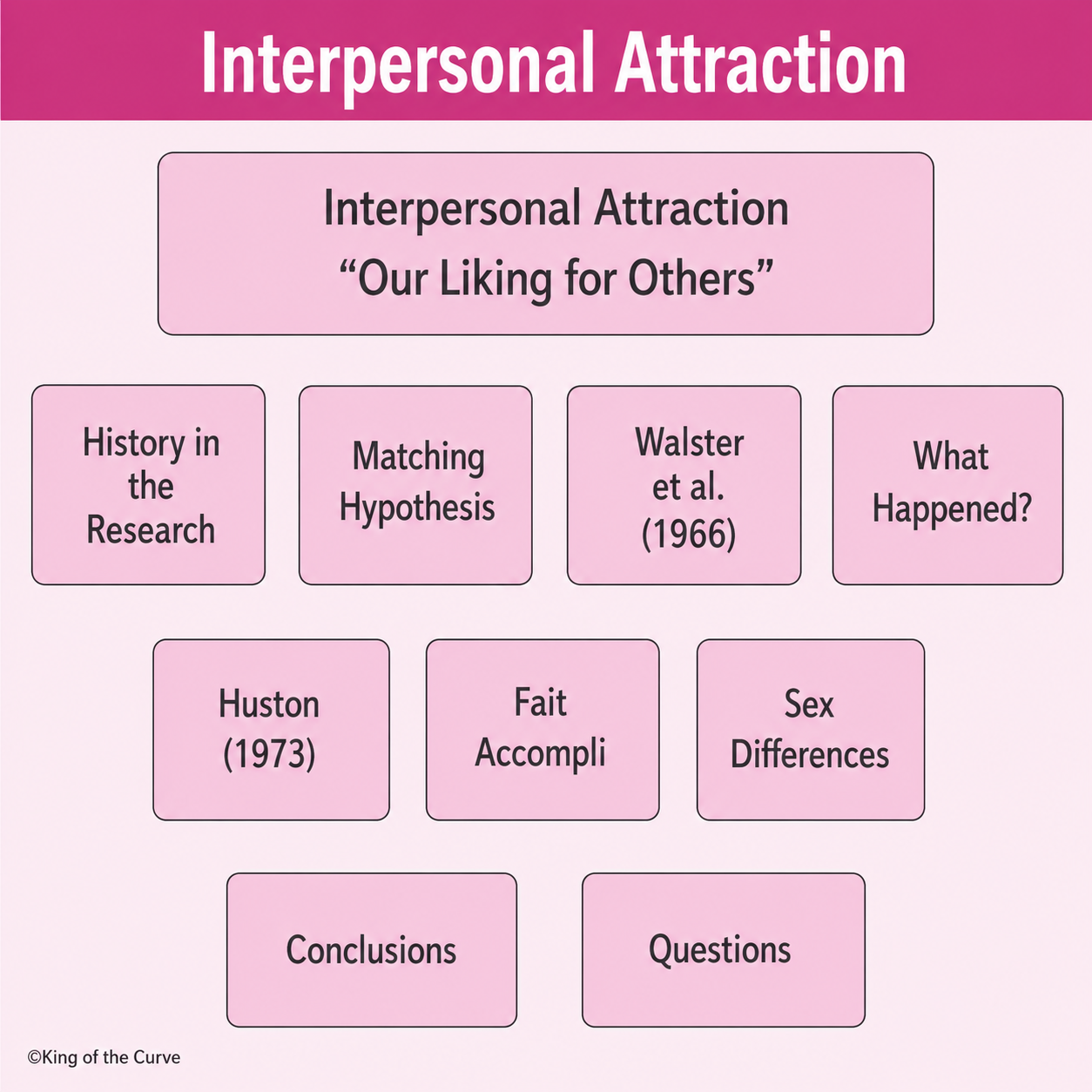
❤️ What Is Interpersonal Attraction?
Interpersonal attraction refers to:
Our liking for, interest in, or positive feelings toward other people.
It encompasses a wide range of relationships, including:
Friendships
Romantic relationships
Family bonds
Professional relationships
Social affiliations
Psychologists seek to understand what causes attraction and why certain individuals become close while others do not.
📚 History of Research on Attraction
Early studies of attraction focused heavily on physical appearance and proximity.
Researchers discovered that attraction is influenced by several factors:
Physical attractiveness
Similarity in attitudes and values
Frequency of interaction
Reciprocity (being liked by others)
Social and cultural influences
Over time, psychologists developed theories explaining how these variables contribute to relationship formation.
⚖️ The Matching Hypothesis
One of the most influential theories of attraction is the Matching Hypothesis.
Definition
The Matching Hypothesis proposes that:
People tend to form romantic relationships with others who are approximately equal to them in physical attractiveness.
Rather than seeking the most attractive partner possible, individuals often choose partners whose attractiveness level is similar to their own.
Why Does Matching Occur?
Possible explanations include:
Reduced risk of rejection
Increased likelihood of acceptance
Greater relationship stability
More realistic expectations
This theory helps explain why couples often appear similar in attractiveness.
🧪 Walster et al. (1966)
Elaine Walster and colleagues conducted one of the most famous studies examining attraction.
The Study
Researchers organized a "computer dance" for college students.
Participants were matched randomly and then evaluated their partners.
Findings
The strongest predictor of attraction was:
✅ Physical attractiveness
Other variables such as:
Intelligence
Personality
Interests
had much less influence during first impressions.
Significance
The study highlighted the powerful role physical appearance plays during initial attraction.
🎯 What Happened Next?
Although Walster et al. demonstrated the importance of attractiveness, later research suggested the findings were incomplete.
Researchers observed that:
Long-term relationships involve more than appearance.
Similarity and compatibility become increasingly important over time.
Relationship satisfaction depends on multiple factors.
This led psychologists to further investigate how attraction evolves after first impressions.
🧠 Huston (1973)
Michael Huston conducted research that provided support for the Matching Hypothesis.
Findings
Huston found that:
Individuals tend to choose partners similar to themselves in attractiveness.
Matching becomes more evident when relationships progress beyond initial encounters.
Perceived likelihood of success influences partner choice.
Importance
His work suggested that attraction involves strategic social decision-making rather than simple preference for maximum attractiveness.
🏆 The Role of Accomplishment
Physical appearance is not the only factor affecting attraction.
People are often attracted to individuals who demonstrate:
Intelligence
Competence
Achievement
Social status
Confidence
Accomplishments can increase perceived attractiveness and influence relationship choices.
Examples
Individuals may be attracted to:
Successful professionals
Talented artists
Skilled athletes
Academic achievers
Achievement often contributes to social desirability.
👥 Sex Differences in Attraction
Research suggests that men and women sometimes emphasize different qualities when evaluating potential partners.
Men Tend to Prioritize
Physical attractiveness
Youthfulness
Visual cues
Women Tend to Prioritize
Resources
Ambition
Stability
Reliability
However, these patterns vary significantly across individuals and cultures.
Modern research emphasizes that attraction is influenced by both biological and social factors.
📊 Major Factors Influencing Attraction
Several variables consistently predict attraction:
🔹 Physical Attractiveness
First impressions are often influenced by appearance.
🔹 Similarity
Shared beliefs, interests, and values increase attraction.
🔹 Proximity
Frequent interaction promotes relationship development.
🔹 Reciprocity
People tend to like those who like them.
🔹 Accomplishment and Competence
Success and achievement can enhance attractiveness.
❓ Questions Raised by Attraction Research
Researchers continue to investigate:
How social media affects attraction
The role of culture in partner selection
Whether attraction changes across the lifespan
How personality influences relationship success
Why some relationships remain stable while others fail
These questions remain active areas of psychological research.
📝 Conclusions
Research on interpersonal attraction demonstrates that relationships are shaped by a combination of physical, psychological, and social factors.
Key findings include:
Physical attractiveness strongly influences first impressions.
People often select partners similar to themselves in attractiveness.
Similarity, reciprocity, and proximity strengthen relationships.
Achievement and competence contribute to attractiveness.
Attraction is complex and influenced by both biological and cultural factors.
Understanding interpersonal attraction provides valuable insight into how human relationships begin, develop, and endure.
🎯 Key Takeaway
Interpersonal attraction refers to our positive feelings toward others and is influenced by factors such as physical attractiveness, similarity, reciprocity, proximity, and personal accomplishments. Research by Walster et al. and Huston helped shape our understanding of the Matching Hypothesis, demonstrating that while appearance matters, successful long-term relationships depend on a much broader combination of social and psychological influences.

Frequently Asked Questions (FAQs)
-
Aim for 4-6 focused hours, ensuring you incorporate breaks to avoid burnout.
-
Practice mindfulness techniques, take practice exams under realistic conditions, and maintain a balanced lifestyle.
-
Set short-term goals, seek support from mentors, and reward yourself for small achievements.
-
Regular exercise improves focus, reduces stress, and enhances overall mental clarity.
-
KOTC offers personalized learning tools, gamification features, and adaptive question banks to help students stay on track without burnout.