
🧪 Hydrochloric Acid Secretion in Gastric Cells
Hydrochloric acid (HCl) plays a crucial role in digestion by creating an acidic environment in the stomach. This acid is secreted by specialized cells known as gastric parietal cells, located in the lining of the stomach. Understanding how HCl is produced helps explain many physiological processes—and even certain diseases.
🧫 What Are Gastric Parietal Cells?
Gastric parietal cells are responsible for secreting:
Hydrochloric acid (HCl)
Intrinsic factor (important for vitamin B₁₂ absorption)
These cells sit between two key environments:
Lumen of the stomach (where acid is released)
Bloodstream (where ions are exchanged)
⚙️ Step-by-Step Mechanism of HCl Secretion
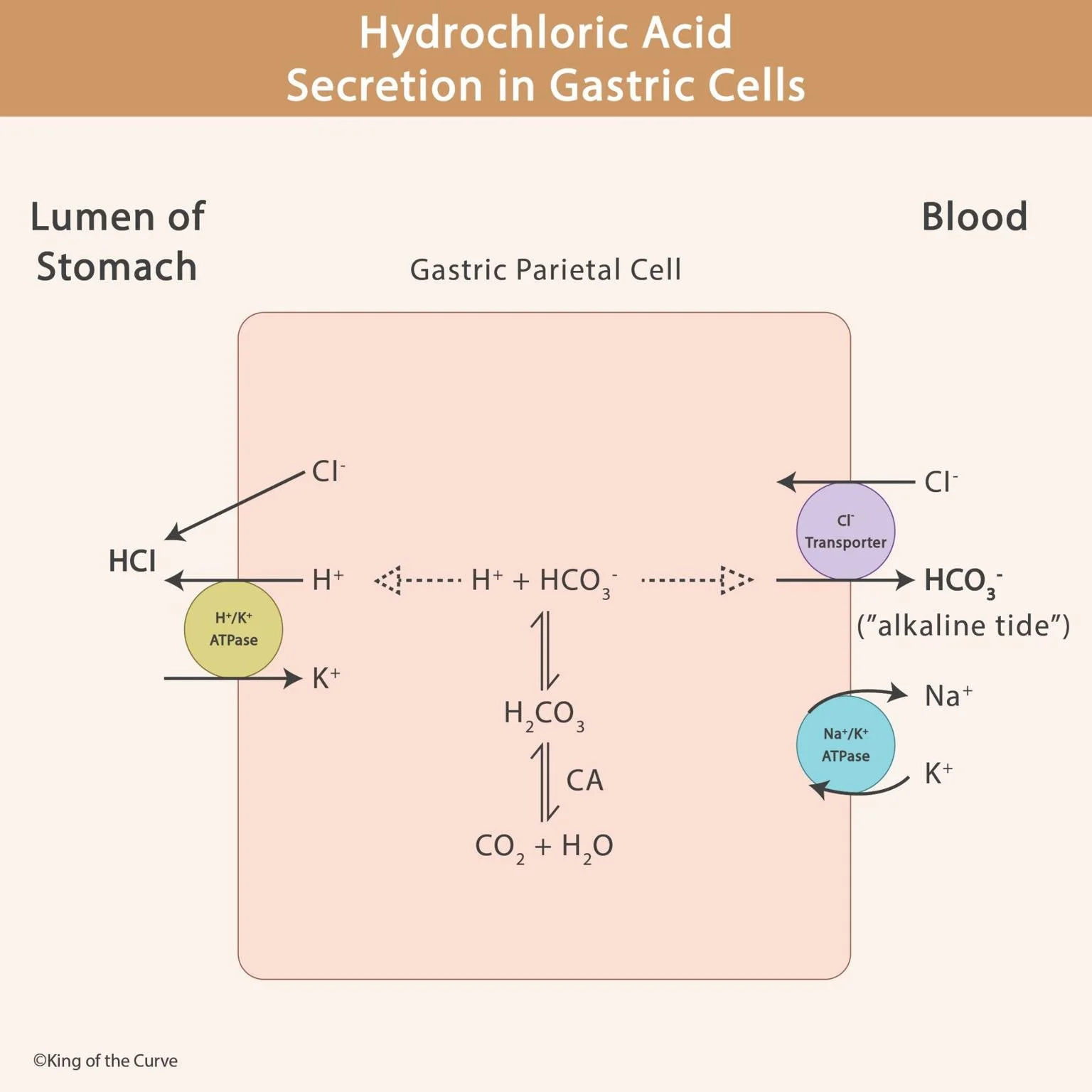
1. Formation of Carbonic Acid
Inside the parietal cell:
Carbon dioxide (CO₂) combines with water (H₂O)
This reaction is catalyzed by the enzyme carbonic anhydrase (CA)
| Chemical Reaction | Description |
|---|---|
| CO2 + H2O ↔ H2CO3 | Carbon dioxide combines with water to form carbonic acid. This reversible reaction is catalyzed by carbonic anhydrase and is essential for bicarbonate reabsorption in the proximal tubule. |
2. Dissociation into Ions
Carbonic acid (H₂CO₃) quickly breaks down into:
Hydrogen ions (H⁺)
Bicarbonate ions (HCO₃⁻)
3. Secretion of Hydrogen Ions (H⁺)
Hydrogen ions are actively pumped into the stomach lumen
This occurs via the H⁺/K⁺ ATPase pump (also called the proton pump)
👉 This is the key step in acid production
4. Chloride Ion (Cl⁻) Movement
Chloride ions enter the cell from the blood via a Cl⁻ transporter
They then diffuse into the stomach lumen
5. Formation of Hydrochloric Acid (HCl)
In the stomach lumen:
H⁺ + Cl⁻ → HCl
This creates the highly acidic environment needed for digestion.
🔄 The “Alkaline Tide”
While acid is secreted into the stomach, something interesting happens in the blood:
Bicarbonate (HCO₃⁻) is transported into the bloodstream
This causes a temporary increase in blood pH after meals
👉 This phenomenon is called the alkaline tide
🔁 Role of Other Transporters
🔹 Na⁺/K⁺ ATPase Pump
Maintains ion balance inside the cell
Pumps sodium (Na⁺) out and potassium (K⁺) in
🔹 Cl⁻ Transporter
Exchanges bicarbonate for chloride ions
Essential for continuous acid production
🩺 Clinical Relevance
Understanding this mechanism is important in medicine:
💊 Proton Pump Inhibitors (PPIs)
Drugs like omeprazole block the H⁺/K⁺ ATPase
Used to treat:
Acid reflux (GERD)
Peptic ulcers
⚠️ Disorders
Overproduction → ulcers, acid reflux
Underproduction → digestion issues, infections
📌 Summary
HCl is produced by gastric parietal cells
Key enzyme: carbonic anhydrase
Key transporter: H⁺/K⁺ ATPase
Bicarbonate release into blood causes the alkaline tide

Frequently Asked Questions (FAQs)
-
Aim for 4-6 focused hours, ensuring you incorporate breaks to avoid burnout.
-
Practice mindfulness techniques, take practice exams under realistic conditions, and maintain a balanced lifestyle.
-
Set short-term goals, seek support from mentors, and reward yourself for small achievements.
-
Regular exercise improves focus, reduces stress, and enhances overall mental clarity.
-
KOTC offers personalized learning tools, gamification features, and adaptive question banks to help students stay on track without burnout.