
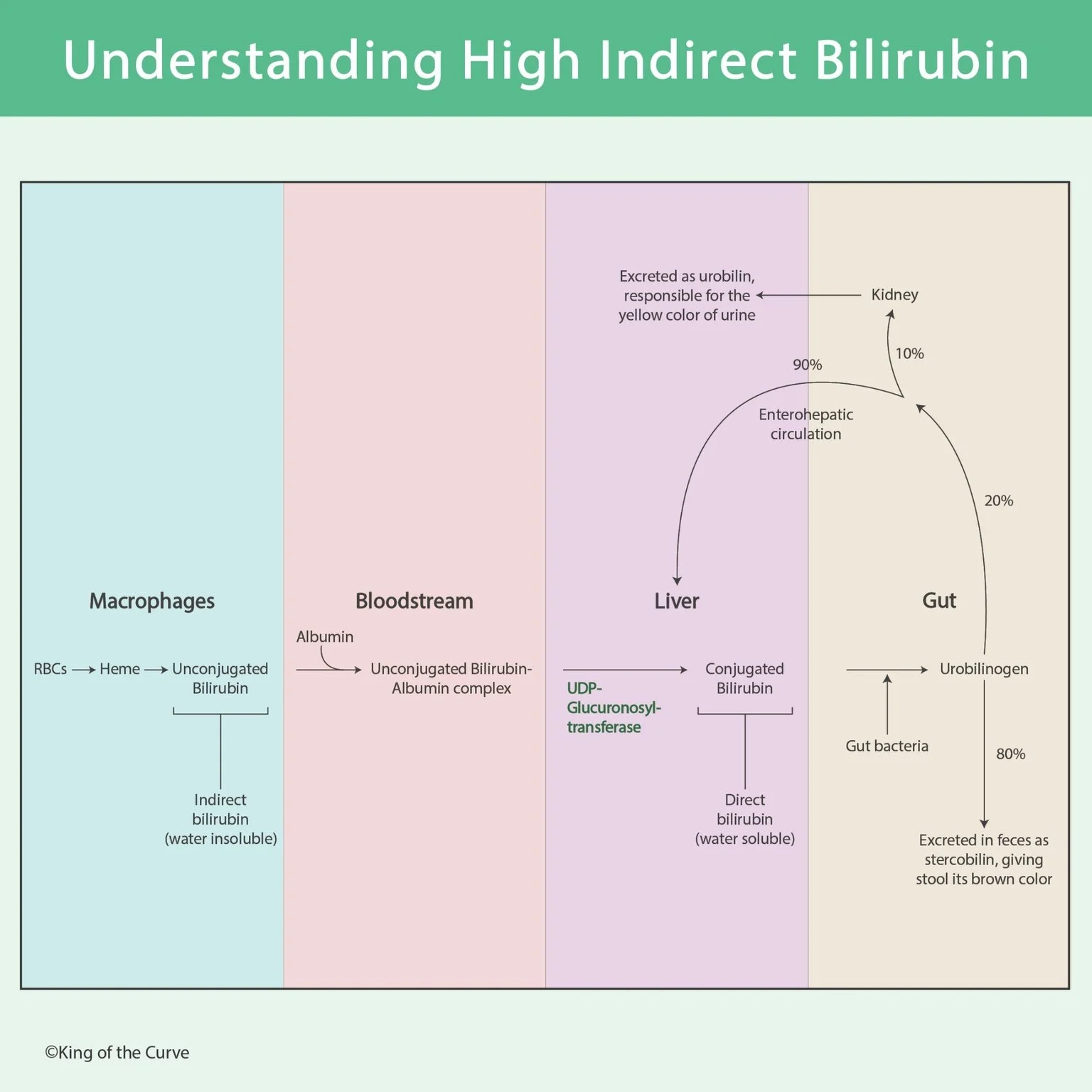
Bilirubin is produced mainly during the breakdown of old red blood cells. Macrophages degrade hemoglobin, releasing heme, which is ultimately converted into unconjugated bilirubin. This form is also called indirect bilirubin and is not water-soluble.
🚚 How Is Indirect Bilirubin Transported?
Because unconjugated bilirubin is poorly soluble in water, it travels through the bloodstream bound to albumin. Albumin carries it to the liver, where it can undergo further processing. This distinction between albumin-bound indirect bilirubin and water-soluble direct bilirubin is important for understanding jaundice.
🧬 What Happens in the Liver?
Hepatocytes take up unconjugated bilirubin and conjugate it primarily with glucuronic acid. The enzyme UDP-glucuronosyltransferase (UGT1A1) performs this reaction. Conjugation makes bilirubin water-soluble, producing conjugated (direct) bilirubin, which can then be secreted into bile.
🦠 What Happens in the Gut?
Conjugated bilirubin reaches the intestine through bile, where gut bacteria metabolize it into urobilinogen. Most intestinal bilirubin-derived pigment is ultimately eliminated in feces, primarily as stercobilin, which contributes to the characteristic brown color of stool.
🔄 Enterohepatic Circulation
Some urobilinogen is reabsorbed from the intestine into the portal circulation. Much of this returns to the liver and is re-excreted into bile, creating enterohepatic circulation. A smaller fraction reaches the systemic circulation and is filtered by the kidneys.
🚽 Why Is Urine Yellow?
Urobilinogen reaching the kidneys can be excreted in urine and oxidized to urobilin, a pigment that contributes to urine's yellow color. Unconjugated bilirubin itself is albumin-bound and therefore is not normally filtered into urine—an important distinction when interpreting bilirubin abnormalities.
⚠️ What Causes High Indirect Bilirubin?
Elevated indirect bilirubin generally results from increased bilirubin production, impaired hepatic uptake, or impaired conjugation. Examples include hemolysis, Gilbert syndrome, and Crigler–Najjar syndrome. The underlying mechanism determines how severe the bilirubin elevation becomes.
📊 Direct vs. Indirect Bilirubin
| 🧪 Feature | 🟡 Indirect Bilirubin | 🟢 Direct Bilirubin |
|---|---|---|
| Other name | Unconjugated bilirubin | Conjugated bilirubin |
| Water solubility | Poorly water-soluble | Water-soluble |
| Blood transport | Bound to albumin | Less tightly albumin-bound |
| Processing | Before hepatic conjugation | After hepatic conjugation |
| Urine detection | Normally absent | May appear when elevated |
| Common elevation | Hemolysis, impaired conjugation | Cholestasis, biliary obstruction |
🧠 MCAT High-Yield Takeaway
For the MCAT, remember the pathway: RBC breakdown → unconjugated bilirubin → albumin transport → liver conjugation → conjugated bilirubin → bile → intestine → urobilinogen → stercobilin/urobilin. High indirect bilirubin points toward excess production or difficulty getting bilirubin conjugated, while high direct bilirubin more often suggests impaired excretion or bile flow.

Frequently Asked Questions (FAQs)
-
Aim for 4-6 focused hours, ensuring you incorporate breaks to avoid burnout.
-
Practice mindfulness techniques, take practice exams under realistic conditions, and maintain a balanced lifestyle.
-
Set short-term goals, seek support from mentors, and reward yourself for small achievements.
-
Regular exercise improves focus, reduces stress, and enhances overall mental clarity.
-
KOTC offers personalized learning tools, gamification features, and adaptive question banks to help students stay on track without burnout.