
🧪 Essential Functional Groups You Must Know
Functional groups are the foundation of organic chemistry. If you can recognize them quickly, you can predict reactivity, polarity, acidity, and biological function all of which are heavily tested on the MCAT, NCLEX, and USMLE.
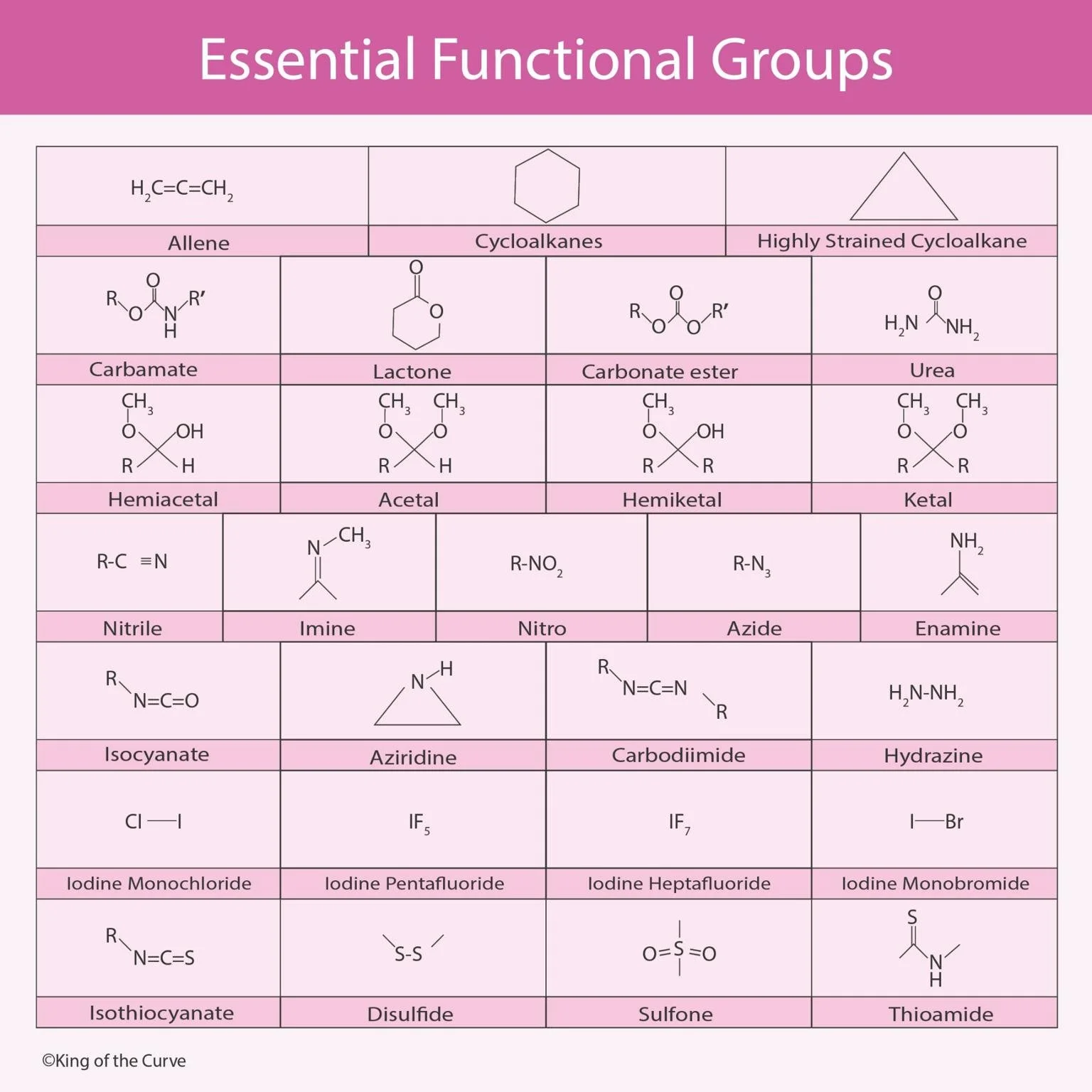
🧠 Big Picture: Why Functional Groups Matter
Each functional group determines how a molecule behaves:
Polarity → affects solubility
Reactivity → determines reaction pathways
Acidity/basicity → critical for biochemistry
Biological role → drugs, enzymes, metabolism
💡 MCAT Insight:
Most questions won’t ask you to name the group—they’ll test whether you understand how it behaves.
🔬 High-Yield Categories to Master
Instead of memorizing 20+ groups randomly, organize them into patterns:
🔹 Carbonyl Derivatives
Carbamate
Lactone
Carbonate ester
Urea
👉 These often appear in biochemistry and drug metabolism
🔹 Acetal & Ketal Family
Hemiacetal / Hemiketal
Acetal / Ketal
💡 MCAT Tip:
Hemi- = one OR + one OH
Full (acetal/ketal) = two OR groups
👉 Important in carbohydrates and sugar chemistry
🔹 Nitrogen-Containing Groups
Nitrile
Imine
Enamine
Azide
Nitro
💡 These show up in:
Amino acid chemistry
Reaction intermediates
Pharmaceutical compounds
🔹 Special Reactive Groups
Isocyanate
Carbodiimide
Hydrazine
Isothiocyanate
👉 Frequently tested in:
Bioconjugation reactions
Protein chemistry
🔹 Sulfur-Containing Groups
Disulfide
Sulfone
Thioamide
💡 High-Yield Concept:
Disulfide bonds stabilize protein structure (tertiary structure)
🔹 Ring Strain & Hydrocarbon Structures
Allene
Cycloalkanes
Highly strained rings
👉 Expect questions on:
Stability
Angle strain
Reactivity
⚡ MCAT Pattern Recognition Strategy
Instead of memorizing structures, train yourself to spot:
C=O → Carbonyl family
C≡N → Nitrile
N double bonds → Imine/Enamine
S-S → Disulfide
Two OR groups → Acetal/Ketal
🎯 How This Appears on Exams
You might see:
A reaction → identify intermediate (imine, enamine)
A biological molecule → identify functional group
A passage → predict reactivity based on structure
💡 Example:
If you see C≡N, think:
👉 Polar + electrophilic carbon → nucleophilic attack
🏁 Conclusion
Functional groups are not just memorization—they’re the language of organic chemistry.
Once you recognize patterns, you can:
Predict reactions
Understand biological molecules
Solve MCAT passages faster

Frequently Asked Questions (FAQs)
-
Aim for 4-6 focused hours, ensuring you incorporate breaks to avoid burnout.
-
Practice mindfulness techniques, take practice exams under realistic conditions, and maintain a balanced lifestyle.
-
Set short-term goals, seek support from mentors, and reward yourself for small achievements.
-
Regular exercise improves focus, reduces stress, and enhances overall mental clarity.
-
KOTC offers personalized learning tools, gamification features, and adaptive question banks to help students stay on track without burnout.