
🧠 Elaboration Likelihood Model (ELM): How We Are Persuaded
The Elaboration Likelihood Model (ELM) is a psychological theory that explains how people process persuasive information and how their attitudes and behaviors change as a result. Developed by Richard Petty and John Cacioppo, this model highlights that persuasion doesn’t happen in just one way it follows two distinct pathways: the central route and the peripheral route.
📢 What is the Elaboration Likelihood Model?
At its core, ELM suggests that when we receive a message (communication), we process it based on:
Motivation (Do we care?)
Ability (Can we understand it?)
This determines whether we engage in deep thinking or rely on surface-level cues.
🔄 The Two Routes of Persuasion
🟢 Central Route (High-Cognitive Processing)
This route involves careful and thoughtful evaluation of the message.
Key Features:
High attention and comprehension
Logical reasoning and analysis
Evaluation of arguments
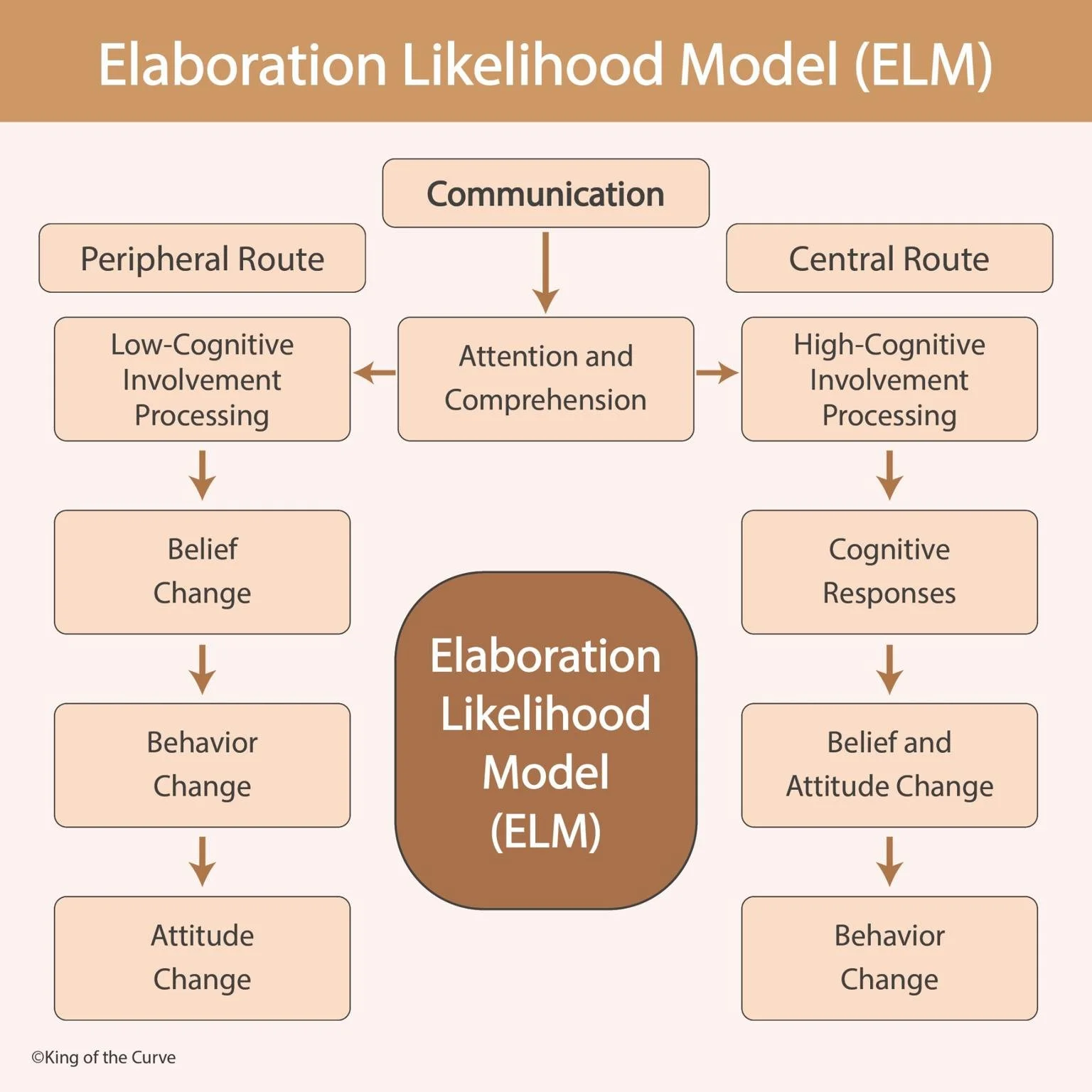
Process (from the diagram):
Communication
Attention and comprehension
High-cognitive involvement processing
Cognitive responses
Belief and attitude change
Behavior change
💡 Outcome:
Strong, long-lasting attitude change
Resistant to future persuasion
📌 Example:
A medical student critically analyzing research before accepting a new treatment guideline.
🔵 Peripheral Route (Low-Cognitive Processing)
This route relies on superficial cues rather than deep thinking.
Key Features:
Low attention or interest
Use of shortcuts (heuristics)
Influenced by emotions, attractiveness, or authority
Process (from the diagram):
Communication
Limited attention
Low-cognitive involvement processing
Belief change
Behavior change
Attitude change
💡 Outcome:
Temporary attitude change
Easily influenced or reversed
📌 Example:
Buying a product because a celebrity endorses it.
⚖️ Central vs Peripheral Route
| Feature | Central Route | Peripheral Route |
|---|---|---|
| Thinking level | High | Low |
| Focus | Message quality | External cues |
| Attitude change | Strong & lasting | Weak & temporary |
| Effort required | High | Low |
| Example | Research-based decision | Influencer-based decision |
🔍 Why “Attention and Comprehension” Matters
In the diagram, attention and comprehension sit at the center. This is crucial because:
Without attention → no processing
Without understanding → no persuasion
It acts as the gateway that determines which route the brain will take.
🚀 Real-World Applications of ELM
📚 Education
Deep learning uses the central route
Memorization often uses the peripheral route
📢 Marketing
Detailed ads → central route
Celebrity endorsements → peripheral route
🏥 Healthcare
Patient education requires central processing for lasting behavior change
🗳️ Politics
Policy debates → central route
Slogans and visuals → peripheral route
🧩 Key Takeaways
ELM explains how persuasion works
Two routes: Central (deep) and Peripheral (surface)
Central route → strong, lasting change
Peripheral route → quick but temporary change
Attention and comprehension determine the path

Frequently Asked Questions (FAQs)
-
Aim for 4-6 focused hours, ensuring you incorporate breaks to avoid burnout.
-
Practice mindfulness techniques, take practice exams under realistic conditions, and maintain a balanced lifestyle.
-
Set short-term goals, seek support from mentors, and reward yourself for small achievements.
-
Regular exercise improves focus, reduces stress, and enhances overall mental clarity.
-
KOTC offers personalized learning tools, gamification features, and adaptive question banks to help students stay on track without burnout.