
🧠 Correspondent Inference Theory Explained
Understanding why people behave the way they do is a core part of psychology. Correspondent Inference Theory, proposed by Jones and Davis, helps explain how we infer a person’s internal traits based on their actions.
🔍 What is Correspondent Inference Theory?
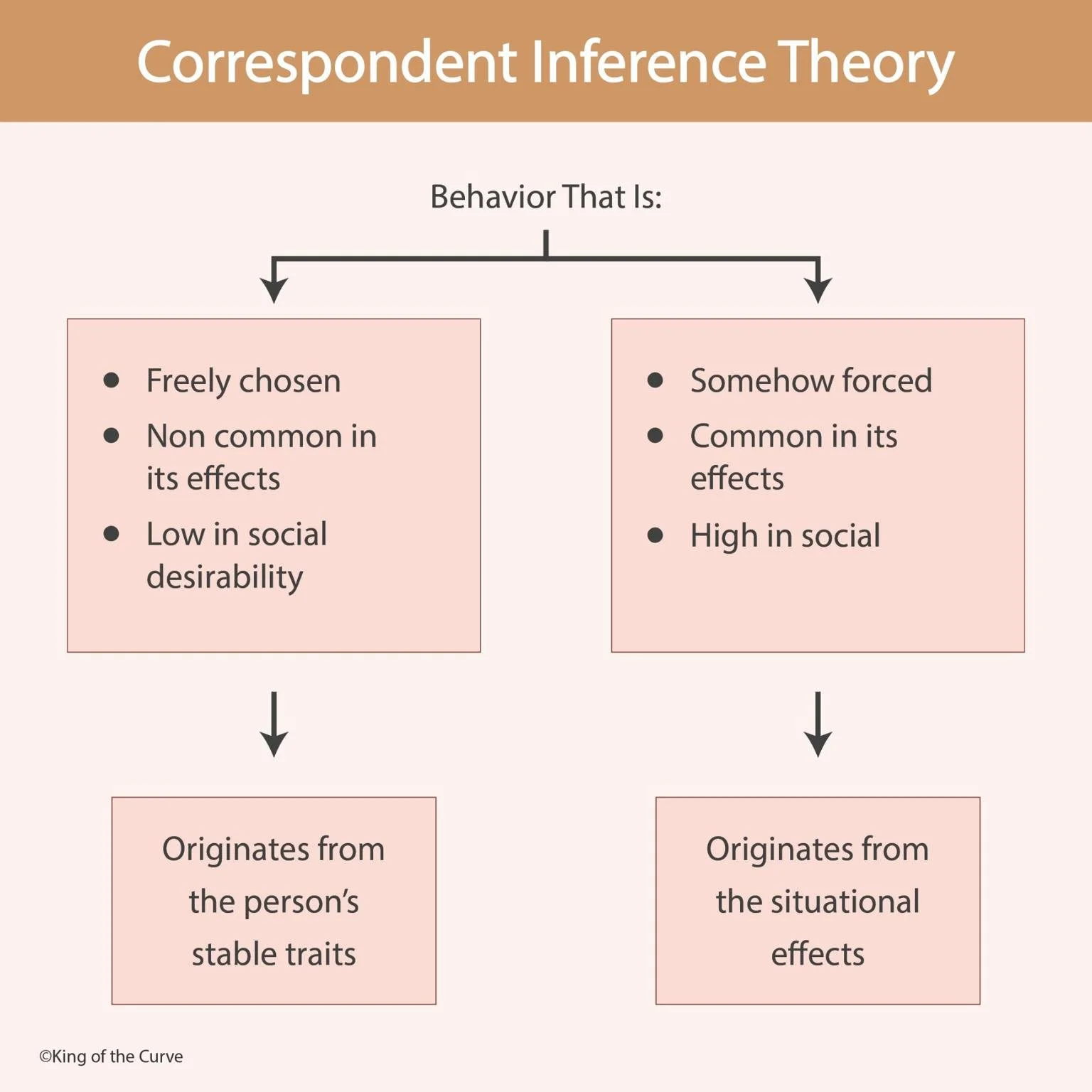
Correspondent Inference Theory suggests that we are more likely to attribute someone’s behavior to their personality (disposition) rather than external circumstances when certain conditions are met.
👉 In simple terms:
We try to decide whether behavior reflects who a person really is.
⚖️ When Do We Make Strong Internal (Dispositional) Attributions?
We are more likely to assume behavior reflects a person’s true character when it is:
✅ Freely Chosen
The person had a choice in their actions
No obvious external pressure
✅ Non-Common Effects
The behavior leads to unique or unusual outcomes
Not something everyone would do
✅ Low in Social Desirability
The behavior is not socially approved
It may even be surprising or unpopular
👉 Conclusion:
In such cases, we infer that the behavior originates from the person’s stable traits.
⚠️ When Do We Attribute Behavior to Situational Factors?
We are less likely to judge behavior as reflecting personality when it is:
❌ Forced or Constrained
The person had little or no choice
❌ Common in Its Effects
Many people would behave the same way
❌ High in Social Desirability
The behavior is expected or socially approved
👉 Conclusion:
Here, behavior is seen as arising from situational influences, not personality.
🔄 Key Idea Behind the Theory
The theory focuses on identifying behaviors that are:
Intentional
Freely chosen
Informative about personality
The fewer alternative explanations there are for a behavior, the more confidently we link it to internal traits.
📊 Quick Comparison Table
| Behavior Characteristics | Attribution Type | Conclusion |
|---|---|---|
| Freely chosen | Internal | Reflects personality |
| Non-common effects | Internal | Unique trait indicator |
| Low social desirability | Internal | True character revealed |
| Forced behavior | External | Situational cause |
| Common effects | External | Not unique |
| High social desirability | External | Social expectation |
🧠 Real-Life Example
Imagine someone donates money anonymously:
Not socially pressured ✔️
Not done for recognition ✔️
Rare behavior ✔️
👉 You’re likely to think:
“They are genuinely generous.”
But if someone donates publicly during a campaign:
👉 You may think:
“They did it because of social pressure.”
🎯 Final Takeaway
👉 We infer personality when behavior is intentional, unique, and not socially expected
👉 We infer situation when behavior is forced, common, or socially desirable
Correspondent Inference Theory helps us understand how we judge others’ character, often quickly and subconsciously.

Frequently Asked Questions (FAQs)
-
Aim for 4-6 focused hours, ensuring you incorporate breaks to avoid burnout.
-
Practice mindfulness techniques, take practice exams under realistic conditions, and maintain a balanced lifestyle.
-
Set short-term goals, seek support from mentors, and reward yourself for small achievements.
-
Regular exercise improves focus, reduces stress, and enhances overall mental clarity.
-
KOTC offers personalized learning tools, gamification features, and adaptive question banks to help students stay on track without burnout.