
🧪 Bicarbonate Reabsorption in the Proximal Tubule
Bicarbonate (HCO₃⁻) is one of the body’s most important buffers, helping maintain blood pH within a narrow physiological range. Because bicarbonate is freely filtered at the glomerulus, the kidneys must efficiently reclaim it rather than allow large amounts to disappear into the urine. Most filtered bicarbonate is reabsorbed in the proximal tubule, making this process an essential renal physiology concept.
🩺 Why Bicarbonate Reabsorption Matters
The bicarbonate buffer system helps regulate acid-base balance through the relationship CO₂ + H₂O ⇌ H₂CO₃ ⇌ H⁺ + HCO₃⁻. The lungs regulate CO₂, while the kidneys regulate bicarbonate and H⁺ over a longer timescale. Reclaiming filtered HCO₃⁻ therefore helps preserve the body’s buffering capacity and maintain normal extracellular pH.
🔄 The First Step: H⁺ Secretion
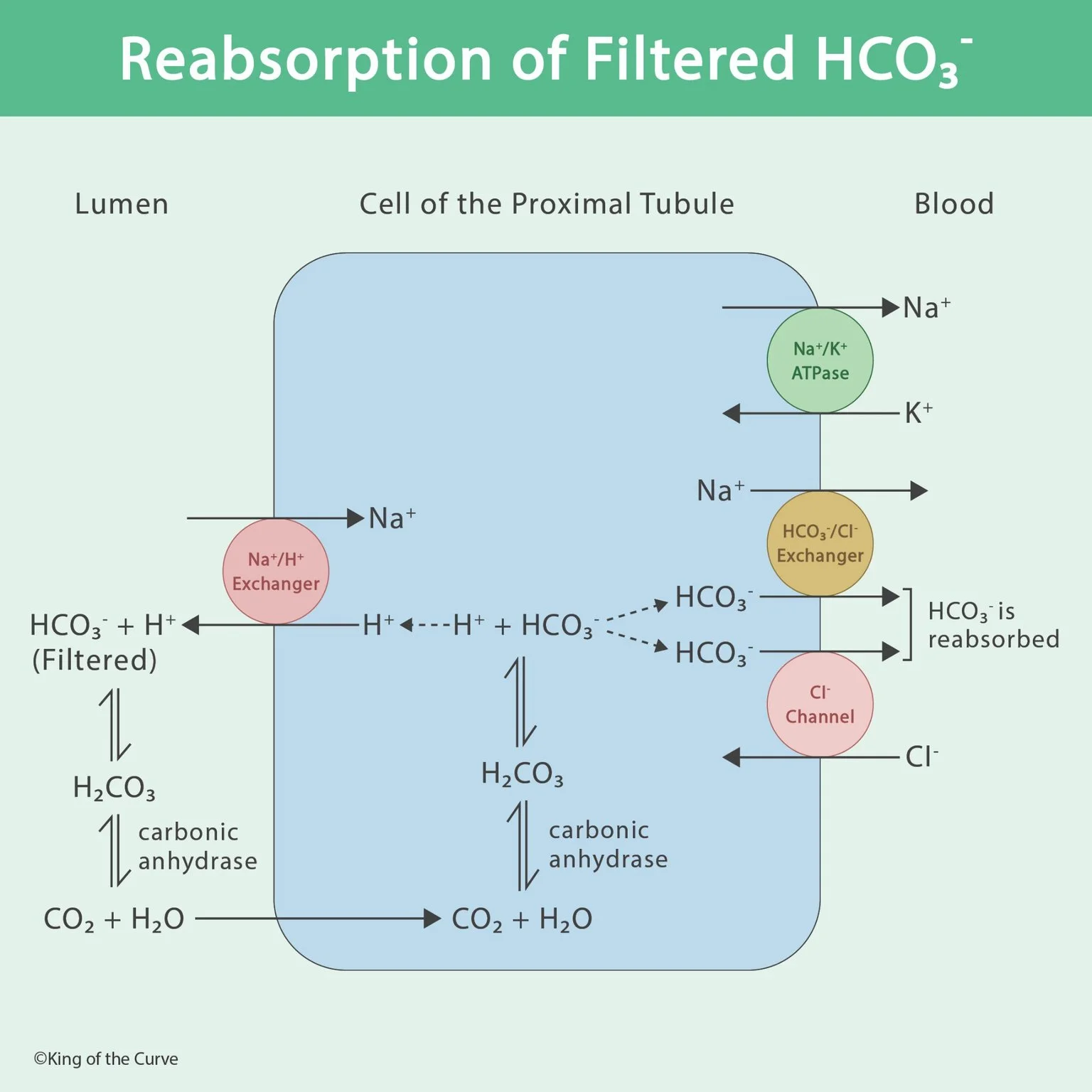
At the apical membrane of the proximal tubular cell, the Na⁺/H⁺ exchanger moves Na⁺ from the tubular lumen into the cell while secreting H⁺ into the lumen. The secreted H⁺ combines with filtered bicarbonate to form carbonic acid (H₂CO₃). This step allows filtered bicarbonate to be indirectly reclaimed rather than simply transported unchanged across the apical membrane.
🧬 Carbonic Anhydrase Drives the Cycle
Luminal carbonic anhydrase facilitates the conversion of H₂CO₃ into CO₂ + H₂O. CO₂ can then diffuse across the cell membrane into the proximal tubular cell. Intracellular carbonic anhydrase reverses the process, generating H₂CO₃, which dissociates into H⁺ and HCO₃⁻. The H⁺ can be secreted again, allowing the cycle to continue.
🩸 How Bicarbonate Returns to the Blood
The newly formed intracellular bicarbonate exits across the basolateral membrane and enters the interstitium and ultimately the blood. In proximal-tubule physiology, a major route is Na⁺-HCO₃⁻ cotransport. Meanwhile, the basolateral Na⁺/K⁺-ATPase maintains the sodium gradient that indirectly powers Na⁺-dependent transport across the tubular cell.
📊 Key Steps to Remember
The complete pathway becomes easier when each location, molecule, and transporter is considered separately.
| 🔬 Location | ⚙️ Main Event | 🧪 Key Molecules / Transporter | 🎯 Result |
|---|---|---|---|
| Tubular lumen | H⁺ combines with filtered bicarbonate | H⁺ + HCO₃⁻ | H₂CO₃ forms |
| Luminal surface | Carbonic acid is converted | Carbonic anhydrase | CO₂ + H₂O |
| Proximal tubular cell | Bicarbonate is regenerated | Carbonic anhydrase | H⁺ + HCO₃⁻ |
| Apical membrane | H⁺ is secreted | Na⁺/H⁺ exchanger | H⁺ recycled |
| Basolateral membrane | Bicarbonate moves toward blood | Na⁺-HCO₃⁻ cotransport | HCO₃⁻ reclaimed |
💊 Why Carbonic Anhydrase Is Clinically Important
Carbonic anhydrase inhibitors, such as acetazolamide, reduce proximal bicarbonate reabsorption. More bicarbonate consequently remains in the tubular fluid and can be excreted, increasing urinary bicarbonate and tending to make the urine more alkaline. This connection between a biochemical enzyme and renal acid-base physiology is especially useful when integrating physiology with pharmacology.
🧠 MCAT Strategy: Follow the Compartments
For an MCAT-style passage, identify the three compartments first: tubular lumen → proximal tubular cell → blood. Then follow carbon: filtered HCO₃⁻ becomes H₂CO₃, then CO₂, and intracellularly returns to HCO₃⁻. Also remember that the secreted H⁺ is largely recycled during filtered bicarbonate reclamation rather than representing equivalent net acid excretion.
🎯 Turn Renal Physiology Into a Visual Pathway
Instead of memorizing isolated arrows, remember the sequence HCO₃⁻ + H⁺ → H₂CO₃ → CO₂ + H₂O → H₂CO₃ → H⁺ + HCO₃⁻. That sequence connects carbonic anhydrase, membrane transport, and acid-base regulation into one logical pathway. Explore more high-yield MCAT science illustrations and practice resources at mcat.kingofthecurve.org to reinforce renal physiology and other frequently tested concepts.

Frequently Asked Questions (FAQs)
-
Aim for 4-6 focused hours, ensuring you incorporate breaks to avoid burnout.
-
Practice mindfulness techniques, take practice exams under realistic conditions, and maintain a balanced lifestyle.
-
Set short-term goals, seek support from mentors, and reward yourself for small achievements.
-
Regular exercise improves focus, reduces stress, and enhances overall mental clarity.
-
KOTC offers personalized learning tools, gamification features, and adaptive question banks to help students stay on track without burnout.