
Autoantibodies are antibodies that recognize the body’s own molecules or tissues. Some contribute directly to tissue injury, while others serve mainly as markers of an autoimmune process. Testing can help identify patterns associated with particular diseases, but a positive result alone does not establish a diagnosis. Symptoms, examination findings, and other investigations provide the context needed to interpret the result.
🎯 Specificity and Sensitivity: Different Questions
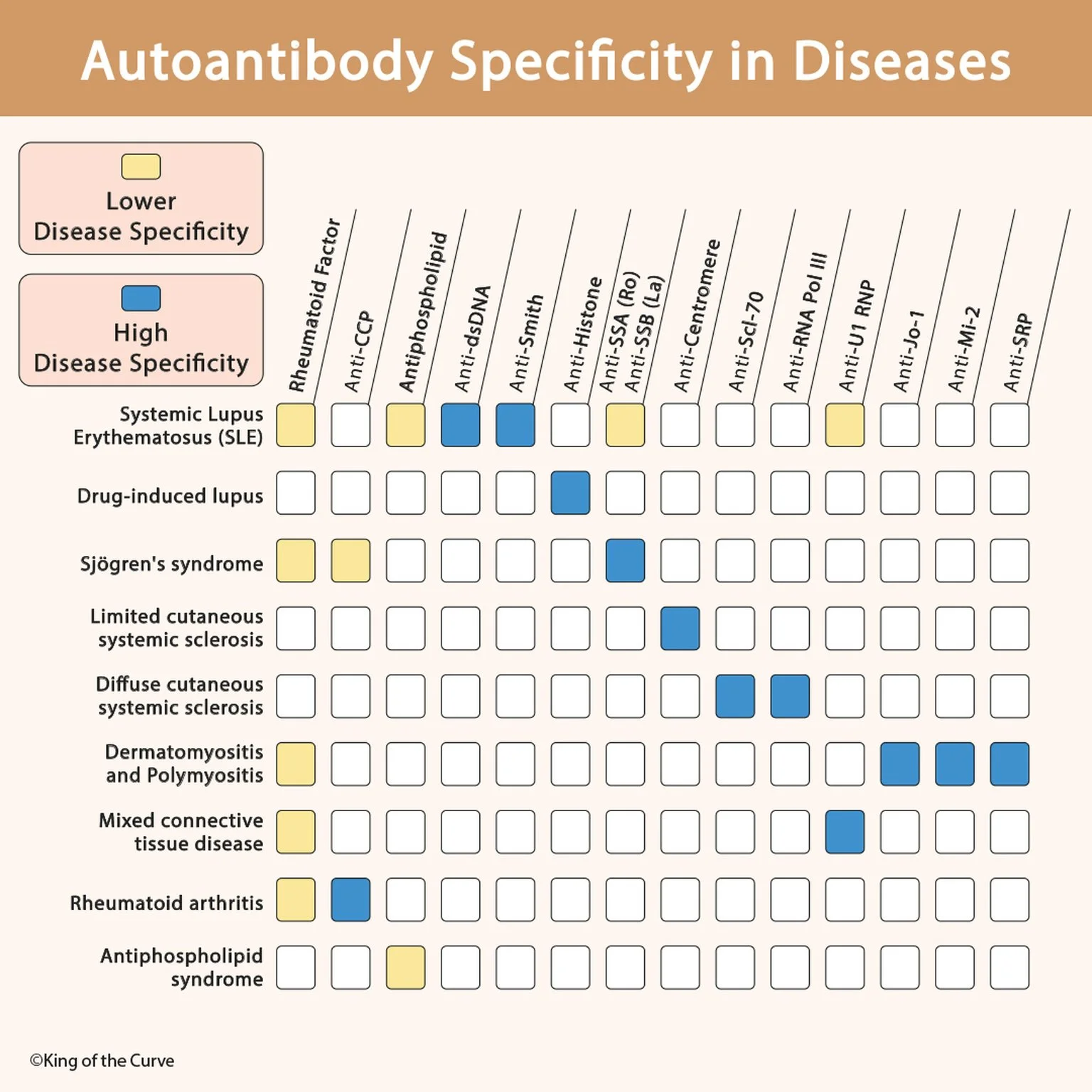
Specificity describes how well a test remains negative in people without the disease being considered. Sensitivity describes how often it is positive in people who have that disease. A highly specific antibody may support a diagnosis when the clinical picture fits, yet its absence may not exclude the condition. The chart’s color categories simplify these relationships; actual test performance depends on the antibody, testing method, and comparison population.
🦋 Lupus and Drug-Induced Lupus
Anti-double-stranded DNA (anti-dsDNA) and anti-Smith (anti-Sm) antibodies are strongly associated with systemic lupus erythematosus (SLE). Anti-dsDNA can also help assess disease activity in some patients, particularly alongside kidney findings and complement levels. Antihistone antibodies are classically associated with drug-induced lupus, but they also occur in SLE and other conditions. Medication exposure and the clinical presentation are therefore essential to interpretation.
💧 Sjögren Syndrome and Rheumatoid Arthritis
Anti-SSA/Ro and anti-SSB/La antibodies are associated with Sjögren syndrome, which commonly causes dry eyes and dry mouth. These antibodies also occur in SLE, so they are not exclusive to Sjögren syndrome. For rheumatoid arthritis, anti-cyclic citrullinated peptide (anti-CCP) antibodies are generally more specific than rheumatoid factor. Rheumatoid factor can also occur in Sjögren syndrome, infections, and people without rheumatoid arthritis.
📊 Major Autoantibodies and Their Associations
Antibody associations are most useful when paired with characteristic clinical findings. Several antibodies help identify disease subtypes rather than simply distinguishing one disease from every other condition.
| Autoantibody | Main Disease Association | Important Interpretation |
|---|---|---|
| Anti-dsDNA | Systemic lupus erythematosus | May correlate with activity and kidney involvement in some patients |
| Anti-Smith | Systemic lupus erythematosus | Highly specific but has limited sensitivity |
| Antihistone | Drug-induced lupus | Also occurs in SLE and other conditions |
| Anti-SSA/Ro | Sjögren syndrome and SLE | Not exclusive to either disease |
| Anti-SSB/La | Sjögren syndrome, often with anti-SSA/Ro | An isolated positive result has limited diagnostic value |
| Anticentromere | Limited cutaneous systemic sclerosis | Supports a characteristic systemic sclerosis phenotype |
| Anti-Scl-70 | Systemic sclerosis, often diffuse cutaneous disease | Also associated with interstitial lung disease |
| Anti-RNA polymerase III | Systemic sclerosis, often diffuse cutaneous disease | Associated with increased risk of scleroderma renal crisis |
| Anti-U1 RNP | Mixed connective tissue disease | Also occurs in SLE and overlap syndromes |
| Anti-CCP | Rheumatoid arthritis | More specific than rheumatoid factor |
| Anti-Jo-1 | Antisynthetase syndrome | Associated with myositis and interstitial lung disease |
| Anti-Mi-2 | Dermatomyositis | Associated with characteristic skin and muscle involvement |
| Anti-SRP | Immune-mediated necrotizing myopathy | More precise than grouping it broadly with dermatomyositis |
| Antiphospholipid antibodies | Antiphospholipid syndrome and sometimes SLE | Require interpretation alongside clinical events and persistent positivity |
🖐️ Systemic Sclerosis: Antibodies Help Identify Patterns
Anticentromere antibodies are most closely associated with limited cutaneous systemic sclerosis. Anti-Scl-70, also called anti-topoisomerase I, and anti-RNA polymerase III are more common in diffuse cutaneous disease. These associations are not absolute boundaries between subtypes. Antibody profiles can also provide clues about potential organ involvement, making them useful beyond the initial diagnostic evaluation.
💪 Myositis Antibodies: Distinguishing Related Conditions
The chart combines dermatomyositis and polymyositis, but the listed antibodies represent different inflammatory muscle disease patterns. Anti-Jo-1 is associated with antisynthetase syndrome, which may involve muscle inflammation, lung disease, arthritis, and mechanic’s hands. Anti-Mi-2 is associated with dermatomyositis. Anti-SRP is most closely linked to immune-mediated necrotizing myopathy, making a single shared disease label an oversimplification.
🔗 Anti-U1 RNP and Mixed Connective Tissue Disease
Anti-U1 ribonucleoprotein (anti-U1 RNP) antibodies are a defining serologic feature of mixed connective tissue disease. This condition combines clinical features that can resemble lupus, systemic sclerosis, and inflammatory myopathy. However, anti-U1 RNP also occurs in other autoimmune diseases. Its presence must therefore be assessed alongside an appropriate combination of clinical findings rather than treated as a diagnosis by itself.
🩸 Antiphospholipid Antibodies and Clinical Context
The principal antiphospholipid tests assess lupus anticoagulant, anticardiolipin antibodies, and anti-β₂-glycoprotein I antibodies. Antiphospholipid syndrome involves relevant clinical manifestations, such as thrombosis or particular pregnancy complications, alongside laboratory evidence. Positive results are generally repeated at least 12 weeks apart to establish persistence. A single positive test, including in someone with SLE, does not by itself establish the syndrome.

Frequently Asked Questions (FAQs)
-
Aim for 4-6 focused hours, ensuring you incorporate breaks to avoid burnout.
-
Practice mindfulness techniques, take practice exams under realistic conditions, and maintain a balanced lifestyle.
-
Set short-term goals, seek support from mentors, and reward yourself for small achievements.
-
Regular exercise improves focus, reduces stress, and enhances overall mental clarity.
-
KOTC offers personalized learning tools, gamification features, and adaptive question banks to help students stay on track without burnout.