
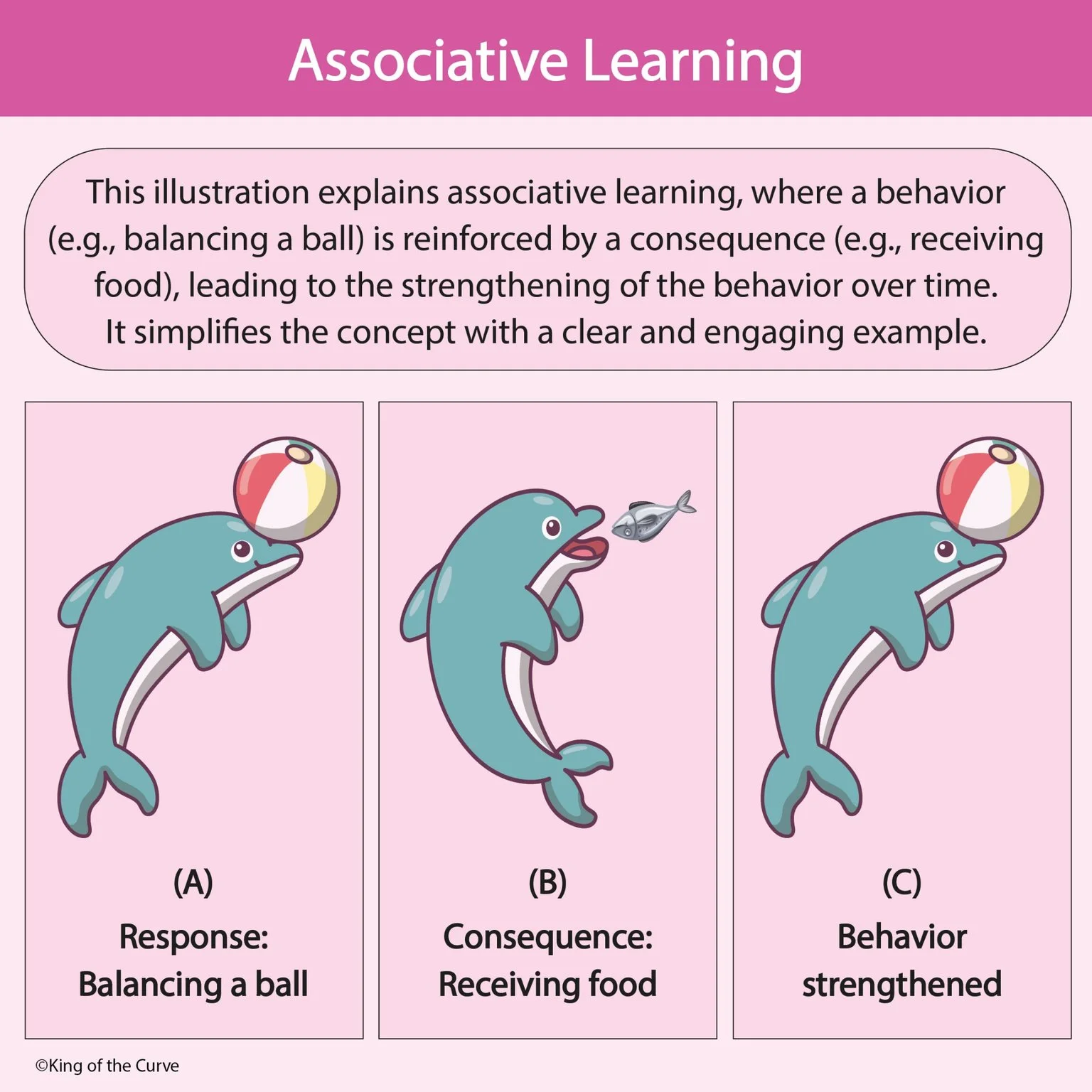
Associative learning occurs when an organism learns a relationship between events, such as two stimuli or a behavior and its consequences. These connections help people and animals anticipate outcomes and adjust their responses. Two major forms are classical conditioning and operant conditioning. The dolphin example illustrates operant conditioning because receiving food after balancing a ball increases the likelihood of that behavior occurring again.
🔔 Classical Conditioning: Connecting Stimuli
In classical conditioning, an organism learns that one stimulus predicts another. For example, if a sound repeatedly precedes food, an animal may eventually salivate in response to the sound alone. Food is the unconditioned stimulus, and salivation to food is the unconditioned response. After learning, the sound becomes a conditioned stimulus that produces a conditioned response. The food’s delivery does not depend on the animal performing the response.
🐬 Operant Conditioning: Learning From Consequences
In operant conditioning, consequences influence the future frequency of a behavior. A behavior followed by reinforcement becomes more likely, while a behavior followed by punishment becomes less likely. In the illustration, the dolphin balances a ball and then receives food. If ball balancing subsequently increases, the food has functioned as reinforcement. The defining feature is the relationship between the action and its consequence.
🍎 Positive Reinforcement in the Dolphin Example
The illustration shows positive reinforcement: adding a stimulus after a behavior increases that behavior’s future occurrence. “Positive” means something is added, while “reinforcement” means the behavior increases. Food can act as a primary reinforcer because it satisfies a biological need. However, a reward is only demonstrated to be a reinforcer when it actually increases the behavior; the trainer’s intention alone does not establish reinforcement.
📊 Reinforcement and Punishment Compared
The terms positive and negative describe whether a stimulus is added or removed. Reinforcement and punishment describe whether the behavior increases or decreases. These are separate distinctions, so negative reinforcement should not be confused with punishment.
| Process | What Happens After the Behavior? | Effect on Future Behavior | Example |
|---|---|---|---|
| Positive reinforcement | A stimulus is added | Behavior increases | A dolphin receives food after balancing a ball and balances it more often |
| Negative reinforcement | An aversive stimulus is removed or avoided | Behavior increases | Fastening a seat belt stops a warning sound, increasing prompt seat-belt use |
| Positive punishment | A stimulus is added | Behavior decreases | A reprimand follows interrupting, and interrupting becomes less frequent |
| Negative punishment | A valued stimulus is removed | Behavior decreases | Gaming privileges are removed after rule-breaking, and rule-breaking decreases |
🪜 Shaping: Building a Complex Behavior
Shaping involves reinforcing successive approximations toward a target behavior. A trainer might initially reinforce a dolphin for touching a ball, then for briefly supporting it, and finally for balancing it for longer periods. As the criterion advances, earlier approximations are no longer sufficient to earn reinforcement. This process explains how complex behavior can develop gradually from simpler actions.
⏱️ How Reinforcement Schedules Affect Learning
A reinforcement schedule specifies when reinforcement follows a behavior. Continuous reinforcement reinforces every target response and can help establish a new behavior. Intermittent schedules reinforce only some responses. Ratio schedules depend on the number of responses, while interval schedules depend on time passing before a response becomes eligible for reinforcement. Fixed schedules use predictable requirements; variable schedules use changing requirements.
🔄 Extinction and the Return of Learned Responses
In operant conditioning, extinction occurs when a previously reinforced behavior no longer produces reinforcement and eventually becomes less frequent. If balancing the ball consistently stops producing food, the dolphin may gradually perform it less often. The behavior may briefly increase when reinforcement first stops, a pattern called an extinction burst. A response can also reappear after a pause, known as spontaneous recovery, showing that extinction does not necessarily erase earlier learning.
🌍 Generalization, Discrimination, and Everyday Learning
Stimulus generalization occurs when a learned response extends to similar stimuli or situations. A dolphin trained with one ball might attempt the same behavior with a similar ball. Stimulus discrimination develops when the organism learns that reinforcement is available under particular conditions, such as after a specific signal. Together, these processes help explain how learned behaviors transfer across situations while remaining sensitive to context.

Frequently Asked Questions (FAQs)
-
Aim for 4-6 focused hours, ensuring you incorporate breaks to avoid burnout.
-
Practice mindfulness techniques, take practice exams under realistic conditions, and maintain a balanced lifestyle.
-
Set short-term goals, seek support from mentors, and reward yourself for small achievements.
-
Regular exercise improves focus, reduces stress, and enhances overall mental clarity.
-
KOTC offers personalized learning tools, gamification features, and adaptive question banks to help students stay on track without burnout.