
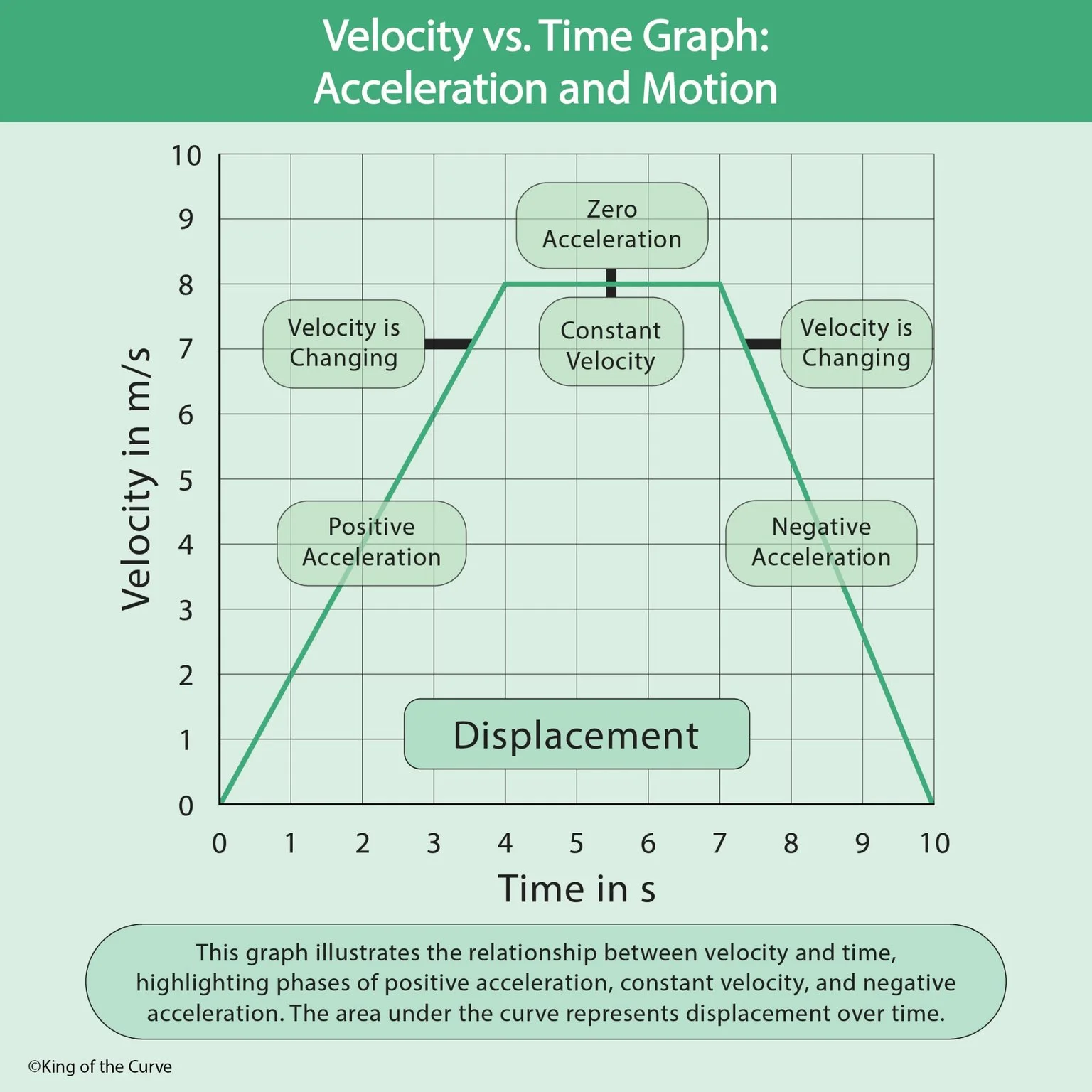
A velocity–time graph shows how an object’s velocity changes as time passes. Time is plotted on the x-axis and velocity on the y-axis. For the MCAT, these graphs are especially useful because their slope represents acceleration, while the signed area under the curve represents displacement.
📈 Positive Acceleration
From 0 to 4 seconds, the graph rises from 0 m/s to 8 m/s. Because velocity increases with time, the object has positive acceleration. Using \(a=\Delta v/\Delta t\), the acceleration during this interval is 2 m/s².
➡️ Constant Velocity
Between 4 and 7 seconds, the graph is horizontal at 8 m/s. A horizontal velocity–time line has a slope of zero, so the object's acceleration is zero. The object is still moving—it simply maintains a constant velocity.
📉 Negative Acceleration
From 7 to 10 seconds, velocity decreases from 8 m/s to 0 m/s. The negative slope indicates negative acceleration. Here, \(a=(0-8)/(10-7)\), giving approximately −2.67 m/s².
📐 Slope Represents Acceleration
One of the most important MCAT relationships is that the slope of a velocity–time graph equals acceleration. A positive slope means positive acceleration, a horizontal line means zero acceleration, and a negative slope means negative acceleration.
📏 Area Represents Displacement
The signed area between the velocity curve and the time axis gives displacement. In this graph, velocity remains nonnegative, so the entire area contributes to positive displacement. The area can be calculated by dividing the graph into two triangles and one rectangle.
🧮 Calculating the Total Displacement
From 0–4 s, the triangular area is \(½(4)(8)=16\) m. From 4–7 s, the rectangular area is \((3)(8)=24\) m. From 7–10 s, the final triangle contributes \(½(3)(8)=12\) m. Therefore, the object's total displacement is 52 m.
🧠 Velocity vs. Speed
Velocity includes both magnitude and direction, whereas speed describes magnitude only. If a velocity–time graph extends below the time axis, velocity is negative. The signed area still gives displacement, while calculating total distance traveled requires adding the magnitudes of the areas.
🎯 MCAT High-Yield Takeaway
Remember two essential rules: slope = acceleration and signed area under a velocity–time graph = displacement. Do not assume that zero acceleration means the object is stationary—a horizontal line above or below zero represents motion at constant velocity. These relationships make velocity–time graphs a high-yield MCAT physics topic.

Frequently Asked Questions (FAQs)
-
Aim for 4-6 focused hours, ensuring you incorporate breaks to avoid burnout.
-
Practice mindfulness techniques, take practice exams under realistic conditions, and maintain a balanced lifestyle.
-
Set short-term goals, seek support from mentors, and reward yourself for small achievements.
-
Regular exercise improves focus, reduces stress, and enhances overall mental clarity.
-
KOTC offers personalized learning tools, gamification features, and adaptive question banks to help students stay on track without burnout.