
⚡ Ohm’s Law: Voltage, Current, Resistance & MCAT Physics Explained
Ohm’s Law is a fundamental electricity concept and an important topic for MCAT physics. It describes the relationship between voltage, current, and resistance using V = IR, where voltage (V) is measured in volts, current (I) in amperes, and resistance (R) in ohms. Understanding this relationship makes many circuit problems much easier to solve.
🔺 Understanding the Ohm’s Law Triangle
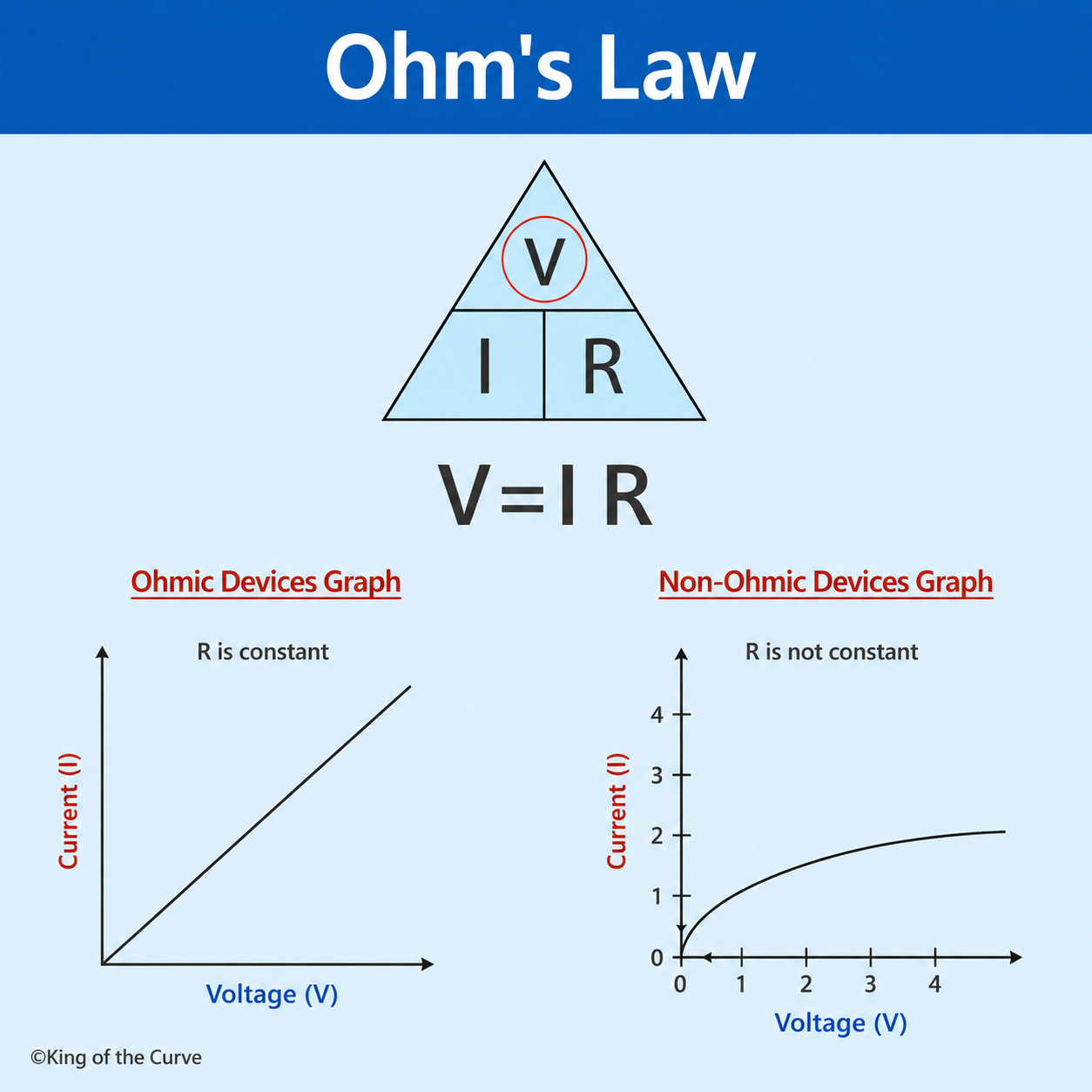
The Ohm’s Law triangle is a quick way to remember all three forms of the equation. With V above I and R, you can derive V = IR, I = V/R, and R = V/I. Instead of memorizing three separate equations, students can understand how changing one electrical quantity affects the others.
🔋 Voltage: The Driving Potential
Voltage is the electric potential difference between two points and represents energy transferred per unit charge. A potential difference can drive charge through a circuit. According to Ohm’s Law, when resistance remains constant, increasing voltage produces a proportional increase in current.
🔄 Current: The Flow of Charge
Electric current describes the rate at which charge flows and can be expressed as I = ΔQ/Δt. For an ohmic resistor with constant resistance, current is directly proportional to the applied voltage. Doubling the voltage therefore doubles the current when resistance and relevant physical conditions remain unchanged.
🚧 Resistance: Opposition to Current
Resistance describes how strongly a component opposes electric current. From R = V/I, greater resistance results in less current for a fixed voltage. Resistance depends on factors such as a conductor’s material, length, cross-sectional area, and temperature, which becomes especially important when analyzing real electrical devices.
📊 Ohmic vs. Non-Ohmic Devices
An ohmic device has approximately constant resistance under fixed physical conditions, producing a linear current–voltage relationship. A non-ohmic device does not maintain constant resistance, so its current–voltage graph is nonlinear. Devices such as filament lamps can behave non-ohmically because their resistance changes as temperature changes.
| ⚙️ Feature | 📈 Ohmic Device | 📉 Non-Ohmic Device |
|---|---|---|
| Resistance | Approximately constant | Changes with operating conditions |
| I–V Graph | Linear | Nonlinear |
| V/I Ratio | Constant | Not constant |
| Ohm’s Law Behavior | Obeys V = IR with constant R | V = IR can define instantaneous R, but R is not constant |
| Typical Example | Ideal/ohmic resistor | Filament lamp, diode |
📐 Reading Current–Voltage Graphs
Graph interpretation is a high-yield skill. In the KOTC image, current is plotted on the y-axis and voltage on the x-axis, so the slope is I/V = 1/R for an ohmic resistor. This means a steeper I-versus-V line represents lower resistance. Be careful: if voltage were plotted on the y-axis instead, the slope would be V/I = R.
🧠 High-Yield MCAT Connections
MCAT questions may combine Ohm’s Law with series and parallel circuits, electrical power, resistivity, batteries, and biological systems. Useful relationships include P = IV, P = I²R, and P = V²/R. Always identify what is held constant before deciding how a change in voltage or resistance affects current or power.
🎯 Turn the Equation Into Understanding
Rather than memorizing V = IR alone, remember the physical relationship: voltage provides a potential difference, resistance opposes current, and current represents charge flow. For an ohmic resistor, increasing voltage increases current proportionally when resistance remains constant. Explore more high-yield physics visuals and MCAT concepts at mcat.kingofthecurve.org, including KOTC’s library of 1,000+ science illustrations designed to make difficult concepts easier to understand and remember.

Frequently Asked Questions (FAQs)
-
Aim for 4-6 focused hours, ensuring you incorporate breaks to avoid burnout.
-
Practice mindfulness techniques, take practice exams under realistic conditions, and maintain a balanced lifestyle.
-
Set short-term goals, seek support from mentors, and reward yourself for small achievements.
-
Regular exercise improves focus, reduces stress, and enhances overall mental clarity.
-
KOTC offers personalized learning tools, gamification features, and adaptive question banks to help students stay on track without burnout.