
🚀 Lorentz Contraction (Special Relativity)
Lorentz contraction, also known as length contraction, is one of the most fascinating predictions of Einstein's Special Theory of Relativity. It states that an object moving at a speed close to the speed of light appears shorter along the direction of motion when observed from a stationary reference frame. This phenomenon becomes significant only at relativistic speeds and has been experimentally confirmed through high-energy particle physics.
📏 What Is Lorentz Contraction?
Lorentz contraction describes the decrease in the measured length of an object traveling at relativistic speeds. The contraction occurs only in the direction of motion, while the object's dimensions perpendicular to the motion remain unchanged. Importantly, the object does not physically compress in its own frame of reference—it only appears contracted to an external observer.
⚡ The Lorentz Contraction Formula
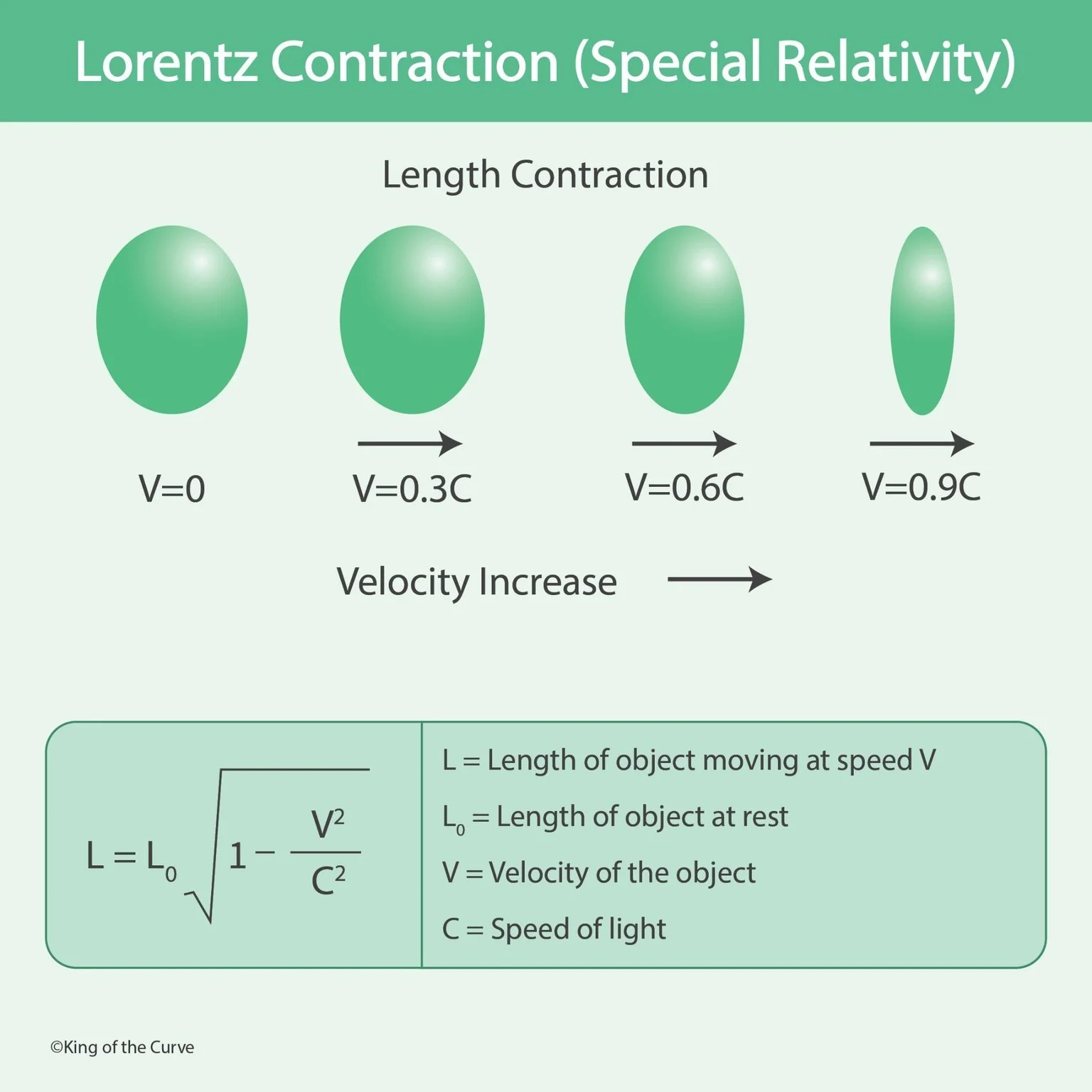
The mathematical relationship for length contraction is:
Lorentz Length Contraction Formula
| Symbol | Meaning |
|---|---|
| L | Observed length of the moving object |
| L0 | Proper length of the object at rest |
| v | Velocity of the moving object |
| c | Speed of light |
As the object's speed approaches the speed of light, the square root term decreases, causing the observed length to become progressively shorter.
📈 How Velocity Affects Length
At everyday speeds, Lorentz contraction is so small that it cannot be detected. However, as velocity increases toward the speed of light, the effect becomes dramatic. For example:
At 0c, no contraction occurs.
At 0.3c, contraction is minimal.
At 0.6c, the object becomes noticeably shorter.
At 0.9c, the contraction is substantial.
This relationship illustrates why relativistic effects are only important for objects moving at extremely high velocities.
🌌 Why Does Length Contraction Occur?
Length contraction arises because space and time are interconnected. According to Special Relativity, measurements of distance and time depend on the observer's frame of reference. To ensure that the speed of light remains constant for all observers, moving objects must appear contracted along the direction of travel.
🔬 Experimental Evidence
Lorentz contraction has been indirectly verified through numerous experiments involving high-speed particles. Muons created in Earth's atmosphere survive long enough to reach the surface because relativistic effects—including time dilation and length contraction—alter measurements between different reference frames. Particle accelerators also provide strong confirmation of these predictions.
🌍 Real-World Applications
Although humans rarely experience relativistic speeds, Lorentz contraction plays a crucial role in modern physics. It is essential for understanding particle accelerators, cosmic rays, astrophysics, and space science. Engineers and physicists rely on relativistic equations when studying particles traveling near the speed of light.
⚠️ Common Misconceptions
A common misunderstanding is that moving objects physically shrink. In reality, the object remains unchanged in its own rest frame. The contraction is an observational effect that depends on the relative motion between the observer and the object. Another misconception is that all dimensions contract; only the dimension parallel to the direction of motion is affected.
🎯 Key Takeaways
Lorentz contraction demonstrates that measurements of space are not absolute but depend on relative motion. As velocity increases toward the speed of light, the observed length decreases according to the Lorentz equation. Together with time dilation, this phenomenon forms one of the fundamental pillars of Einstein's Special Theory of Relativity and continues to shape our understanding of the universe.

Frequently Asked Questions (FAQs)
-
Aim for 4-6 focused hours, ensuring you incorporate breaks to avoid burnout.
-
Practice mindfulness techniques, take practice exams under realistic conditions, and maintain a balanced lifestyle.
-
Set short-term goals, seek support from mentors, and reward yourself for small achievements.
-
Regular exercise improves focus, reduces stress, and enhances overall mental clarity.
-
KOTC offers personalized learning tools, gamification features, and adaptive question banks to help students stay on track without burnout.