
🧪 Glutathione Redox Reactions: Reduction, Oxidation & Antioxidant Defense
Glutathione is one of the cell’s most important antioxidant defense molecules. It protects cells from oxidative damage by helping convert harmful reactive oxygen species, particularly hydrogen peroxide (H₂O₂), into less reactive products.
🛡️ What Is Glutathione?
Glutathione is a small tripeptide composed of glutamate, cysteine, and glycine.
It exists primarily in two forms:
GSH = reduced glutathione
GSSG = oxidized glutathione (glutathione disulfide)
The sulfhydryl (–SH) group on cysteine allows glutathione to participate in redox reactions.
A useful relationship is:
2 GSH ⇌ GSSG
Oxidation converts two molecules of GSH into GSSG, while reduction converts GSSG back into GSH.
⚡ Why Is Glutathione Important?
Reactive oxygen species can damage cellular molecules such as:
🧬 DNA
🧪 Proteins
🫧 Membrane lipids
Glutathione helps neutralize oxidative molecules before they cause extensive cellular damage.
This antioxidant system is especially important in red blood cells, which are continually exposed to oxygen and therefore vulnerable to oxidative stress.
🔋 Step 1: NADPH Is Generated
The glutathione antioxidant system depends on NADPH.
A major cellular source of NADPH is the pentose phosphate pathway (PPP).
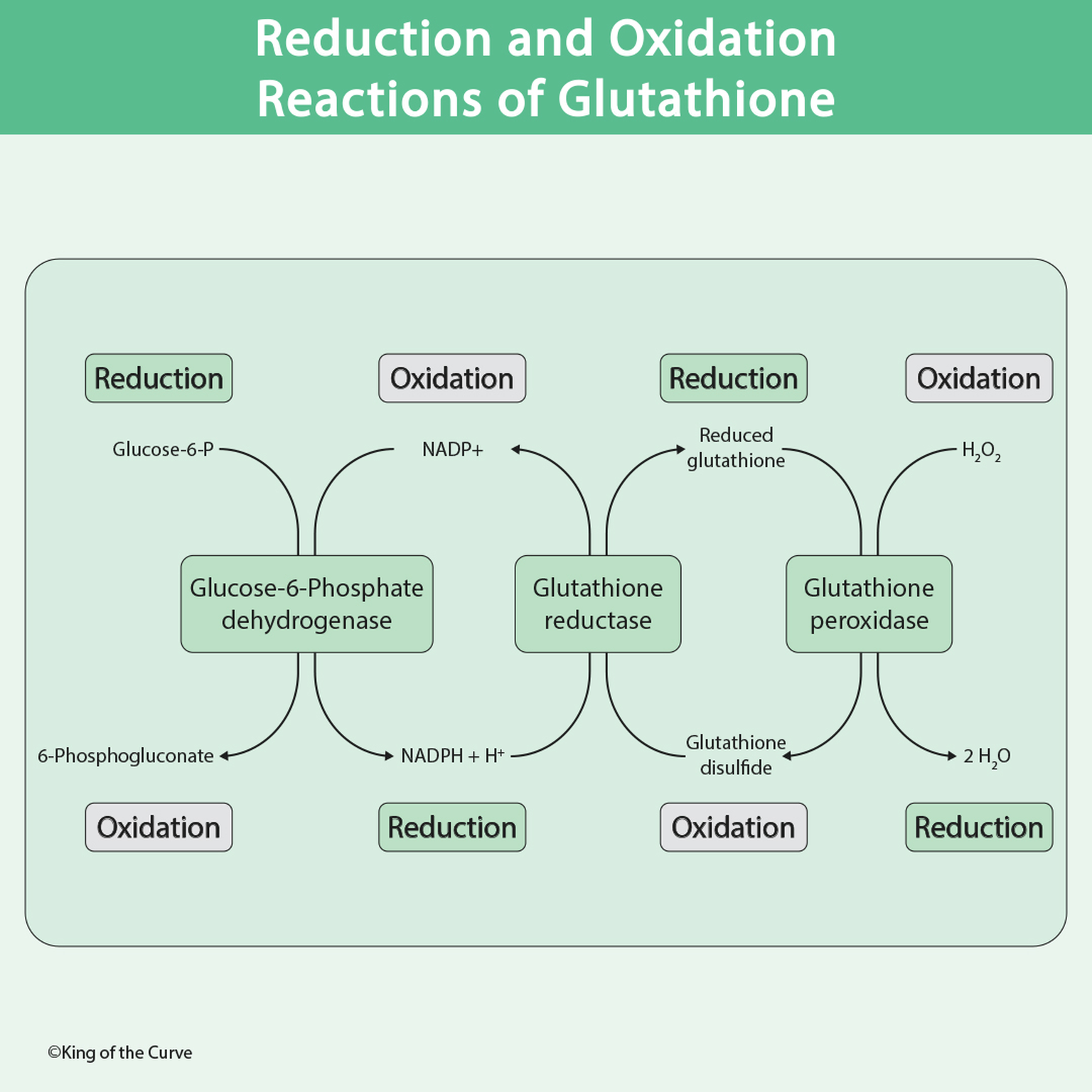
The enzyme glucose-6-phosphate dehydrogenase (G6PD) catalyzes an early oxidative step of the pathway:
Glucose-6-phosphate + NADP⁺ → 6-phosphoglucono-δ-lactone + NADPH + H⁺
The lactone is subsequently converted to 6-phosphogluconate.
The important MCAT connection is:
Pentose phosphate pathway → NADPH production
♻️ Step 2: Oxidized Glutathione Is Reduced
The enzyme glutathione reductase uses NADPH to regenerate reduced glutathione.
A simplified reaction is:
GSSG + NADPH + H⁺ → 2 GSH + NADP⁺
Here:
NADPH is oxidized → NADP⁺
while
GSSG is reduced → GSH
This continuously replenishes the cell's supply of antioxidant-ready glutathione.
💧 Step 3: Hydrogen Peroxide Is Reduced
The enzyme glutathione peroxidase uses reduced glutathione to detoxify hydrogen peroxide:
2 GSH + H₂O₂ → GSSG + 2 H₂O
During this reaction:
H₂O₂ is reduced → H₂O
and
GSH is oxidized → GSSG
This is the central antioxidant function of the glutathione cycle.
🔄 How the Glutathione Cycle Works
The pathway can be summarized as:
Glucose-6-phosphate
⬇️ G6PD / Pentose Phosphate Pathway
NADPH
⬇️ Glutathione reductase
GSSG → GSH
⬇️ Glutathione peroxidase
H₂O₂ → H₂O
NADPH therefore provides the reducing power needed to maintain glutathione in its reduced, protective form.
🧠 Understanding Oxidation vs. Reduction
A classic MCAT mnemonic is:
OIL RIG
Oxidation Is Loss of electrons.
Reduction Is Gain of electrons.
Another useful way to recognize biological redox reactions is to track hydrogen.
In many biochemical reactions:
Gain of hydrogen → Reduction
Loss of hydrogen → Oxidation
NADPH acts as an important reducing agent because it donates reducing equivalents to other molecules.
🩸 Why G6PD Matters in Red Blood Cells
Red blood cells have no mitochondria, so the pentose phosphate pathway is especially important for generating NADPH.
NADPH allows glutathione reductase to regenerate GSH.
The chain is:
G6PD activity → NADPH → Reduced glutathione → Protection against oxidative damage
If NADPH production becomes inadequate, reduced glutathione cannot be regenerated efficiently, leaving red blood cells more susceptible to oxidative injury.
🔬 Key Enzymes to Know
| 🧪 Enzyme | ⚙️ Main Role | 🔄 Redox Connection |
|---|---|---|
| Glucose-6-phosphate dehydrogenase | Generates NADPH through the pentose phosphate pathway | NADP⁺ is reduced to NADPH |
| Glutathione reductase | Regenerates reduced glutathione | GSSG is reduced to GSH |
| Glutathione peroxidase | Detoxifies hydrogen peroxide | H₂O₂ is reduced while GSH is oxidized |
🔗 Connecting NADPH and Glutathione
One of the most important relationships to remember is:
NADPH keeps glutathione reduced.
Reduced glutathione can then neutralize hydrogen peroxide.
Therefore:
NADPH ↓ → GSH regeneration ↓ → oxidative stress ↑
This relationship links metabolism and cellular antioxidant defense.
🎯 High-Yield MCAT Takeaway
The entire pathway can be condensed into three steps:
1️⃣ G6PD helps generate NADPH.
2️⃣ NADPH allows glutathione reductase to convert GSSG → GSH.
3️⃣ Glutathione peroxidase uses GSH to convert H₂O₂ → H₂O.
The ultimate purpose is to protect the cell from oxidative damage.
💡 MCAT Quick Tip
If an MCAT question connects G6PD, NADPH, glutathione, and oxidative stress, remember:
G6PD → NADPH → Reduced glutathione → Antioxidant protection
And for the redox cycle:
GSH = reduced
GSSG = oxidized
NADPH = reducing power
H₂O₂ = detoxified to H₂O
That pathway is the key to solving most glutathione-related MCAT questions.

Frequently Asked Questions (FAQs)
-
Aim for 4-6 focused hours, ensuring you incorporate breaks to avoid burnout.
-
Practice mindfulness techniques, take practice exams under realistic conditions, and maintain a balanced lifestyle.
-
Set short-term goals, seek support from mentors, and reward yourself for small achievements.
-
Regular exercise improves focus, reduces stress, and enhances overall mental clarity.
-
KOTC offers personalized learning tools, gamification features, and adaptive question banks to help students stay on track without burnout.