
🦴 Regulation of Blood Calcium Levels: PTH, Calcitonin & Vitamin D for the MCAT
Blood calcium (Ca²⁺) is tightly regulated because calcium is essential for muscle contraction, neuronal signaling, blood clotting, intracellular signaling, and bone structure. For the MCAT, the key is understanding how the body responds differently to low vs. high blood calcium.
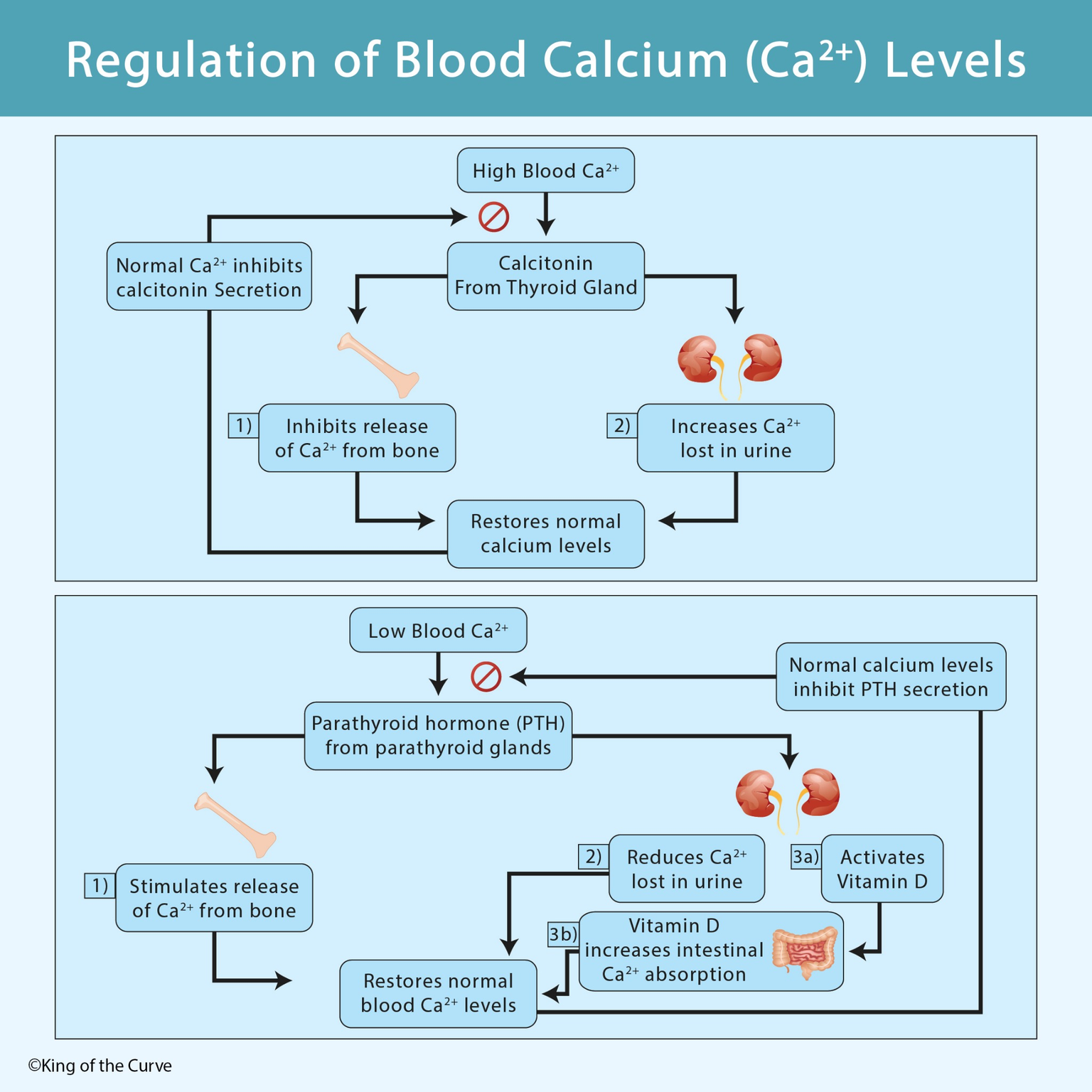
🧠 The Big Picture: Calcium Homeostasis
The body uses negative feedback to keep blood Ca²⁺ within a relatively narrow range.
When blood calcium falls, the body primarily uses PTH to increase blood Ca²⁺. When blood calcium rises, calcitonin can promote processes that lower blood Ca²⁺, although PTH and vitamin D are more important regulators of calcium homeostasis in humans.
A useful MCAT memory rule is:
PTH → Pulls calcium into the blood
Calcitonin → Tones down blood calcium
📉 What Happens When Blood Calcium Is Low?
Low blood Ca²⁺ stimulates the parathyroid glands to release parathyroid hormone (PTH).
PTH works to restore blood calcium through several coordinated mechanisms.
🦴 1. PTH Increases Calcium Mobilization From Bone
PTH ultimately promotes bone resorption, increasing the movement of Ca²⁺ from bone into the bloodstream.
Importantly, PTH does not directly activate osteoclasts. It acts on osteoblast-lineage cells, which increase signals such as RANKL that promote osteoclast differentiation and activity.
The net effect is:
Bone resorption ↑ → Blood Ca²⁺ ↑
🫘 2. PTH Increases Renal Calcium Reabsorption
PTH causes the kidneys to reabsorb more Ca²⁺, meaning less calcium is lost in the urine.
Therefore:
Renal Ca²⁺ reabsorption ↑ → Urinary Ca²⁺ loss ↓ → Blood Ca²⁺ ↑
PTH also decreases phosphate reabsorption in the proximal tubule, causing increased phosphate excretion.
☀️ 3. PTH Activates Vitamin D
PTH stimulates the kidney enzyme 1α-hydroxylase, which promotes formation of active vitamin D:
25-hydroxyvitamin D → 1,25-dihydroxyvitamin D (calcitriol)
Calcitriol then acts primarily on the intestine.
🥛 4. Vitamin D Increases Intestinal Calcium Absorption
Active vitamin D increases the absorption of calcium from the gastrointestinal tract.
The pathway can therefore be summarized as:
Low Ca²⁺ → PTH ↑ → Active vitamin D ↑ → Intestinal Ca²⁺ absorption ↑ → Blood Ca²⁺ ↑
This relationship between PTH, the kidney, vitamin D, and the intestine is especially high-yield for MCAT questions.
📈 What Happens When Blood Calcium Is High?
High blood Ca²⁺ suppresses PTH secretion and can stimulate release of calcitonin from the parafollicular, or C cells, of the thyroid gland.
Calcitonin tends to lower blood calcium by opposing bone resorption and promoting calcium deposition in bone.
Its physiological role in adult human calcium homeostasis, however, is less important than the PTH–vitamin D system.
🦴 How Calcitonin Affects Bone
Calcitonin inhibits osteoclast-mediated bone resorption.
As a result:
Bone resorption ↓ → Ca²⁺ release from bone ↓
This helps oppose increases in blood calcium.
🫘 How Calcitonin Affects the Kidneys
Calcitonin can decrease renal reabsorption of calcium, thereby promoting Ca²⁺ excretion in the urine.
For MCAT purposes, remember the overall contrast:
PTH conserves and raises blood Ca²⁺
while
Calcitonin generally favors lowering blood Ca²⁺
🔄 Negative Feedback in Calcium Regulation
Once blood calcium returns toward its normal range, the original hormonal stimulus decreases.
For example:
Low Ca²⁺ → PTH secretion → Blood Ca²⁺ rises → PTH secretion decreases
Similarly, rising calcium removes the stimulus for mechanisms designed to increase blood Ca²⁺.
This is a classic example of negative feedback, a recurring concept throughout MCAT physiology.
📊 PTH vs. Calcitonin vs. Vitamin D
| 🔍 Feature | 🦴 PTH | 🧊 Calcitonin | ☀️ Vitamin D (Calcitriol) |
|---|---|---|---|
| Main trigger | Low blood Ca²⁺ | High blood Ca²⁺ | Stimulated partly by PTH |
| Source | Parathyroid glands | Thyroid C cells | Activated in kidneys |
| Bone effect | Promotes net Ca²⁺ mobilization | Inhibits bone resorption | Supports Ca²⁺ availability |
| Kidney effect | ↑ Ca²⁺ reabsorption | Can ↑ Ca²⁺ excretion | Supports Ca²⁺ homeostasis |
| Intestinal effect | Indirect via vitamin D | Minimal | ↑ Ca²⁺ absorption |
| Overall blood Ca²⁺ effect | Increases | Decreases | Increases |
🧪 MCAT Connection: PTH and Phosphate
A commonly tested detail is that PTH has opposite overall effects on blood calcium and phosphate.
PTH:
↑ Blood Ca²⁺
but
↓ Blood phosphate
Why? Although bone resorption releases both calcium and phosphate, PTH causes the kidneys to excrete more phosphate by decreasing proximal tubular phosphate reabsorption.
This helps prevent calcium and phosphate from precipitating together.
💡 MCAT Memory Trick
Remember:
PTH = “Phosphate Trashing Hormone”
PTH increases renal phosphate excretion while helping increase blood calcium.
For calcitonin:
Calcitonin → Calcium tones down
And for vitamin D:
Vitamin D → Dietary calcium absorption
🎯 High-Yield MCAT Takeaway
The most important pathway to memorize is:
Low blood Ca²⁺ → PTH ↑ → renal Ca²⁺ reabsorption ↑ + bone resorption ↑ + vitamin D activation ↑ → intestinal Ca²⁺ absorption ↑ → blood Ca²⁺ restored
For high calcium:
High blood Ca²⁺ → PTH ↓ + calcitonin may ↑ → bone resorption ↓ → blood Ca²⁺ moves toward normal
The MCAT frequently tests these pathways through questions involving endocrine feedback, kidney physiology, bone remodeling, vitamin D, or phosphate regulation.

Frequently Asked Questions (FAQs)
-
Aim for 4-6 focused hours, ensuring you incorporate breaks to avoid burnout.
-
Practice mindfulness techniques, take practice exams under realistic conditions, and maintain a balanced lifestyle.
-
Set short-term goals, seek support from mentors, and reward yourself for small achievements.
-
Regular exercise improves focus, reduces stress, and enhances overall mental clarity.
-
KOTC offers personalized learning tools, gamification features, and adaptive question banks to help students stay on track without burnout.