
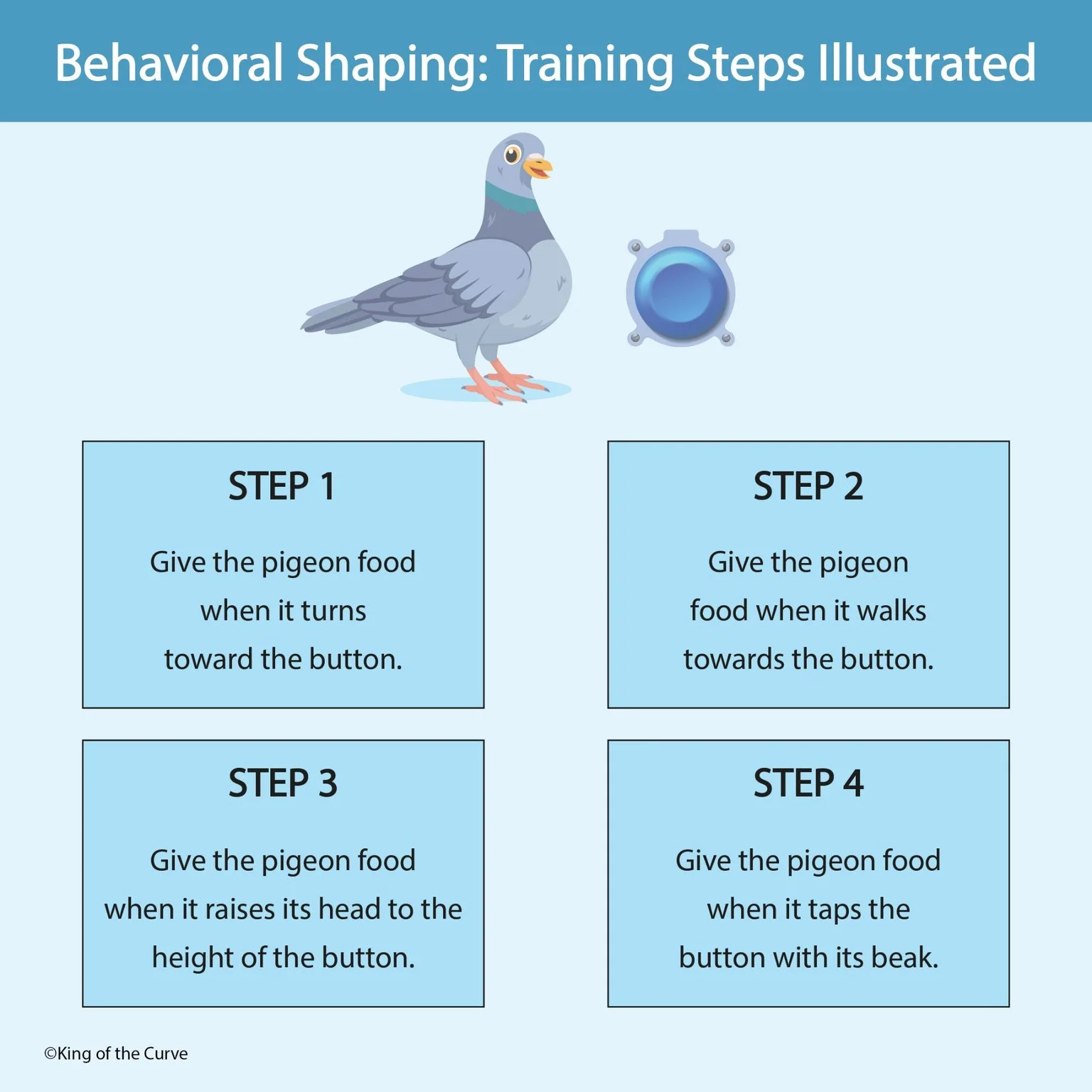
Shaping is a learning process in which progressively closer versions of a target behavior are reinforced. These intermediate behaviors are called successive approximations. Instead of waiting for a learner to perform a complex action perfectly, reinforcement begins with a simpler action already within their abilities. The illustration shows how a pigeon can gradually learn to tap a button with its beak.
🧠 How Shaping Relates to Operant Conditioning
Shaping is a technique within operant conditioning, where consequences influence the future occurrence of behavior. In this example, food follows a selected action. If that consequence makes the action more likely, it functions as reinforcement. Because food is added after the behavior, the procedure illustrates positive reinforcement. The word “positive” refers to adding a stimulus, while “reinforcement” refers to increasing behavior.
🎯 Defining the Target Behavior
A shaping procedure begins with a clear, observable goal. Here, the target is for the pigeon to tap the button with its beak. A precise definition makes it possible to distinguish successful responses from incomplete attempts. The starting criterion should be achievable: if the pigeon rarely approaches the button, reinforcing only a completed tap would provide few opportunities for learning.
🪜 Successive Approximations: Moving Toward the Goal
The trainer first reinforces turning toward the button, then approaching it, then raising the head to button height, and finally tapping it. Each criterion represents progress toward the same target. As training advances, an earlier approximation alone no longer earns reinforcement. This changing requirement is central to shaping; continuing to reinforce every initial movement equally would not selectively strengthen closer approximations.
📊 The Four Shaping Steps in the Illustration
The sequence below organizes the example into observable training criteria. The exact number and size of the steps can vary according to the learner’s behavior.
| Training Stage | Behavior Reinforced | Purpose |
|---|---|---|
| Step 1: Orientation | Turning toward the button | Establishes movement in the target’s direction |
| Step 2: Approach | Walking toward the button | Brings the pigeon closer to the target |
| Step 3: Positioning | Raising the head to the button’s height | Reinforces a movement closer to the final action |
| Step 4: Target response | Tapping the button with the beak | Establishes the desired behavior |
🍎 Why Reinforcement Timing Matters
Reinforcement delivered promptly after the selected response makes the behavior–consequence relationship clearer. If food arrives after several unrelated actions, a different behavior may be strengthened unintentionally. Trainers may use a brief marker, such as a click, that has been associated with reinforcement to identify the relevant moment. However, food or a marker functions as reinforcement only when it increases the behavior it follows.
⚙️ Adjusting the Criterion Gradually
Progress depends on choosing manageable changes in the reinforcement criterion. Advancing too quickly may leave the learner making repeated unsuccessful attempts, while advancing too slowly may prolong an earlier approximation. If responding breaks down, an intermediate step or a temporary return to an easier criterion may help. Effective shaping follows the learner’s demonstrated performance rather than a fixed timetable.
🔗 Shaping vs. Chaining and Prompting
Shaping develops a target behavior by reinforcing increasingly close approximations. Chaining connects distinct behaviors into an ordered sequence, such as completing the steps of getting dressed. Prompting provides an added cue or assistance to help produce a response. Although the pigeon’s learning is presented in stages, the defining feature is that reinforcement requirements progressively approach a final button tap.
🌱 Maintaining and Generalizing the Learned Behavior
Once the target behavior is established, reinforcement can be adjusted gradually to support continued performance. Practice across different settings or examples can help the behavior generalize, while reinforcing responses under a particular signal can build stimulus control. Shaping therefore involves more than obtaining one successful attempt: it develops a reliable behavior that occurs under the intended conditions.

Frequently Asked Questions (FAQs)
-
Aim for 4-6 focused hours, ensuring you incorporate breaks to avoid burnout.
-
Practice mindfulness techniques, take practice exams under realistic conditions, and maintain a balanced lifestyle.
-
Set short-term goals, seek support from mentors, and reward yourself for small achievements.
-
Regular exercise improves focus, reduces stress, and enhances overall mental clarity.
-
KOTC offers personalized learning tools, gamification features, and adaptive question banks to help students stay on track without burnout.